PB: Notice on maps c. 1870 that there is no "Frying Pan" - the flat, smooth-bottomed depression on the other side of Windmill Drive opposite the RVPA. When did it appear? Find on maps.
What was extracted and why? Was it to fill the Black Sea? This seems possible [but...].
Find a map to show the "handle" - the approach track for carts collecting sand.
I have seen a reference once [Greg Smye-Rumsby in his Scope website] that it had been dug to make bricks for the Prison - but this seems unlikely. Was there much/any clay suitable for brickmaking on WC? Probably not. To build what? The main part of the prison had already been built by the time, though not all of the officers' houses.
No, it was a later sand pit.]
ADD bit about John Burns watching the Coldstream Guards and punching someone who criticised him for opposing the Boer War...
ADD bit about military parades after WWI
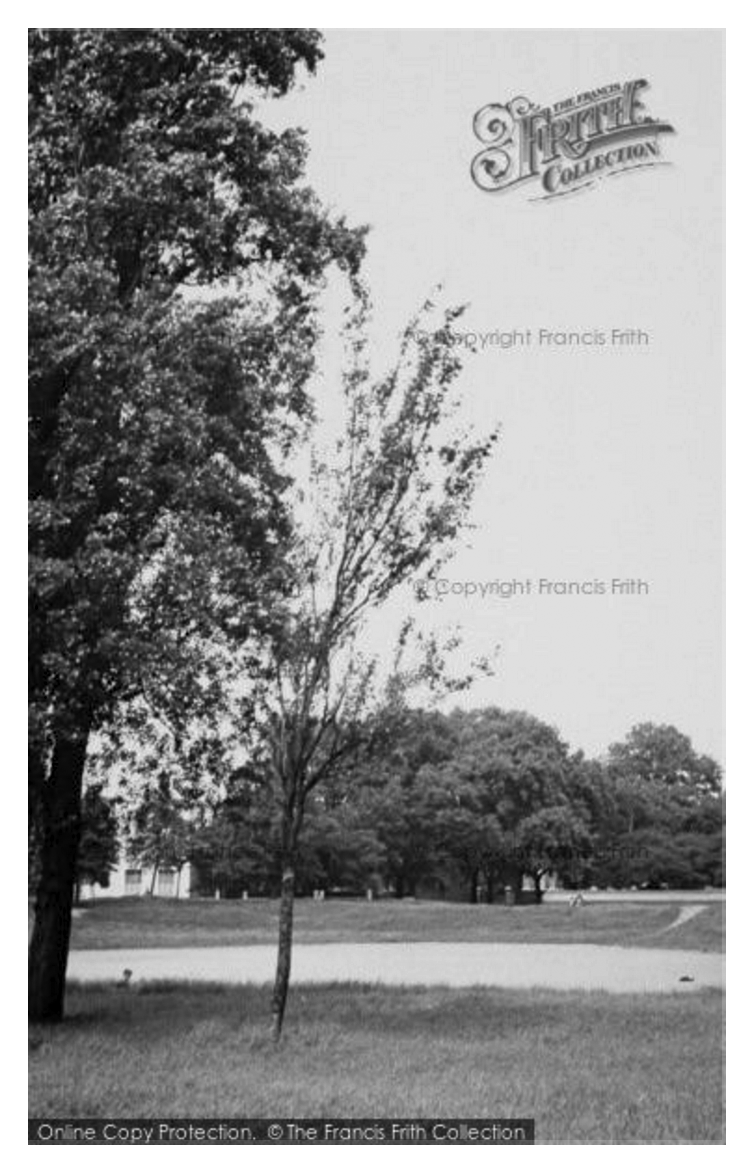
Notice how level and smooth the Frying Pan was at this time (c.1955) with gently sloping banks for spectators - in short, an amphitheatre. Unlike now, here were no trees or shrubs on or around the frying pan. PB:I remember it still looking like this in the 1960s as I walked to school along Windmill Drive. I recall somebody recalling bonfires there on Firework Night (See the Memory bank).
On 31 Mar 2024, at 15:58, janet paul
You are a mine of information!
On 31 March 2024, at 15:23, Philip Boys
A VERY quick reply, Janet
Thrilled with your memory of the "Salt Pan", which I knew as the "Frying Pan"
I've been meaning to write about it for a long time, and now perhaps I will sometime soon
There's a wealth of local theories - for example, that it was dug as a lake (but couldn't be made to contain water for long, because it always drained away), or an overflow pond for water from the Windmill/pump that drained the railway.
Another theory is that it was a brick clay quarry, from which the Prison (and maybe the big telescope near Lyford Road) was constructed. (Neither can be true, because geologically it didn't contain brickclay.)
But I think the real explanation is probably that it was started as a quarry, but for fine sand (but possibly gravel) - there certainly was just such a quarry nearby for many years, probably called "Potter's Hole", between Heathfield Cottages and the railway. This latter one was filled with refuse, smelled horrible, and was filled in at the end of the C19 after a local petition).
Earlsfield Road was then extended over it to form one end of Windmill Drive, leading towards Clapham Junction
On some old maps you can see the cart track that took sand/gravel towards Trinity Road.
Then came the Boer War, and then the First World War, and it was adapted for use as a parade ground, a ceremonial field, and a place for military brass bands to perform.
It's flat-bottomed, and drains well.
In short, it became an amphitheatre.
The "walls" were made straighter and steeper so that audiences could more easily watch the proceedings. It looks quite symmetrical on maps of the period.
(Which makes them so good for tobogganing.)
This map's from about 1900.
Screenshot 2024-03-31 at 15.16.02.png
frying-pan-photo-2021-1024px.jpeg
Today, there are trees on some of the sides, and grass in the bottom. But it was always clear of vegetation when I was young in the 1950s and early 1960s. Excellent for riding bikes! I've also read that people used to light bonfires on it on November 5.
What do you think about my theory?
All best
Philip
PS Please keep the memories coming!
On 31 Mar 2024, at 14:24, waterlane1@btinternet.com waterlane1@btinternet.com
Yes, I have seen about the balloons and I think they worked as we had very little bombing near us.
Did I say to you that when the docks were bombed, we could actually see the reflection in the sky of the flames and that must have been some distance away. Regarding bombing, one of the targets was obviously the railway, but even with the large area of Clapham Junction station, only one bomb landed there and that was on an outside line - platform 19 comes to mind, but I wouldn't swear to that.
I've been trying to remember what happened at school if an air raid siren went off. No shelters so far as I remember so I presume we just stayed put where we were. Strangely, I don't remember being frightened, but as a child I wouldn't have had any real idea of the likely impact I suppose. Or we just got used to it. Looking back, it really is strange to think that for nearly six years we were at war with all that entailed. And how amazingly the women coped. In many, if not most, households, the men held the purse strings and handed out housekeeping money for food shopping for instance. Then, suddenly the men were away and the women had to deal with all of it. Just think what a task that must have been for some. The more you think about the war years, the more things come to mind.
Something else I thought about. Do you know about the so-called salt pan on Wandsworth Common, up just before the railway line? I have no idea what it was, but it was quite deep and in the winter when it snowed it was magic with a sledge. In fact, I remember getting into real trouble with my mother when I had taken my two brothers up there with a sledge - suppose I was nearly nine, so they would have been rising six and three - and the younger one fell off into the snow so was soaking when we got home!! I wonder what it actually was - digging for salt in Wandsworth seems a bit far fetched to me.
I expect you have looked at the old cemetery on East Hill at the end of Trinity Road, where the Huguenots were buried? I think they came over in the 18th century, or perhaps a bit later, and were silk weavers. I've no idea why they should have settled in that area, but they obviously did. When I was a child, seeing those French names on the stones was absolutely fascinating. I suppose it must still be there.
------ Original Message ------
From: "Philip Boys"
To: "waterlane1@btinternet.com waterlane1@btinternet.com"
Cc: "Philip Boys"
Sent: Saturday, 30 Mar, 2024 At 21:09
Subject: Re: Wartime memories
A really wonderful account, Janet - thank you so much for sending your recollections
Would it be OK for me to use them (attributed to you, of course) in the Chronicles?
I missed out on the war, of course, but as I said in the current Chronicles , there were still plenty of signs of the recent past just about everywhere
I don;'t know if you saw these but here are a couple of articles about barrage balloons on the Common:
https://www.historyofwandsworthcommon.org/world-war-two/barrage-balloons.html
https://www.historyofwandsworthcommon.org/chronicles/10/10-2022.html
I recall Hugh saying your dad was very much involved. That's right, isn't it?
Do any of the pics ring any bells?
More from me soon...
Very best wishes, and thank you once again
Philip
On 30 Mar 2024, at 13:53, waterlane1@btinternet.com waterlane1@btinternet.com
My brother, Hugh, has asked me to dig into my memories of the war years as I was just turned 6 when war was declared and can remember some of it. We lived at West Side, just at the bottom of Trinity Road - the house was pulled down in the late 1960's for road widening. I went to All Farthing Lane school in 1937 when I was nearly four and a half, so was there at the beginning of the war. In early 1940 my mother put me on a train "in charge of the guard" - just imagine doing that with a 7 year old now! - to go to stay with her cousin just outside of Carlisle. I was there for a few months - ironically the first school I went to there was bombed, so I moved to another - but went home later that year.
In 1941 we went as a family to Wiltshire where my paternal grandmother had a job as a housekeeper on a farm - during the war all women under 60 (I think that is the age) had to work or be in the services unless they had dependent children. My next brother and I stayed with the cowman's family next to the farmhouse while my mother and my younger brother stayed in the next village. That was a marvellous time because we had great freedom to play in the fields and river, and I learnt to milk a cow! I also realised how much forward London schools were compared to small village ones, when I was set to help the little ones read because I had finished the work scheduled for the under-11's!! My mother wasn't really happy being away from home and we returned to Wandsworth Common later that year. I am a little hazy about whether All Farthing Lane had returned by then: I know that I did go to a small private school for a while but am not sure which year that was, but I am sure that I was back at AFL in 1942.
You may well know that on Wandsworth Common there was a barrage balloon site and that seemed to work because we had virtually no bomb damage in the immediate area, except for a couple of houses being destroyed further along West Side. On the small piece of the Common there was a shelter and my mother helped there for a while as my grandmother was living with us and could keep an eye on us in the evening. My only memory of being afraid was when I was going home from school one afternoon when a plane started shooting and bullets were dancing around me on the pavement! So I ran!
When we were at home we had proper beds down in the cellar as the theory was that that was safer than being up in the house. When the "doodle-bugs" arrived, if we could still see the tail flame through the lid of the coal hole and hear the engine, that was OK as they were still moving away, but when it went silent, they were going to come down pretty soon.
One of the things that did have a great impact was food rationing. If you were a family, as we were, I think it must have been easier to combine the ration allowances. For instance, I think it was two and a half ounces of meat a week (you'll have to change that to grams yourself!); under fives had more milk - 5 pints a week I think - but no tea ration. I do remember a local greengrocer having a delivery of oranges - almost literally gold dust! - and the queue was along the street. There were even stories of women going home, changing their hat (they all wore a hat then) and coming back to try for some more. And the meat rationing didn't end until 1954.
I saw the pictures of prefabs in your email, but can't recall where they were locally. A school friend of mine lived in one in, I think, Southfields, and we loved going there especially in the winter because it was warm!
I was at school in Putney when the war ended and we were all called into the main hall to listen to the broadcast announcing peace. As I had heard the original broadcast announcing We are at war with Germany" in 1939, that seemed to complete the circle.
But, you know, that was how it was and, of course, as a child you don't have the same level of fear as an adult would because you aren't really aware of the likely consequences.
Perhaps some of this will have been of interest to you.
Janet Paul
CHAPTER I
JOINING UP
When the Great War struck Europe I was living with my people in Ireland. I had served in the South African campaign, so, of course, I realised that it was up to me to roll up again and do my bit towards keeping the old rag flying. It's a queer thing, but let a man once go on the war-path and it's all the odds to a strap ring he's off again, full cry, to the sound of the bugle.
["all the odds to a strap ring" - presumably pretty much a certainty, but what's the origin of the phrase?]
I reckon it's in the Britisher's blood; he kind of imbibes it along with his mother's milk. When all's said and done we are a fighting breed. A sporting crowd, too, and we tackle war much as we would a game of football—or a big round-up in the Never-Never.
When England took off the gloves to Germany, I knew the Colonies wouldn't hang back long. They breed men on the fringes of our Empire. Hence I wasn't surprised when I saw a notice in the papers calling on all New Zealanders, or men who had seen service with the Maorilanders in South Africa, to roll up at the High Commissioner's office in London, to be trained for service with the "Down Under" contingents. Well, I had lived for years in New Zealand, and had fought Boers time and again side by side with New Zealand troops, so I sent in my name right away.
In due course I received a polite letter of thanks, and was told to turn up at the office on a certain date, to be examined and attested. I did so, and in company with some two hundred other Colonials was put through the eye-sight, hearing, and other tests, said "ninety-nine" to the doctor's satisfaction, and was duly passed as fit for service.
And now began a period of stress and strenuous life.
Morning after morning we repaired to Wandsworth Common, there to acquaint ourselves with the intricacies of "Right turn," "Left turn," "Form fours," etc., under the tutelage of certain drill-sergeants of leathern lungs and bibulous-looking noses.
At noon we knocked off for an hour and a half, repairing for refreshment to a house of entertainment which stood fairly "adjacent" to our drill ground. Here we very soon found that our instructors' looks did not belie them. However, we consoled ourselves with the reflection that English beer was cheap as drinks went, and that all things come to an end in this world.
[My fairly confident guess is that the "Fairly adjacent...house of entertainment" was the Freemason's [Taverrn], now the Round House.
The afternoons were repetitions of the mornings, with the added attraction of a largish audience composed principally of nursemaids and infants in arms—and prams. The audience enjoyed our efforts if we, the actors, didn't. It was thirsty work.
During this period we lived in London, "finding" ourselves, but receiving a slight increase of pay in lieu of quarters and rations. It's a gay city is the Rio London. Our pockets suffered, hence most of us, although we growled on principle (being Colonials), were secretly relieved in mind when the order came to transfer to Salisbury Plain, there to camp in tents until such time as huts should be prepared for us.
[I wonder where he and his fellow soldiers found to live? In nearby houses?]
[It's a gay city is the Rio London. Our pockets suffered... " See]
On-the-Anzac-Trail-Being-extracts from-a-Diary-of-a-New-Zealand-Sapper-1916.pdf
Brief article / IWM blog >>Looking for Home? New Zealanders in London during the First World War - Anna Maqguire reflects on the activities of New Zealand troops in the capital IWM articvles Based o a substantial essay Publication Cover The London Journal A Review of Metropolitan Society Past and Present Volume 41, 2016 - Issue 3: London and the First World War Looking for Home? New Zealand Soldiers Visiting London during the First World War Anna Maguire Pages 281-298 | Published online: 22 Sep 2016 Cite this article https://doi.org/10.1080/03058034.2016.1209343 >>Looking for Home New Zealand Soldiers Visiting London during the First World War.pdf