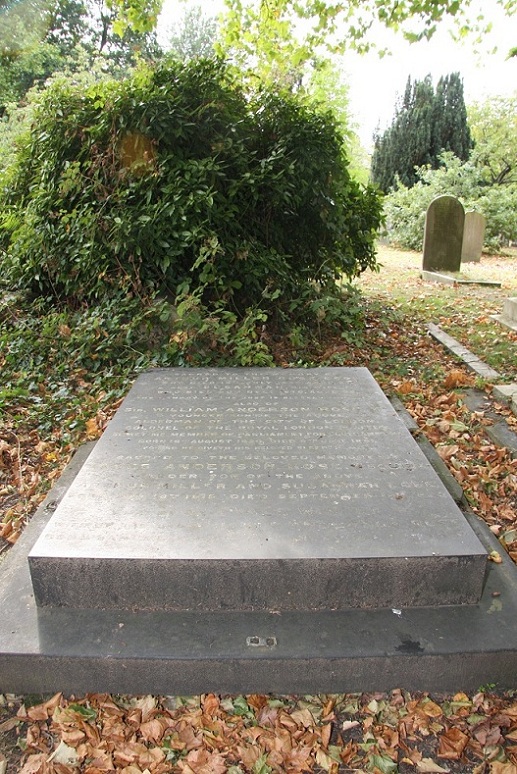
The gravestone of Sir William Anderson Rose, Battersea Cemetery. [FindaGrave: Added by Julia&Keld.
Build: 05 July 2026 — v1
[Holding page — notes compiled so far, awaiting further research and integration with the main James Anderson Rose page.]
Sir William Anderson Rose was the brother of James Anderson Rose, and lived nearby at “Bifrons”, Upper Tooting, on the eastern side of what is now Tooting Bec Common, directly opposite it. He is understood to be buried locally, at St Mary's Church, Battersea.
Sir ROSE William Anderson Knt.
Personal Estate £51,023 13s. 8d.
18 October. The Will of Sir William Anderson Rose late of 66 Upper Thames-street in the City of London and of Upper Tooting in the County of Surrey Knight Merchant an Alderman of the said City and Colonel Commanding the Royal London Militia who died 9 June 1881 at Upper Tooting was proved at the Principal Registry by Charlotte Grace Rose of Bifrons Upper Tooting Widow the Relict one of the Executors.
Source: Principal Probate Registry Calendar, via Ancestry
["Bifrons" was a large private estate and house on the eastern side of Upper Tooting, directly opposite Tooting Bec Common, later absorbed or redeveloped as the area was built up in the late 19th/early 20th century — including the adjacent Tooting Bec Hospital site. Exact boundaries not yet pinned down — worth checking against a specific survey or census year. Is it the old Manor House? (For my Falcon Brook talk, I recall writing about someone who complained the Board of Works about the pollution of his lake, formed from a tributary, but who was berated by them because they said it was a sewer and should never have been dammed. "Bifrons" seems like a strange choice. Literally "two-faced" (from bi- meaning "two" and frons meaning "forehead" or "face"). It primarily refers to the Roman god Janus, but also and a notable entity in classical demonology: Bifrons is classified as a powerful Earl or Count of Hell who commands 26 legions of spirits. But probably in this instance, simply to Janus.
[Google AI notes:
"The term Bifrons originates from Latin and literally translates to "two-faced" (from bi- meaning "two" and frons meaning "forehead" or "face"). It primarily refers to an ancient Roman god and a notable entity in classical demonology.
The Roman God
Janus Bifrons: In ancient Roman mythology, Janus is the god of beginnings, gates, transitions, and endings. Because he is depicted with two faces—one looking to the future and one to the past—he was famously given the epithet Bifrons.
The Demonic Figure
Ars Goetia: In historical texts of demonology like the Lesser Key of Solomon (and the Dictionnaire Infernal), Bifrons is classified as a powerful Earl or Count of Hell who commands 26 legions of spirits.
Abilities: In folklore, he initially appears as a monster before taking human form. He is known as a teacher of arts and sciences—specifically astrology, geometry, and the properties of herbs and stones. He is also associated with necromancy, often transporting corpses and lighting strange magical candles over tombs.
Modern Metaphor
Two-Faced: In a broader literary or psychological sense, "Janus-faced" or "bifrons" describes a situation, concept, or person that has two contrasting sides, meanings, or deliberate deceitfulness." ]
William Anderson Rose was born in London on 16 August 1820, of Scottish descent, the second son of merchant Arthur Miller Rose and his wife Susanna. He was educated at St Olave's Grammar School, Southwark, and University College London. He married twice: first to Charlotte Flockton (née Magnall) in 1851, and, after her death in 1855, to Charlotte Grace Snow in 1858, with whom he had three sons and three daughters.
His public life was extensive, spanning both the City of London and national politics. He served as a Common Councillor for Queenhithe ward from 1849, became an Alderman in 1854, Sheriff the following year, and Lord Mayor of London in 1862–63. He was knighted in 1867. He also held senior positions across several livery companies (Spectaclemakers, Loriners, Wax Chandlers) and rose through the ranks of the London Rifle Volunteers to Colonel. He contested Parliament unsuccessfully at Newport, Isle of Wight, in 1857, before being elected MP for Southampton in 1862, a seat he lost in 1865.
He died at Bifrons, Upper Tooting, on 9 June 1881, having been taken ill in his carriage on the way to his office, and was buried at St Mary's Cemetery, Battersea, on 14 June.
Source: Claus, Peter Mark (1998), 'Real Liberals' and Conservatives in the City of London, 1848–1886, PhD thesis, The Open University, pp.301–2. Full thesis (PDF)
As Lord Mayor, Rose found himself at the centre of a diplomatic row during the American Civil War. In February 1863 he hosted a Mansion House banquet for the City's aldermen and Court of Common Council, and included among the guests James Mason, the Confederacy's official commissioner in London. Rose proposed a toast acknowledging his visitors that named Mason specifically; while he stopped short of recognising him as an official diplomatic representative, he defended his right, as the City's chief magistrate, to extend a warm welcome to him. Mason spoke in response and was received enthusiastically by the company.
The invitation itself, rather than any formal act of recognition, is what drew fire from the pro-Union camp. The abolitionist campaigner George Thompson publicly condemned Rose for having invited Mason to the Mansion House at all, and the matter fed into a larger protest meeting of the Emancipation Society at St James's Hall shortly afterwards, at which Thompson denounced Mason in vivid terms as a "man stealer and a fugitive-slave kidnapper."
In essence, Rose's role was as the host whose civic hospitality became a lightning rod: a Lord Mayor exercising what he saw as a straightforward courtesy of office toward a foreign visitor, which his opponents read as Britain's civic establishment cosying up to the Confederacy at a highly sensitive moment in the war.
Source: American Civil War Round Table (UK), “Lord Mayor of London in Confederate Controversy”, originally published in Crossfire, the magazine of the ACWRT (UK), No. 47, as “Places in Britain of Civil War Interest: The Mansion House, London.” © ACWRT (UK) 1994 & 2002.
WAR's name is inscribed on a massive horizontal slab in Battersea Cemetery.
The gravestone of Sir William Anderson Rose, Battersea Cemetery. [FindaGrave: Added by Julia&Keld.
FindaGrave: William Anderson Rose.
Transcribe! It would be good to know what is inscribed on the gravestone.
Is his brother James also in this grave - which I read somewhere is a family tomb - or elsewhere in this cemetery?
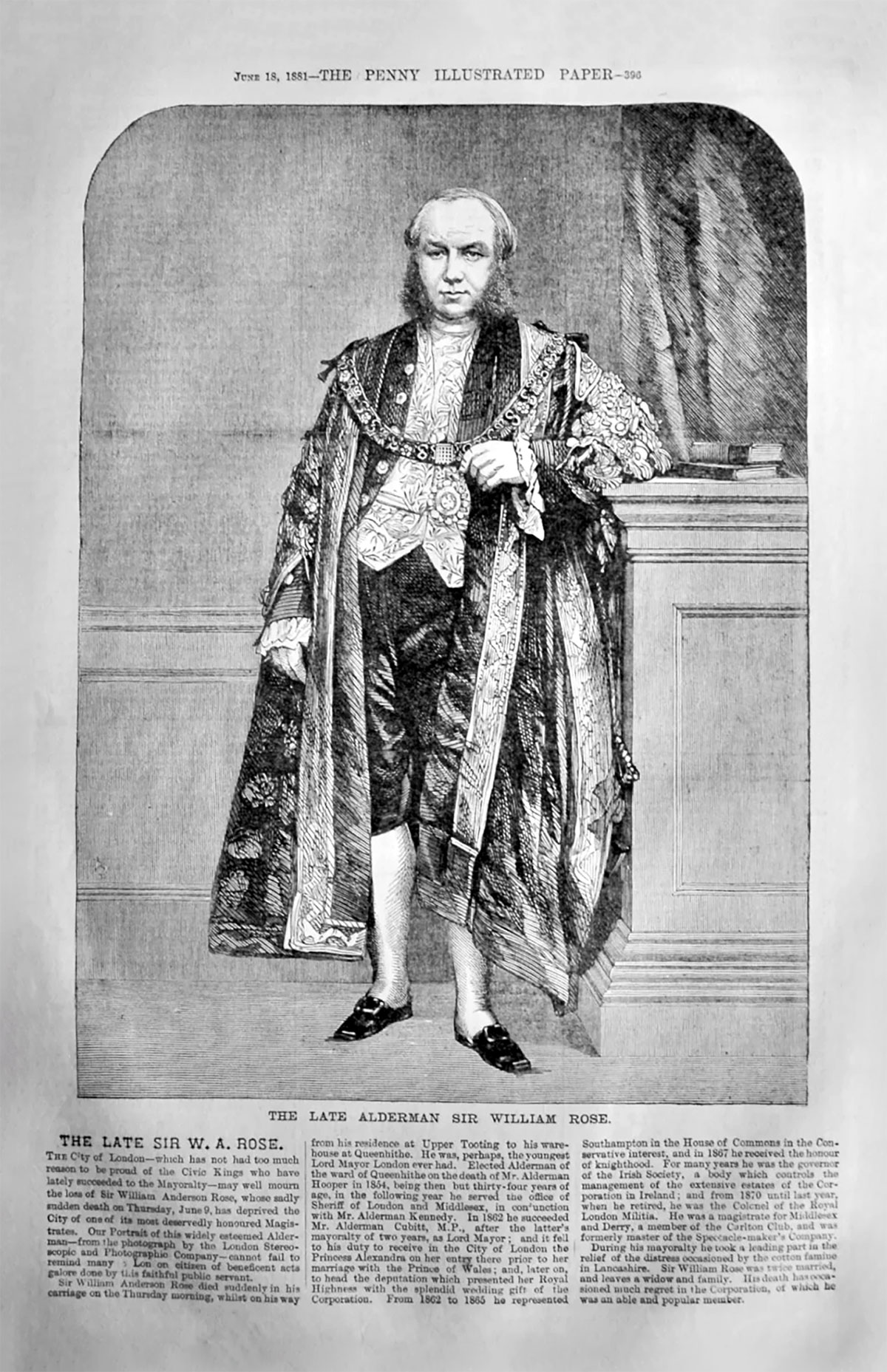
“The Late Alderman Sir William Rose” — from an obituary portrait in The Penny Illustrated Paper, 18 June 1881, published nine days after his death.
A full illustrated obituary, published just nine days after his death.
THE LATE SIR W. A. ROSE.
The City of London — which has not had too much reason to be proud of the Civic Kings who have lately succeeded to the Mayoralty — may well mourn the loss of Sir William Anderson Rose, whose sadly sudden death on Thursday, June 9, has deprived the City of one of its most deservedly honoured Magistrates. Our Portrait of this widely esteemed Alderman — from the photograph by the London Stereoscopic and Photographic Company — cannot fail to remind many a London citizen of beneficent acts galore done by this faithful public servant.
Sir William Anderson Rose died suddenly in his carriage on the Thursday morning, whilst on his way from his residence at Upper Tooting to his warehouse at Queenhithe.
He was, perhaps, the youngest Lord Mayor London ever had. Elected Alderman of the ward of Queenhithe on the death of Mr Alderman Hooper in 1854, being then but thirty-four years of age, in the following year he served the office of Sheriff of London and Middlesex, in conjunction with Mr Alderman Kennedy. In 1862 he succeeded Mr Alderman Cubitt, M.P., after the latter's mayoralty of two years, as Lord Mayor; and it fell to his duty to receive in the City of London the Princess Alexandra on her entry there prior to her marriage with the Prince of Wales; and, later on, to head the deputation which presented her Royal Highness with the splendid wedding gift of the Corporation.
From 1862 to 1865 he represented Southampton in the House of Commons in the Conservative interest, and in 1867 he received the honour of knighthood.
For many years he was the governor of the Irish Society, a body which controls the management of the extensive estates of the Corporation in Ireland; and from 1870 until last year, when he retired, he was the Colonel of the Royal London Militia. He was a magistrate for Middlesex and Derry, a member of the Carlton Club, and was formerly master of the Spectacle-maker's Company.
During his mayoralty he took a leading part in the relief of the distress occasioned by the cotton famine in Lancashire. Sir William Rose was twice married, and leaves a widow and family. His death has occasioned much regret in the Corporation, of which he was an able and popular member.
Source: The Penny Illustrated Paper, 18 June 1881, p.396
“His residence at Upper Tooting” confirms Bifrons as his primary home right up to his death, consistent with everything else gathered so far.
“Youngest Lord Mayor London ever had” is a nice, quotable claim — worth flagging as a period assertion rather than a verified fact, since papers often repeated this kind of superlative loosely.
The cotton famine relief work during his mayoralty (1862–63) is a detail that doesn't appear in the Claus thesis extract or the ACWRT piece — genuinely new material for the page.
“Elected Alderman… on the death of Mr Alderman Hooper in 1854, being then but thirty-four years of age” gives an independent age check: 1854 minus 34 ≈ born 1819–20, consistent with the 16 August 1820 birth date already on record.