
 S WE SAW in the Chronicles for April and May, fence-breaking had been quite the thing on Wandsworth Common in the 1860s. It even featured in a poem in Punch magazine, thanks to local resident and Commons' activist Tom Taylor.
Tom had previously published two poems in defence of the Common, The Warning of Wandsworth Common (4 March 1865) and The Commons to the Rescue! (11 March 1865). Always quick to sharpen his quill (and dip it in vitriol), within a few days of Samuel Sullings's imprisonment in Wandsworth Gaol (April 1870) he had written and published the exuberant The Cry of the Commoners. (I particularly love the line about "Earl Spencer, the devourer of Commons".)
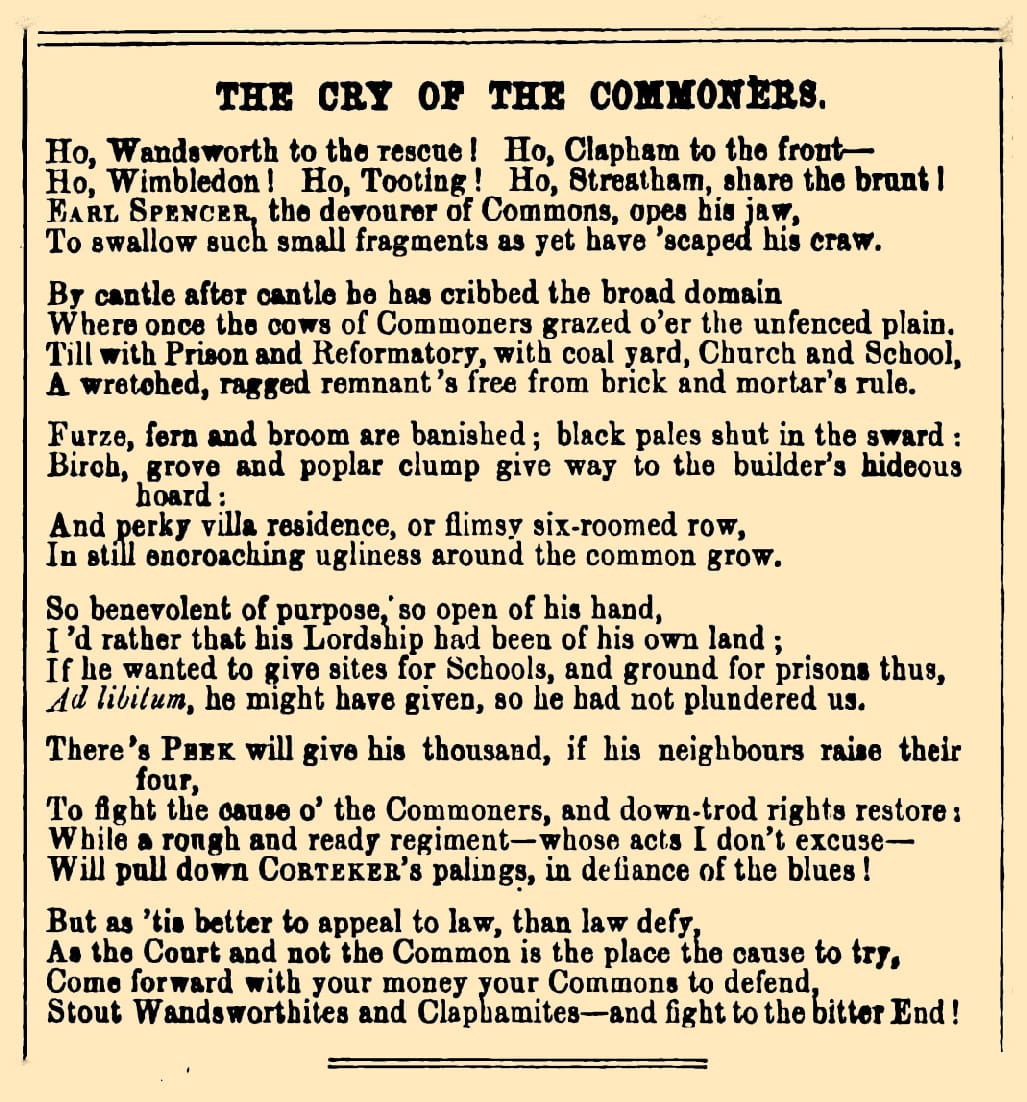
THE CRY OF THE COMMONERS
Ho, Wandsworth to the rescue! Ho, Clapham to the front —
Ho, Wimbledon! Ho, Tooting! Ho, Streatham, share the brunt!
EARL SPENCER, the devourer of Commons, opes his jaw,
To swallow such small fragments as yet have 'scaped his craw.
By cantle after cantle he has cribbed the broad domain
Where once the cows of Commoners grazed o'er the unfenced plain.
Till with Prison and Reformatory, with coal yard, Church and School,
A wretched, ragged remnant’s free from brick and mortar’s rule.
Furze, fern and broom are banished; black pales shut in the sward:
Birch, grove and poplar clump give way to the builder’s hideous hoard:
And perky villa residence, or flimsy six-roomed row,
In still-encroaching ugliness around the common grow.
So benevolent of purpose, so open of his hand,
I'd rather that his Lordship had been of his own land;
If he wanted to give sites for Schools, and ground for prisons thus,
Ad libitum, he might have given, so he had not plundered us.
There's PEEK will give his thousand, if his neighbours raise their four,
To fight the cause o' the Commoners, and down-trod rights restore:
While a rough and ready regiment — whose acts I don’t excuse —
Will pull down CORTEKER's palings, in defiance of the blues!
But as 'tis better to appeal to law, than law defy,
As the Court and not the Common is the place the cause to try,
Come forward with your money your Commons to defend,
Stout Wandsworthites and Claphamites — and fight to the bitter End!
Notes
"brunt" — shock or impact of something unpleasant or destructive
"craw" — throat
"cantle" — section or slice cut off a whole
"cribbed" — stolen
"...brick and mortar's rule...builder's hideous hoard...ugliness round the common grow" — notice the disgust at the new houses ("villas...six-room rowed"), widely expressed by the local great and good
"Prison and Reformatory, with coal yard, Church and School" — Surrey House of Correction (Wandworth Prison), Wandsworth Boys' Home Reformatory and St James's Industrial School; coal yards near New Wandsworth Station and the new Wandsworth Common Station; St Mark's Church and school.
"Ad libitum" — freely, at one's pleasure
"Peek will give his thousands . . . Henry Peek, MP, promised £1000 to a fund to pay legal fees to fight the case in court if local people could collect £4000.
"Corteker" — John Costeker, who was enclosing parts of Plough Green — is this a typo, or was it deliberate to avoid a possible legal challenge?
"Pales", "Palings" — fences
"The blues" — police
TT declares that he disapproves of illegal acts — and that decisions/justice should be reached through legal means. But it seems likely that he was sympathetic to the vigorous actions of the "rough and ready regiment", among whom was the imprisoned Samuel Sullings.
The implication is, perhaps, that unless people contribute to the fund, more acts of violence will follow.
[In practice it was [not at all clear what was and wasn't ] "illegal" - whether Lords were entitled to sell off Common land as "theirs", or whether copyholders and other local people were able to act vigrously to protect their [routes] when they were impedded. A number of actions at this time were aimed at ... getting legal judgments to clarify things - but without the cost of taking e.g. Spence to court. Hence the frequent calls on him to take the people to court - at his own expense.

["Pull together" — surely this can't be a pun, can it? An encouragemen to []the fences?t?]
Back to the top of this page . . .
