

There's an enormous literature on Thomas Crapper, which I won't deal with here.
Essentially:
1. Yes, he really did exist — he is not an invention.
2. No, he did not invent the flushing lavatory.
3. No, he did not walk from Yorkshire to London in search of work.
4. No, he was never knighted (so there was no "Sir Thomas" Crapper).
5. The word "crap" does not derive from his name — it's Middle English. (Though I suppose you could argue it illustrates "nominative determinism" — that he was drawn to this area of work by his name). It is however possible that the word "crapper", slang for lavatory (mainly in the USA), was inspired by the branding on the flush lavatories he manufactured.
BUT, he did live for many years in Battersea, very close to the Common, on what was then called "Middleton" Road — renamed Buckmaster Road in the 1930s (to honour either John Buckmaster or his son Stanley, or possibly both).
He was there for example in the 1871 Census — the year the Common passed into public ownership — and still there for the 1881 Census.

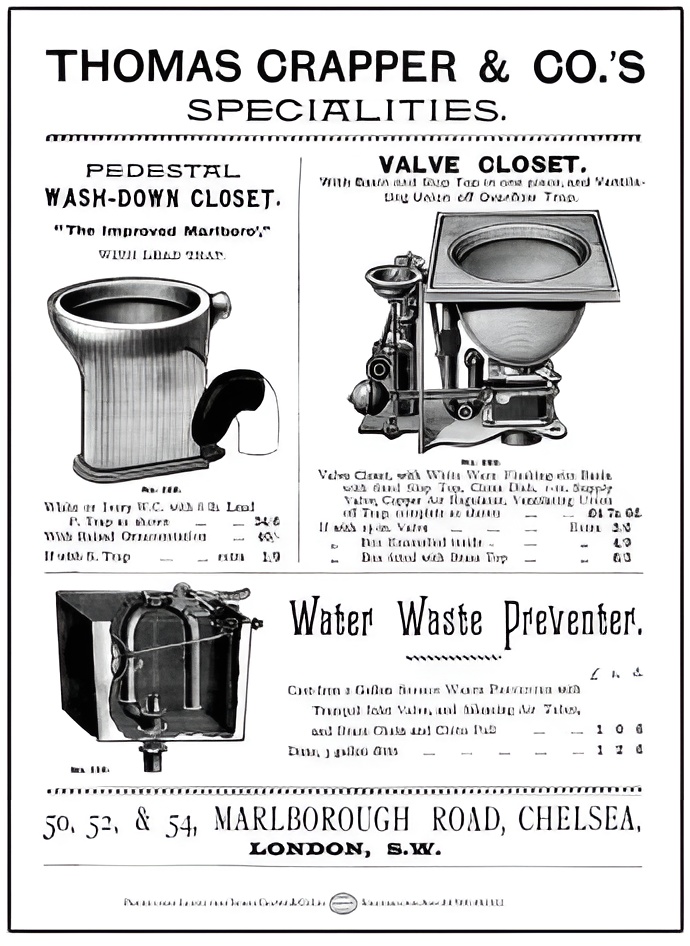
When piped water and mains sewerage became universal, lavatories proliferated. (Whether retro-fitted or built into new houses.) It was a great time to be a plumber. And there were new technical challenges. Flushes needed to be effective but not wasteful of water, and bad smells had to be trapped and voided outside of the house. To these ends, Thomas Crapper's innovations included ball-cock valves, siphons and the U-bend.
Perhaps more important still, he pioneered adverts with illustrations, and showrooms which home-owners could visit to view and choose sanitary ware, thus enormously expanding the market.

I was going to write that his particular genius was to bring lavatories, baths, wash-basins and other bathroom paraphernalia out of the, er, closet. But actually the opposite is true.
By the time of the 1891 Census, Thomas Crapper had moved away from Battersea to Penge. He died in 1910 at 12 Thornsett Rd, Anerley, and is buried in Beckenham Cemetery.
Curiously, Anerley/Penge was until as late as 1899 a detached part of Battersea parish (albeit 8 miles away). The parish was more properly called "Battersea with Penge", with St Mary's its parish church. John Buckmaster was for a while an overseer of the poor of Penge.
See also George Jennings
Back to the top of this page . . .