— Wikipedia: https://en.wikipedia.org/wiki/Henry_Perkins_(brewer)
— Google Books: The Perkins Library: A Catalogue of the Very Valuable and Important ...
— English Book Collectors: Henry Perkins, 1778-1855
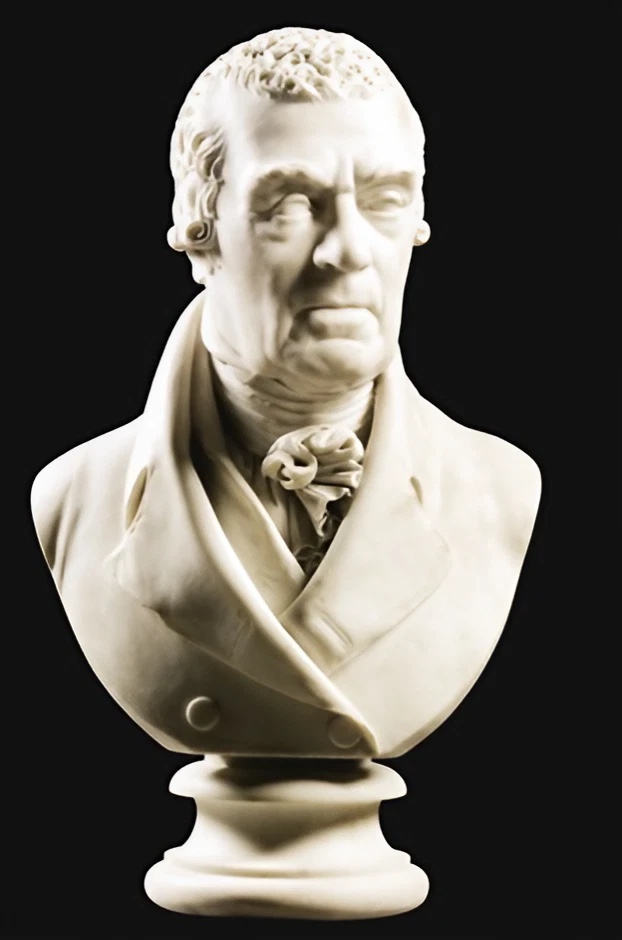
— ArtNetBust, probably of HP, by Francis Legatt (Sir) Chantrey (British, 1781–1842)
— Google Sites: The Perkins of Hanworth Park
— Beer & Brewing: Barclay, Perkins & Co.
— BarclayPerkins Blogspot: Barclay Perkins - some stuff
— Brewery History: Barclay, Perkins & Co. Ltd
— Gordseller.com: How John Perkins Saved Thrale’s Anchor Brewery From the Gordon Riots
NB Probably a LOT more references to Perkins et al
NB Don't forget the Haynau story and plaque! This is a reference to the comment in the Commons in 1863, deploring the birching of girls at the RVPA - that this is the sort of thing that Haynau and Austria might do, but not the English. When Haynau came to London, the Draymen of the Barclay & Perkins Brewery in Southwark thrashed him [or similar].
It was on Wednesday 4th September 1850 that General Haynau, accompanied by an interpreter and his nephew, visited the brewery of Messrs Barclay and Co on Park Street in Southwark. The brewery had recently been rebuilt and was regularly accepting visitors who wanted to see its modern equipment https://www.ianvisits.co.uk/articles/the-day-londoners-humbled-an-austrian-tyrant-59784/
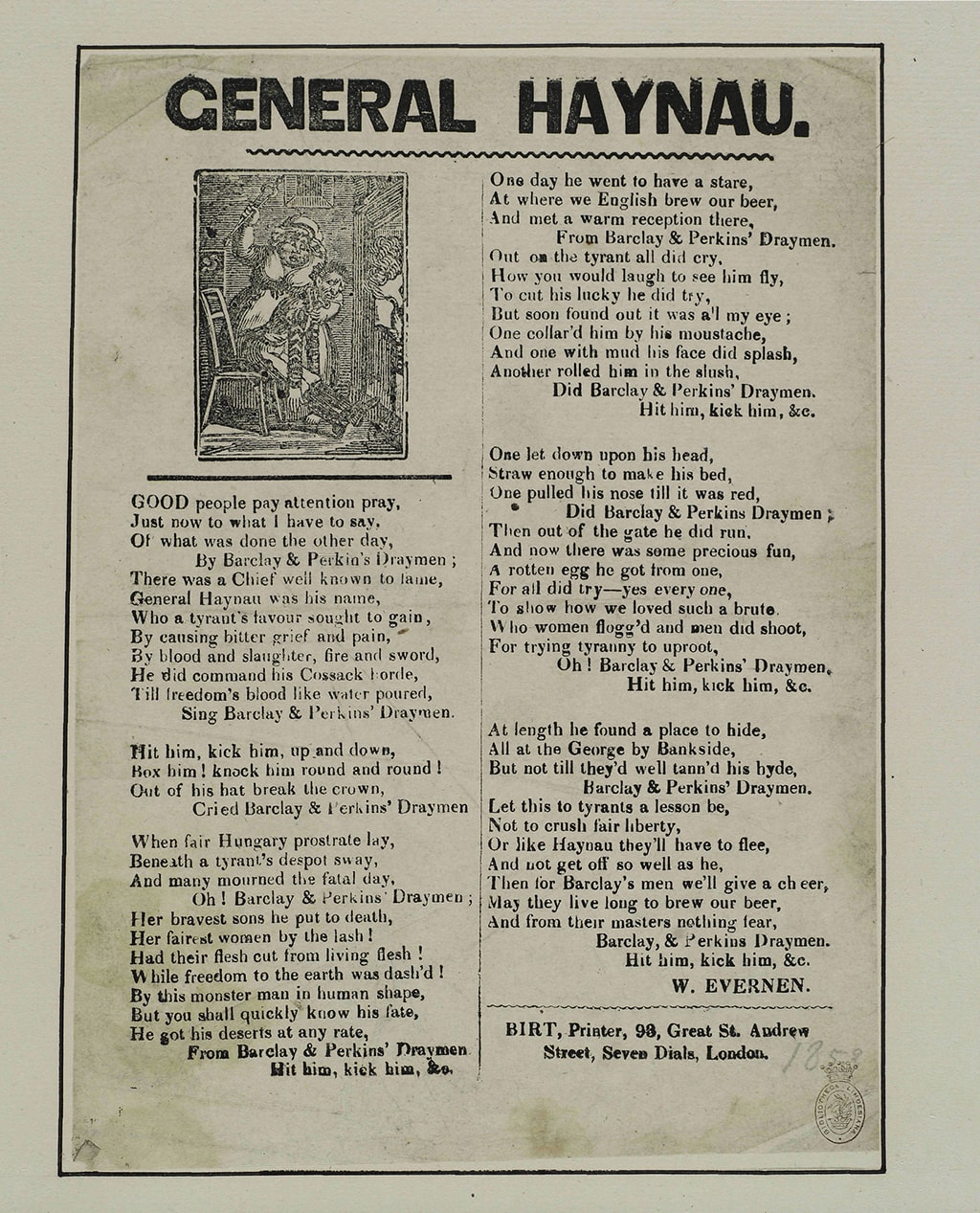
https://digital.nls.uk/english-ballads/archive/74893054?mode=transcription
Permanent URL https://digital.nls.uk/74893054
Description This ballad concerns Baron Haynau, who, on a visit to London, narrowly escaped lynching when recognized in the street by some draymen from a local brewery (Barclay & Perkin's) for his cruelty in supressing the reform movement in Hungary. First line reads: Good people pay attention pray.
Shelfmark Crawford.EB.2118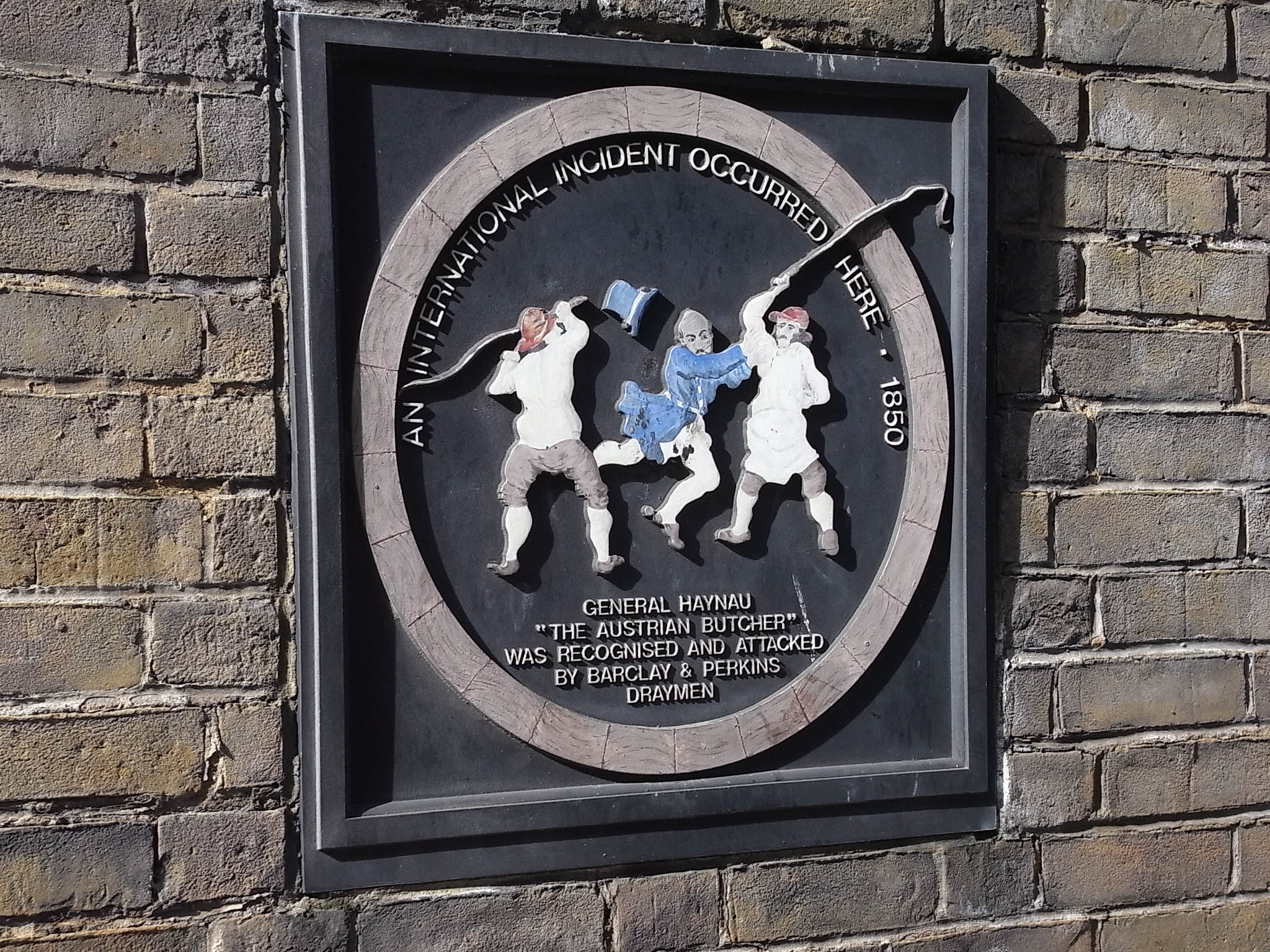
Sotheby's
Francis Legatt Chantrey
Bust of Gentleman, probably the brewer Henry Perkins (1778-1855)
white marble, on a white marble socle
... This fine bust is the original marble version of a plaster bust by Chantrey, described as 'Mr Perkins, a brewer', in the Ashmolean Museum in Oxford (Penny, op. cit. no. 746). The present bust is recorded in the Chantrey Ledgers as having been commissioned in 1819 and completed in 1820.
Given the reference in the Ashmolean records to Mr Perkins being 'a brewer', it can be confidently proposed that the sitter is Henry Perkins, a partner in the prosperous brewery Barclay, Perkins and Co.
Perkins was also a noted bibliophile, and a fellow of the Linnean, Geological and Horticultural societies. He amassed a small but important library, which included two copies of the Gutenberg Bible (one paper, one vellum), a first edition of the Latin Bible (1462), a Coverdale Bible (1835), the first four Shakespeare folios, several works from the Caxton press, and numerous fine illuminated manuscripts, among them John Lydgate's Siege of Troy (c. 1425).
In 1873, following the death of his son Algernon in 1870, Perkins' library was dispersed. The 865 lots in the sale raised the sum of £25,000, the largest amount hitherto realised for a collection of its size.
The present bust display's Chantrey's masterful skill as a carver of portrait busts. The focus on the sitter's mental concentration is typical of the sculptor's work, as is the interest in details such as the wig and the relatively informal dress.
Related literature
A. Potts (ed.), Sir Francis Chantrey. Sculptor of the great, exh. cat. National Portrait Gallery, London and Mappin Art Gallery, Sheffield, London, 1981
N. Penny, Catalogue of European sculpture in the Ashmolean Museum. Volume III: British, Oxford, 1992, p. 241, no. 746
S. Dunkerley, Francis Chantrey Sculptor. From Norton to Knighthood, Sheffield, 1995
A. Yarrington, I. D. Lieberman, A. Potts and M. Baker, 'An Edition of the Ledger of Sir Francis Chantrey R. A., at the Royal Academy, 1809-1841,' The Fifty-sixth Volume of the Walpole Society, 1991-1992, p. 127, no. 109b
I. Roscoe, E. Hardy and M. G. Sullivan, A Biographical Dictionary of Sculptors in Britain 1660-1851, New Haven and London, 2009, p. 248, no. 413
Condition
[Near] Southwark Street... is situated Messrs. Barclay, Perkins, and Co.'s Brewery (PL R, 38 ; III), partly on the former site of the Globe Theatre.
This is one of the most extensive establishments of the kind in London, and is well worthy of a visit, on account both of its great size and its admirable arrangements. It was founded more than 200 years ago.
The brewery covers an area of about 12 acres, forming a miniature town of houses, sheds, lofts, stables, streets, and courts. At the entrance stand the Offices, where visitors, who readily obtain an order to inspect the establishment on application by letter, enter their names in a book. The guide who is assigned to the visitor on entering expects a fee of a shilling or so.
In most of the rooms there is a somewhat oppressive and heady odour, particularly in the cooling-room, where the carbonic acid gas lies about a foot deep over the fresh brew. Visitors are recommended to exercise caution in accepting the guide's invitation to breathe this gas.
In spite of the vast dimensions of the boilers, vats (one of which has a capacity of 112,000 gallons, or more than twice that of the Great Tun of Heidelberg), fermenting 'squares', and other apparatus, none but the initiated will have any idea of the enormous quantity of liquor brewed here in the course of a year, amounting to nearly 20 million gallons. About 200,000 quarters of malt are annually consumed, and the yearly duty paid to government by the firm amounts to the immense sum of £180,000.
The head brewer is said to receive a salary of lOOOi. per annum. One of the early owners of the brewery was Dr. Johnson's friend Thrale, after whose death it was sold to Messrs. Barclay and Perkins. Dr. Johnson's words on the occasion of the sale, which he attended as an executor, though often quoted, are worthy of repetition : 'We are not here to sell a parcel of boilers and vats, but the potentiality of growing rich beyond the dreams of avarice.'
Most of the water used in brewing is supplied by an artesian well sunk on the premises.
The stables contain about 150 strong dray-horses, used for carting the beer in London, and many of them bred in Yorkshire.
The brewing-trade in London has become a great power within the last twenty or thirty years, and is felt to have a serious bearing npon the results of parliamentary and municipal elections. It is no longer a merely manufacturing trade, but promotes the consumption of its own goods by the purchase or lease of public-houses, where its agents are installed to conduct the sale. These agents are nominal tenants and are possessed of votes, and their number and influence are so great, that the power of returning the candidate who favours the "trade" is often in their hands. All the great brewers are now understood to be extensive proprietors of such 'tied houses.