Build 1 — 30 August 2026
[PB/Claude, 30 August 2026: built from the reference list Philip supplied — the Guardian, Lancet, BMJ, Telegraph and Psychiatric Bulletin obituaries and notices — and the Wikipedia article and BJPsych Bulletin obituary itself, cross-checked against each other. One correction along the way, already flagged when the reference list was first tidied: the Pediatrics citation in Philip's list had become garbled in transcription ("104(2):337"); the actual reference is "Sterilization of Women Who Are Mentally Handicapped," Pediatrics, May 1990, vol. 85, no. 5, p. 868 — and, importantly, that piece isn't by Bicknell at all. It's a statement by the American Academy of Pediatrics' own Committee on Bioethics, cited on her Wikipedia page because it followed her own 1988 position on the same question by two years, not because she wrote it — worth being careful about, since it would be easy to misattribute. On the "first" claim: earlier drafts of this kind of research sometimes hedge between "first woman professor of psychiatry" and "first professor of psychiatry of learning disability," as if these were two different, competing claims. Having now read the obituary itself closely, they aren't in tension: her chair, created for her in 1980, was specifically the professorship of the psychiatry of learning disability at St George's — but she was also, more broadly, the first woman in Britain to hold a professorship in psychiatry of any kind. Both things are true at once, and I've said so below.]
Joan Bicknell spent almost her whole working life a few minutes' walk from Wandsworth Common, at Springfield Hospital and St George's, and it is worth saying plainly what she achieved there before saying anything else about her: in 1980 she became the first woman in Britain to hold a professorship in psychiatry, in a chair created for her and devoted to a subject that barely had a name yet — the psychiatry of learning disability. That a distinction of that size fell to someone working with the most marginalised, least fashionable group of patients in the whole of medicine, rather than in one of psychiatry's more prestigious corners, seems entirely in character for a career that ran, from beginning to end, against the institutional grain.
She was born Dorothy Joan Bicknell on 10 April 1939 in Isleworth, the daughter of a solicitor's secretary who later became a foster parent and a father who served in bomb disposal during the war — a household, on that evidence, not unused to looking after other people's difficulties. She read medicine at Birmingham, graduating in 1962, and did not go straight into psychiatry at all: her first years as a doctor were spent as a paediatrician in Nigeria, in mission hospital work, before she returned to Britain in the later 1960s to train in psychiatry proper, taking her diploma in psychological medicine in 1969 and an MD in 1971 on lead poisoning among institutionalised children — a subject that already announces where her sympathies lay.
Bicknell became a consultant psychiatrist at Botleys Park Hospital before joining, in 1978, the task force sent in to reform Normansfield Hospital in the wake of that year's notorious scandal there — one of the defining institutional-abuse cases of the period, and a formative one for her own thinking. She argued, against the grain of the old medical-superintendent model, for multidisciplinary teams in place of a single doctor's absolute authority over a long-stay institution.
In 1980 St George's, University of London created a chair for her: professor of the psychiatry of learning disability, based at Springfield Hospital, Tooting. Her inaugural lecture that November, on the "psychopathology of handicap," looked at how families actually experienced a diagnosis of intellectual disability in their own child — framed, deliberately, as a form of grief — at a time when the emotional lives of those families were barely considered a proper subject for psychiatry at all. The community team base at what is now Springfield University Hospital, and a separate building in Tooting, the Joan Bicknell Centre, are both named for her.
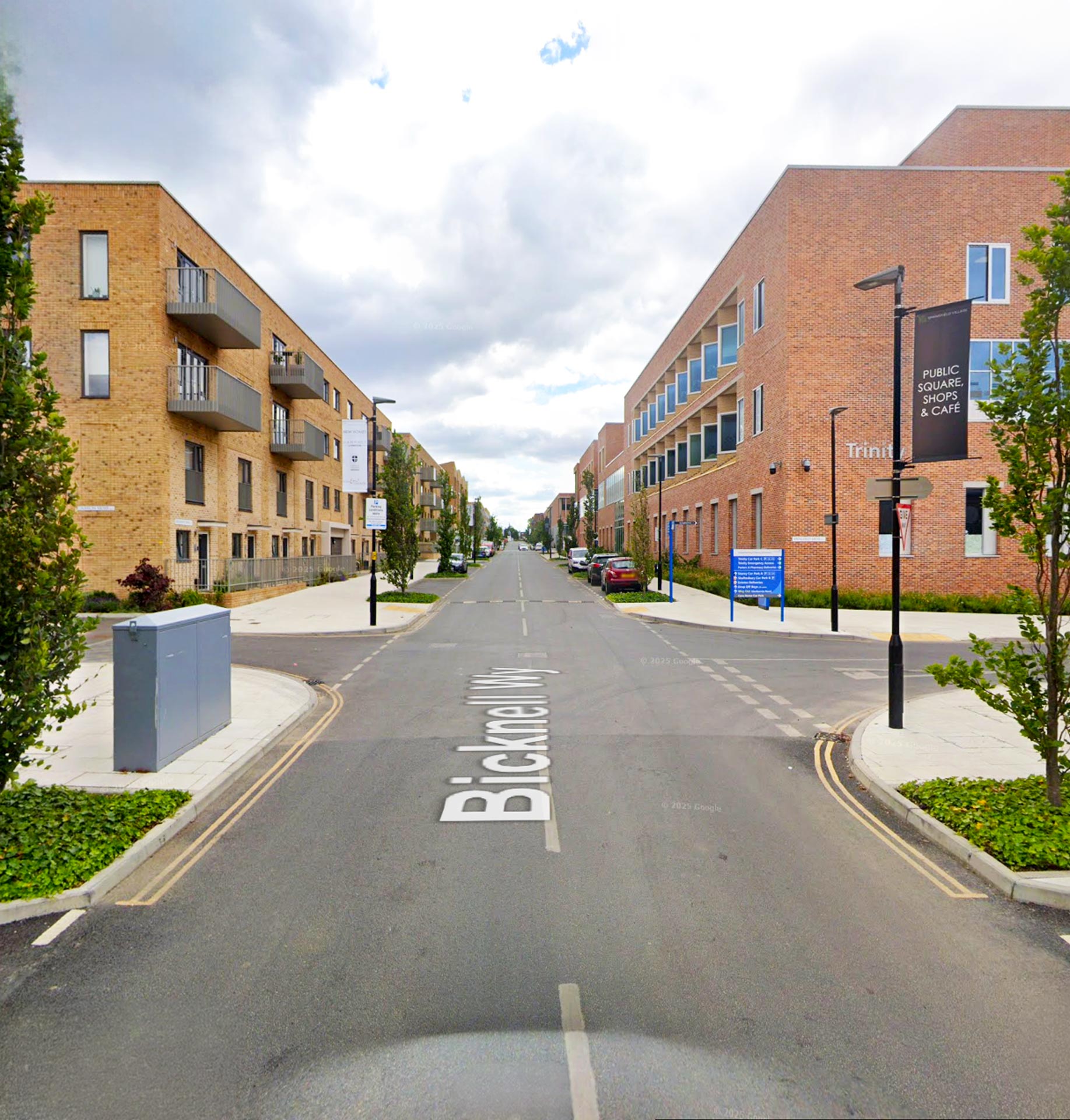
The old Springfield Hospital site itself has since been rebuilt as Springfield Village, a mixed development of housing and a new 32-acre public park opened around the hospital that remains, its own stated purpose being to "destigmatise mental illness and reconnect the NHS site with its local area" — to integrate mental health services with the community as a whole, rather than screen them off behind a wall, which is more or less the argument Bicknell herself had been making, in clinical rather than architectural terms, since the 1970s. The development's main road is Bicknell Way, named for her.
Promotional documents refer to "a community built around mental health care... designed to destigmatise mental illness and reconnect the NHS site with its local area," and its chief executive has said the point of building homes and parks alongside the hospital is that it "creates a greater understanding of mental health and makes it less frightening." We can assume Joan Bicknell would have been very pleased.
The part of her work that reads most pointedly today concerns consent. Through the late 1980s Bicknell wrote and argued against the routine, non-consensual sterilisation of women and girls with learning disabilities — then still a live clinical practice, and one defended by parts of the medical establishment as a straightforward kindness. Her own position paper, "Sterilization for mentally handicapped girls" (1988), and her later "Consent and people with mental handicap" (1989), pressed the case that people with learning disabilities were entitled to the same presumption of autonomy, and the same scrutiny of who was deciding on their behalf and why, as anyone else. It is a detail worth pausing on that the American Academy of Pediatrics' own Committee on Bioethics did not reach a comparable published position until 1990, two years after Bicknell had already staked hers out in Britain. None of this made her popular with colleagues who preferred the older, more paternalistic consensus; by her own account and her obituarists', community-based, rights-respecting care of this kind remained a minority position within the medical establishment for most of her working life, however clearly later opinion has come round to her side of the argument.
Bicknell retired early, around 1990, at fifty, worn down by severe asthma and by a period of her own mental illness — an irony not lost on colleagues who knew how much of her career had been spent insisting that psychiatric patients be treated with dignity rather than distance. She moved to Stalbridge in Dorset with her partner, the social worker Diana Worsley, where the two of them ran a farm that welcomed disabled children to spend time with the animals there — a second, quieter career built on exactly the same instinct as the first. She died of cancer on 12 June 2017, aged seventy-eight. The Royal College of Psychiatrists' Joan Bicknell Prize, established in 1990 for the best trainee essay on the psychiatry of learning disability, keeps her name attached to the specialty she had done more than almost anyone to establish.
Sources: Sheila Hollins, "Joan Bicknell obituary," The Guardian, 2 July 2017 — Geoff Watts, "Obituary: Joan Bicknell," The Lancet, vol. 390, no. 10113 (16 December 2017), p. 2622 — "Joan Bicknell," BMJ, 28 July 2017 — "Professor Joan Bicknell, pioneer of enlightened psychiatry — obituary," The Telegraph, 16 July 2017 — "Joan Bicknell," BJPsych Bulletin (obituary), 2017 — American Academy of Pediatrics Committee on Bioethics, "Sterilization of Women Who Are Mentally Handicapped," Pediatrics, vol. 85, no. 5 (May 1990), p. 868 — Joan Bicknell, Wikipedia.