A History of Wandsworth Common
Added
IN PROGRESS — NOT FOR PUBLICATION
Refresh this page
Index
Common People
Edward Thomas, In Pursuit Of Spring (1914)
10 am, 21 March 1913: Edward Thomas set off to cycle from Wandsworth Common to Nether Stowey, in the Quantock Hills of North Somerset.
Edward Thomas, In Pursuit Of Spring (1914)
10 am, 21 March 1913: Edward Thomas set off to cycle from Wandsworth Common to Nether Stowey, in the Quantock Hills of North Somerset.
Why Nether Stowey? Because Coleridge had lived there in the late 1790s, and there Edward Thomas would see "the native soil of "Kubla Khan," "Christabel," and "The Ancient Mariner," where Coleridge "on honey-dew hath fed and drunk the milk of Paradise."
[Sets off across a sodden Wandsworth Common]
I had planned to start on March 21, and rather late than early, to give the road time for drying. The light arrived bravely and innocently enough at sunrise; too bravely, for by eight o'clock it was already abashed by a shower. There could be no doubt that either I must wait for a better day, or at the next convenient fine interval I must pretend to be deceived and set out prepared for all things.
So at ten I started, with maps and sufficient clothes to replace what my waterproof could not protect from rain.
The suburban by-streets already looked rideable; but they were false prophets: the main roads were very different. For example, the surface between the west end of Nightingale Lane and the top of Burntwood Lane was fit only for fancy cycling — in and out among a thousand lakes a yard wide and three inches deep. These should either have been stocked with gold-fish and aquatic plants or drained, but some time had been allowed [35] to pass without either course being adopted.
It may be that all the draining forces of the neighbourhood had been directed to emptying the ornamental pond on Wandsworth Common. Empty it was, and the sodden bed did not improve the look of the common — flat by nature, flatter by recent art.
The gorse was in bloom amidst a patchwork of turf, gravel, and puddle. Terriers raced about or trifled. A flock of starlings bathed together in a puddle until scared by the dogs.
A tall, stern, bald man without a hat strode earnestly in a straight line across the grass and water, as if pleasure had become a duty. He was alone on the common. In all the other residences, that form walls round the common almost on every side, hot-cross buns had proved more alluring than the rain and the south-west wind.
The scene was, in fact, one more likely to be pleasing in a picture than in itself. It was tame: it was at once artificial and artless, and touched with beauty only by the strong wind and by the subdued brightness due to the rain. Its breadth and variety were sufficient for it to respond — something as Exmoor or Mousehold Heath or Cefn Bryn in Gower would have responded — to the cloudily shattered light, the threats and the deceptions, and the great sweep of the wind.
But there was no one painting [36] those cold expanses of not quite lusty grass, the hard, dull gravel, the shining puddles, the dark gold-flecked gorse, the stiff, scanty trees with black bark and sharp green buds, the comparatively venerable elms of Bolingbroke Grove, the backs and fronts of houses of no value save to their owners, and the tall chimney-stacks northwards.
Perhaps only a solitary artist, or some coldish sort of gnome or angel, could have thoroughly enjoyed this moment. That it was waiting for such a one I am certain; I am almost equally certain that he could create a vogue in scenes like this one, which are only about a thousandth part as unpleasant as a cold bath, and possess, furthermore, elements of divinity lacking both to the cold bath and to the ensuing bun.
It is easier to like the blackbird's shrubbery, the lawn, the big elm, or oak, and the few dozen fruit trees, of the one or two larger and older houses surviving — for example, at the top of Burntwood Lane. The almond, the mulberry, the apple trees in these gardens have a menaced or actually caged loveliness, as of a creature detained from some world far from ours, if they are not, as in some cases they are, the lost angels of ruined paradises.
[Burntwood Lane, the playing fields, the Asylum]
Burntwood Lane, leading down from a residential district to an industrial district, is no longer [37] as pretty as its name. Also, when it seems to be aiming at the country, it turns into a street of maisonettes, with a vista of houses terminated by the two tall red chimneys of the Wimbledon Electricity Works. But it has its character.
The Lunatic Asylum helps it with broad, cultivated squares, elms, and rooks' nests, and the voices of cows and pigs behind the railings that line it on the left hand from top to bottom.
On the right, playfields waiting to be built all over give it a lesser advantage. How sorry are the unprotected elms on that side! They will never be old. Man, child, and dog, walking in and out of them, climbing them, kicking and cutting them, have made them as little like trees as it is possible for them to be while they yet live. They have one hour of prettiness, when the leaf-buds are as big as peas on the little side sprays low down. Then on a Saturday — or on a Sunday, when the path is darkened by adults in their best clothes — the children come and pick the sprays in bunches instead of primroses. For there are no primroses, no celandines, no dandelions outside the fences in Burntwood Lane.
[Garratt Green]
And Garratt Green at the bottom is now but a railed-in, perfectly level square for games, with rules on a notice-board. It is greener than when it was crossed diagonally by paths, and honoured [38] on a Saturday by gypsies and coconut-shies. Probably it now gives some satisfaction to the greatest number possible, but nobody will ever again, until After London, think of Garratt Green as a sort of country place. I went round it and its footballers in haste.
["After London" is a reference to Richard Jefferies's 1885 post-apocalyptic novel After London or Wild England. England has been depopulated after a sudden unexplained catastrophe — the countryside has reverted to nature, and the few survivors to a quasi-medieval way of life. Thomas was greatly inspired by Jefferies's nature writing.]
Nor is that thickening portion of London beyond it easily made to appear beautiful or interesting.
It is flat and low, suitable rather for vegetables than men, and built on chiefly because people can always be enticed into new houses. The flatter and lower and more suitable for vegetables, the more easily satisfied are the people with their houses, partly because they are poor, partly because they are half country folk and like this kind of land, it may be, and the river Wandel, the watercress beds, the swampy places, the market gardens, the cabbages and lavender, and Mitcham Fair, more than they would like the church-parade along Bolingbroke Grove, the bands, the teetotallers, the atheists, and the tennis-players, on the commons which have a gravel soil.
[Huntspill Road. The "outdoor museum" of street names, "elements of a puzzle map of England which gradually we fill in".]
As I left the Green I noticed Huntspill Road. Why is it Huntspill Road? I thought at once of Huntspill in Somerset, of Highbridge on the Brue, of Brent Knoll, of Burnham and Hunt's Pond, and the sandhills and the clouded-yellow butterflies that shared the hollows of the sandhills with [39] me in the Summer once.
Such is the way of street names, particularly in London suburbs, where free play is given to memory and fancy. I suppose, if I were to look, I should find names as homely as the Florrie Place and Lily Place at lower Farringdon near Alton, or the Susannah's Cottage and Katie's Cottage near Canute's Palace at Southampton. But Beatrice, Ayacanora, or Megalostrate would be as likely.
To the casual, curious man, these street names compose an outdoor museum as rich as any in the world. They are the elements of a puzzle map of England which gradually we fill in, now recognizing from a bus-top the name of a Wiltshire village, and again among the Downs coming upon a place which had formerly been but a name near Clapham Junction.
Not far beyond Huntspill Road, at what is called (I think) New Wimbledon, I noticed a De Burgh Street. Do you remember how Borrow, speaking of the tricks of fortune, says that he has seen a descendant of the De Burghs who wore the falcon mending kettles in a dingle? He counted himself one of the De Burghs. De Burgh Street is a double row of more than dingy — better than dingy — swarthy, mulatto cottages, ending in a barrier of elm trees.
The monotony of the tiny front gardens is broken by a dark pine tree in one, [40] and by an inn called the "Sultan" — not "Sweet Sultan," which is a flower, but "Sultan," a dusky king.
And out of the "Sultan," towards me, strode a gaunt, dusky man, with long black ringlets dangling from under his hard hat down over his green and scarlet neckerchief. His tight trousers, his brisk gait, and his hairless jib, were those of a man used to horses and to buyers and sellers of horses. He came rapidly and to beg. Rapid was his begging, exquisitely finished in its mechanical servility.
His people were somewhere not far off, said he. That night he had travelled from St. Albans to rejoin them. They were not here: they must be at Wandsworth, with the vans and horses. All questions were answered instantly, briefly, and impersonally. The incident was but a pause in his rapid career from the "Sultan" to Wandsworth. He took the price of a pint with a slight appearance of gratitude, and departed with long, very quick steps, head down, face almost hidden by his bowler.
But there was much to be seen between Huntspill Road and De Burgh Road.
The scene, for instance, from the corner by the "Plough," the "Prince Albert," and the "White Lion," at Summerstown, was curious and typical. These three great houses stand at the edge of the still cultivated [41] and unpopulated portion of the flat land of the Wandel — the allotment gardens, the watercress beds, the meadows plentifully adorned with advertisements and thinly sprinkled with horse and cow, but not lacking a rustic house and a shed or two, and to-day a show of plum-blossom.
This suburban landscape had not the grace of Haling Park and Down, but at that moment its best hour was beginning. The main part visible was twenty acres of damp meadow.
On the left it was bounded by the irregular low buildings of a laundry, a file and tool factory, and a chamois-leather mill; on the right by the dirty backs of Summerstown.
On the far side a neat, white, oldish house was retiring amid blossoming fruit trees under the guardianship of several elms, and the shadow of those two tall red chimneys of the Electricity Works.
On my side the meadow had a low black fence between it and the road, with the addition, in one place, of high advertisement boards, behind which lurked three gypsy vans.
A mixture of the sordid and the delicate in the whole was unmistakable.
Skirting the meadow, my road led up to the Wandel and a mean bridge. The river here is broadened for a hundred yards between the bridge and the chamois-leather mill or Copper Mill. The [42] buildings extend across and along one side of the water; a meadow comes to the sedgy side opposite.
The mill looks old, has tarred boards where it might have had corrugated iron, and its neighbours are elms and the two chimneys. It is approached at one side by a lane called Copper Mill Lane, where the mud is of a sort clearly denoting a town edge or a coal district.
Above the bridge the back-yards of new houses have only a narrow waste between them and the Wandel, and on this was being set up the coconut-shy that would have been on Garratt Green twenty years ago.
The rain returned as I was crossing the railway bridge by Hayden's Road station. It was raining hard when the gypsy left the "Sultan," and still harder when I turned to the right along Merton Road. Rather than be soaked thus early, I took the shelter offered by a bird-shop on the left hand. This was not a cheerful or a pretty place. Overhead hung a row of cages containing chaffinches — battered ones at a shilling, a neater one at eighteen-pence — that sang every now and then, -
"My life and soul, as if he were a Greek."
[Project Gutenberg: Link.]
- Archive.org: Link.
Also
[T]he Quantocks were to be my goal.
I had a wish of a mildly imperative nature that Spring would be arriving among the Quantocks at the same time as myself — that "the one red leaf the last of its clan," that danced on March 7, 1798, [30] would have danced itself into the grave: that since my journey was to be in "a month before the month of May," Spring would come fast, not slowly, up that way.
Yes, I would see Nether Stowey, the native soil of "Kubla Khan," "Christabel," and "The Ancient Mariner," where Coleridge fed on honey-dew and drank the milk of Paradise.
- Childhood — complete text (in progress, but the WC section has been completed)
- The Pursuit of Spring — ET crosses Wandsworth Common en route for the Mendips by bicycle (date?)
- The Gypsy
- Nick Pruce's poem/song for Wandsworth Common — The Musical, "Edward Thomas RIP — Easter Monday 1917"
Hello again, Robin
I always think it's unfortunate that the Shelgate address alone has a plaque.
He lived with his parents in three houses locally - of which I tend to think the first, 49 Wakehurst Road, was the most important emotionally. (It was here that his 4 brothers were born, and from which he first sallied out onto the Common and local streets).
The family moved to 61 Shelgate Road when he was about 10 or 11.
They moved to the larger/grander 13 Rusham Road - I'll check the date but they had already moved by 1913.
After he married Helen Noble, ET also lived in a couple of flats locally.
I must say I'm puzzled by the bit about the ornamental pond: " Empty it was, and the sodden bed did not improve the look of the Common", particularly since the rest of the passage is about how very wet the season has been.
It's possible, I suppose, that the pond had recently been drained (via the sluice at the end of the pond closest to the Hope pub), and possibly that hat this coincides with the digging of the channel that made the new island in the larger lobe, or that the pond as a whole was having a new waterproof bottom made - the usual method at the time was "puddling" using a deep layer of clay.
If you haven't seen Benedict Mackay's 2021 essay, you will find it helpful.
(Plus other essays and walks on the Edward Thomas Fellowship website.)
Have you seen these?
Gutenberg: https://www.gutenberg.org/files/58395/58395-h/58395-h.htm" target="_blank">Link
Scolar Cardiff: Link
Faber: Link
Amazon: Link
I'd better stop now - much too much information!
All best
Philip
On 18 Feb 2023, at 11:03, robinakers9@icloud.com wrote:
Dear Philip,
Our emails obviously crossed this morning!
Thank you very much for your email and the information provided. I can see from the map you have attached that the pond is quite different now. Interestingly the introduction to the book by Alexandra Harris says he left his parents house & when I looked up the address the location of the English Heritage blue plaque is given as 61 Shelgate St, a different address to the one you have highlighted on your map. What a great map by the way. I love these old maps, I’ll show it to a friend who is keeper of the maps at the Bodleian Library in Oxford he’ll be very interested.
I’ll be sure to have a look at the rest of the links provided before I start the trip and will keep you updated on my progress. I’m planning to complete the journey in four stages, I think he took 7 days but then he was on an old bike that would have been a lot heavier than the modern bike I’ll be using and probably a single speed! So he must have been pretty fit! I did try and find out what bike he rode but failed to do so. I don’t suppose you know do you!?
In the book there are quite a few photographs that he took along the way, so I’m going to try and locate as many as I can to see if they still exist today as he saw them. Plotting his route has been a bit tricky though because he does zig zag around a bit and in the book he jumps back and forth, but I think I am just about there now and reasonably close to the route he used.
I have to confess that not being that widely read (and definitely not poetry!) I hadn’t heard of Edward Thomas before I came across the story of the book, the journey and the man in a cycling magazine. It was the Lincoln College connection that really caught my attention though (apart form the journey itself) because I worked in the surveyors department at Lincoln for about 5 years in the late 90’s on renovation projects and may well have been in his rooms totally oblivious! The more I get into the trip the more I am discovering about him and just how well respected he was. So it’s going to be an interesting trip in his foot steps I’m sure. He had very changeable weather, lets hope I am a bit luckier!
Thanks again for taking the time to respond.
Regards
Robin
On 18 Feb 2023, at 10:29, Philip Boys <philip.boys@btinternet.com> wrote:
Hello, Robin
Good to hear from you.
Here's a map of the area more or less as ET would have known it when he set out (I've marked in purple his parents' home on the corner of Rusham and Sudbrook Roads). His route is clearly south from their house to Nightingale Lane, then right and across the railway line, with the pond on his right. Then down Burntwood Lane to Garrett Green and the Handle.
You will have read about all the water he experienced on the pot-holed (pre-tarmacked) roads across the Common.
There were numerous ponds all over the Common when ET was a child (her writes about them so brilliantly in his fragment of autobiography), but by this time only two - the very small "Three-island Pond" on Bolingbroke Grove, and the larger lobed pond running alongside the railway line that you can see below. This must be the one he is referring to.
He knew this as e.g. "The Long Pond" or "Dog Pond", though people now generally call it "The Lake". It's now a little larger, and a wooded area has been made into an island:
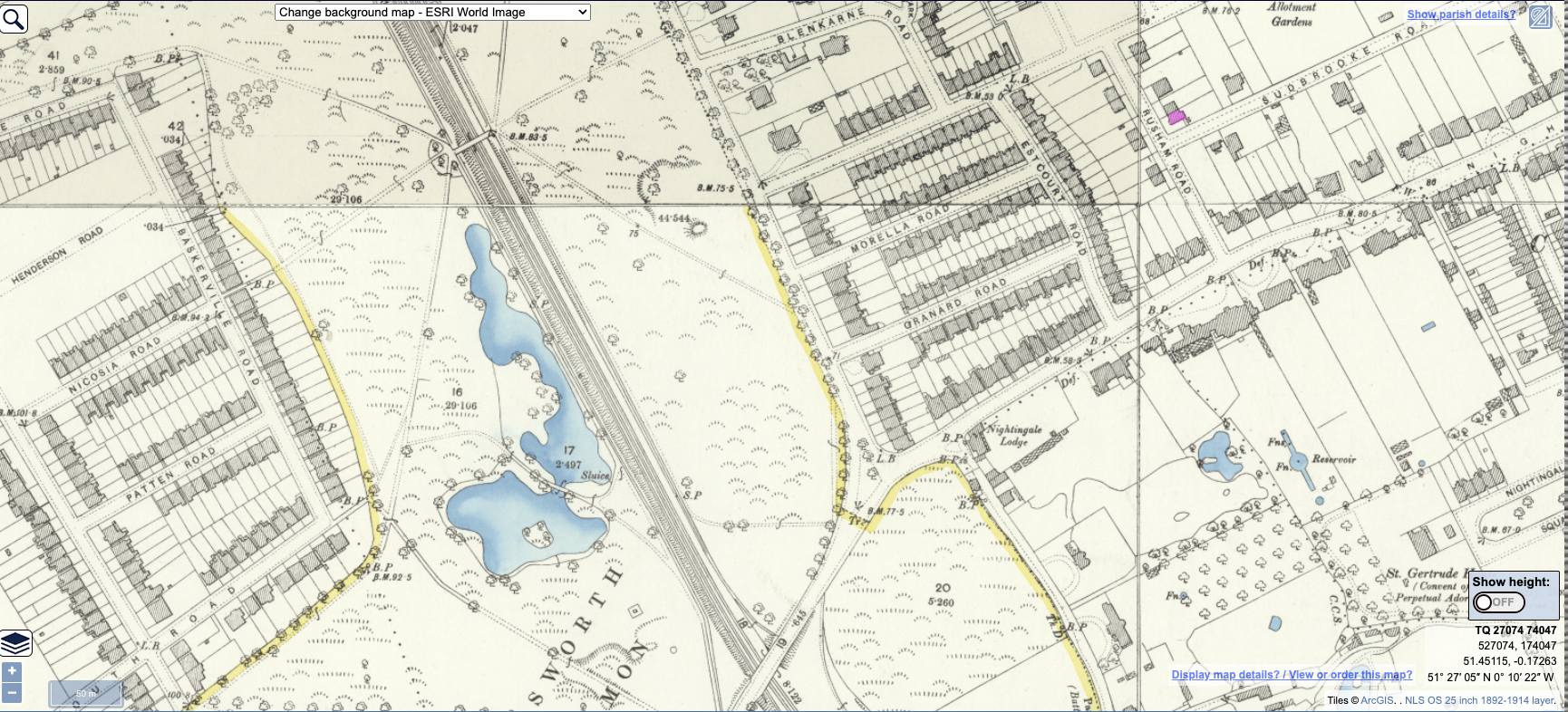
(Click on image to enlarge)
This is a very good online source of maps for at least the earlier sections of his journey here:
https://maps.nls.uk/geo/explore/#zoom=14.9&lat=51.44881&lon=-0.16145&layers=168&b=1
I'm always intending to write more about ET and the Common, but here are a couple of short pieces:
https://historyofwandsworthcommon.org/chronicles/03/03-2022.html (a number of mentions)
https://historyofwandsworthcommon.org/chronicles/04/04-2022.html
I also spoke about the start of ET's journey in a zoom talk to the Friends of Wandsworth Common in March last year - "WaterWorld":
https://www.wandsworthcommon.org/videos
I hope this helps. If you have any other questions, just ask.
All best for your journey
Philip
PS I'm really interested in your cycling project - I've often thought of doing it myself. Could you keep in touch and say how you get on?