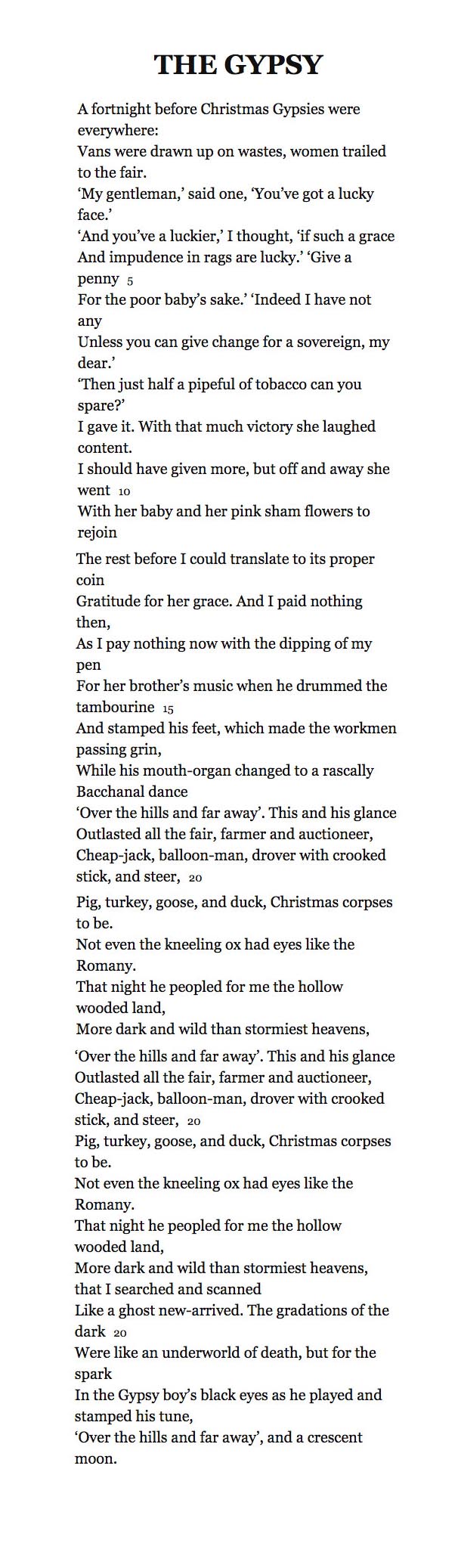
PB: I have a strong feeling that this is based on ET's experiences on Wandsworth Common. I recall reading about the Gypsy Christmas Fair on the Common. But where did I read it? And where might it have been? North Side?
By the way, ET's poem about an execution - what was it called? Was it influenced by his knowledge that executions took place in the prison not far away over the Common?
[Source: SEARCH: Edward Thomas "Gypsy".]
Edward Thomas, George Borrow: The Man and His Books, 1912.
http://www.gutenberg.org/ebooks/18588
http://www.gutenberg.org/files/18588/18588-h/18588-h.htm
"Romano Lavo-Lil" contains a note on the English Gypsy language, a word-book, some Gypsy songs and anecdotes with English translations, a list of Gypsy names of English counties and towns, and accounts of several visits to Gypsy camps in London and the country. It was hastily put together, and the word-book, for example, did not include all the Romany used in "Lavengro" and "The Romany Rye." There were now critics capable of discovering other shortcomings.
Borrow's book was reviewed along with Leland's "English Gypsies" and Dr. Miklosich's "Dialects and Migrations of the Gypsies in Europe," and he was attacked for his derivations, his ignorance of philology and of other writers on his subject, his sketchy knowledge of languages, his interference with the purity of the idiom in his Romany p. 310 specimens. His Gypsy songs were found interesting, his translations, of course, bad. The final opinion of the book as a book on the Gypsy language was: {310}
"Whether or not Mr. Borrow has in the course of his long experience become the deep Gypsy which he has always been supposed to be, we cannot say; but it is certain that his present book contains little more than he gave to the public forty years ago, and does not by any means represent the present state of knowledge on the subject. But at the present day, when comparative philology has made such strides, and when want of accurate scholarship is as little tolerated in strange and remote languages as in classical literature, the 'Romano Lavo-Lil' is, to speak mildly, an anachronism."
Nor, apart from the word-book and Gypsy specimens, is the book a good example of Borrow's writing. The accounts of visits to Gypsies at Kirk Yetholm, Wandsworth, Pottery Lane (Notting Hill), and Friar's Mount (Shore-ditch), are interesting as much for what they tell us of Borrow's recreations in London as for anything else.
The portrait of the "dark, mysterious, beautiful, terrible" Mrs. Cooper, the story of Clara Bosvil, the life of Ryley Bosvil - "a thorough Gypsy, versed in all the arts of the old race, had two wives, never went to church, and considered that when a man died he was cast into the earth, and there was an end of him" - and his death and burial ceremony, and some of Borrow's own opinions, for example, in favour of Pontius Pilate and George IV. - these are simple and vigorous in the old style. They show that with a sufficient impulse he could have written another book at least equal to "Wild Wales." But these uneven fragments were not worthy of the living man.
[2]
He went in search of [gypsies] in Wandsworth and Battersea and where-ever they were to be found, from Notting Hill to Epsom Downs, though they were corrupted by loss of liberty and, in his opinion, were destined soon to disappear, "merged in the dregs of the English population."
[3] Only one mention each of "Battersea" and "Cooper" (above).

The Gypsy by Edward Thomas
—
Summary of The Gypsy
'The Gypsy' by Edward Thomas describes an encounter the speaker had with a band of gypsies and how they transported him with their music.
The poem begins with the speaker talking to one gypsy woman. He ends up giving her some tobacco, but wishes he had given her more, especially after hearing her brother play. The majority of the poem is focused on the sights and sounds around the woman's brother. He stamps his feet and sings and plays the "mouth-organ." The speaker describes the festivities in the camp as a "Bacchanal."
In the last lines the speaker wishes that he could've thanked the family sufficiently for the the way he was transported out of his life and into an emotional, dark and intense mental landscape. This experience has given him something to write about, and he can't pay them back for that.
Analysis of The Gypsy
Lines 1-7
A fortnight before Christmas Gypsies were everywhere:
Vans were drawn up on wastes, women trailed to the fair.
'My gentleman,' said one, 'you've got a lucky face.'
'And you've a luckier,' I thought, 'if such grace
And impudence in rags are lucky.' 'Give a penny
For the poor baby's sake.' 'Indeed I have not any
Unless you can give change for a sovereign, my dear.'
In the first lines of 'The Gypsy' the speaker begins by stating a simple fact, that two weeks before Christmas there were Gypsies everywhere. The next lines take the reader through lines of conversation that the speaker has with a woman, and the sights he takes in while watching the group.
When he passed by, one woman addressed him as "gentleman." She told him that he had a "lucky face." The speaker returned the comment but added onto the end that he isn't sure that the luck is real considering that it exists within "rags." This tells the reader something about both the speaker and the gypsy addressing him.
The woman, undeterred asks if he could give a penny for "the poor baby's sake." These lines show that the men and women traveling in this caravan are quite poor. They need to beg to make ends meet. The man declines to make a donation to the woman and her child. He says he only has a "sovereign" and would need change, something he can't provide.
Lines 8-14
'Then just half a pipeful of tobacco can you spare?'
I gave it. With that much victory she laughed content.
I should have given more, but off and away she went
With her baby and her pink sham flowers to rejoin
The rest before I could translate to its proper coin
Gratitude for her grace. And I paid nothing then,
As I pay nothing now with the dipping of my pen
The next question is about tobacco. The woman hopes that he might have "half a pipeful." When he gave it over, she laughed. This was a simple victory for her, and develops the character of the man further. He is clearly not without sympathy.
He thinks to himself that he would've liked to have given the woman more but she went off with her baby after this brief exchange. The woman is described as wearing "pink sham," or fake, flowers.
The speaker took something from this encounter, an experience he found to be valuable. He was unable to pay her properly for what he learned from her and from her "grace." This is seen through the metaphor of translating to "coin." He did not pay her anything then, and moving to the present as he writes this poem, he pays nothing "now."
Read more: Biography of Edward Thomas
Lines 15-21
For her brother's music when he drummed the tambourine
And stamped his feet, which made the workmen passing grin,
While his mouth-organ changed to a rascally Bacchanal dance
'Over the hills and far away.' This and his glance
Outlasted all the fair, farmer, and auctioneer,
Cheap-jack, balloon-man, drover with crooked stick, and steer,
Pig, turkey, goose, and duck, Christmas corpses to be.
The lines which follow speak to the music that the gypsies played in the camp. From afar he saw the woman's brother and heard him drum his "tambourine." He stamped his feet and caught the attention of passing "workmen." There is an interesting contrast within these lines between the speaker, or those passing by the scene, and the gypsy group. Everyone on the outside takes pleasure from seeing these men and woman who are "rascally."
In line three the speaker describes the man has playing his "mouth-organ." This is a reference to a whole family of instruments, of which a harmonica is one. The dance the brother is playing is described as "Bacchanal." This is a term that fits perfectly into the scene, but also stands out. It could only have come from someone on the outside looking in. It refers to the god Bacchus who is well-known for his wild and drunken state. The word speaks to revelry and celebration. Line four contains a phrase from the song.
Within lines 19-21 a reader gets a clear image of how much the speaker got from the encounter with the gypsy family. When he looked at the brother he saw so much more than one man. There was something about him, embodied through the dance, song and most importantly his eyes, that caught the speaker's attention. When he tries to think of someone similar, he is unable. The man "Outlasted all the fair," or beautiful. He also surpassed every other kind of person one might think of. Including the "balloon-man" and "Cheap-jack."
The speaker's comparison moves beyond people, and into the Christmas season. There is something more vibrant and real about the man than any of the "Christmas corpses" which are soon to be present throughout the city.
Lines 22-28
Not even the kneeling ox had eyes like the Romany.
That night he peopled for me the hollow wooded land,
More dark and wild than the stormiest heavens, that I searched and scanned
Like a ghost new-arrived. The gradations of the dark
Were like an underworld of death, but for the spark
In the Gypsy boy's black eyes as he played and stamped his tune,
'Over the hills and far away,' and a crescent moon.
In the final seven lines the speaker moves onto another animal, the "kneeling ox." It has interesting eyes, but not like "the Romany." Romany refers to an ethnic group, usually of South Asian origin. The word "Gypsy" is generally to speaker about this segment of the population.
The speaker finally clears up what exactly it was that so moved him about this encounter. It was not the brother himself, but the way he was able to transport the speaker out of his mundane world and into one that was "More dark and wild than the stormiest heavens." For a time, he could visit, like "a ghost new-arrived" a dark, and perhaps perilous place. The "spark" in the gypsy's eyes was one of only two lights in the darkness. It, along with the "crescent moon," guided the speaker and kept him anchored as he was emotionally transported.
Now, the speaker is able to write on this experience and what it meant to him to feel the "hollow wooded land" become "peopled." The only regret he has is that he couldn't pay the group sufficiently for this experience. It isn't exactly money he wishes for, but something of equivalent value.
[Source: Link.]