Last modified: 11 October 2026 · Build 4
The escape from occupied Ikaria, and the journey through Turkey to the Middle East
Antigoni Romiliou, my mother's cousin, told this story to the journalist Nasos Bratsos for a series on Greek war refugees published by ertnews.gr, the news site of the Greek state broadcaster ERT, on 3 September 2016. What follows is an English translation of the interview, with her own short biography, which ERT printed at the end.
The original Greek article had photographs of the submarine Katsonis and of Avlakas, the remote cove from which the refugees left (photograph by N. Bratsos, with a 1957 map of Ikaria by Michalis Mazaris). They are not reproduced here.
They were the generation that knew war, occupation and exile, but who also gave everything for victory over the forces of fascism and Nazism. Antigoni Romiliou describes to ert.gr her journey as a refugee in 1942, to the Turkish coast and then on to the Middle East.
How did your departure come about?
I left Ikaria in 1942, between autumn and spring.
After the capitulation to the Germans, the ships of the Greek navy gathered in the area of Pachi, near Megara. There the call went up, "We do not abandon the Niki" (a navy ship), and then, more generally, "We do not abandon the ships." The decision was to leave and carry on the war, and so a number of ships sailed for the Middle East rather than fall into the hands of the Germans. The Germans bombed the ones they could catch, and it was there that Douris, a man from Ikaria, was killed.
In 1941, at the time of the great famine, a submarine reached the island and put ashore at the village of Kyparissi. If I remember rightly, it was Stefanos Kavouriaris who brought us the message: anyone who could carry even a gra (an old army rifle) should cross to Turkey, and from there go to the Middle East to fight alongside the Allies. Then he left on the submarine, without taking anyone else with them that time. The message spread very quickly, and in the period that followed volunteers escaped by submarine.
And how did you respond?
I was young, but I found I could hold a gra. At first I went along, in nothing but my little dress, with an aunt of mine who was trying to escape, and we had to hide for a day under a tree. After that first attempt my father decided that we would leave too, and that the family would split up.
We set out from our village, Arethousa, one sorrowful afternoon: me, my father, and my little brother Theofilos, who was five or six. There was a deafening silence. All you could hear was running water and the croaking of frogs. On the way we also came across an atsida (the local marten). There were no voices of children, who no longer played or talked, worn out by hunger.
On the road we saw an unshaven man (in those days everyone went out shaved, even to do a job in the yard), walking as if he were hopping, staggering, with his eyes wide. My father said "Good day" to him. It was hunger that had brought him to that state. At that time the rule was that anyone who felt they were about to die should go as near to the cemetery as they could, because the others were too exhausted to carry them. Karavostamo in particular was a village that suffered terribly from the famine, and many people died there.
At another spot we saw a man of about 45, swollen from hunger and dressed in a suit, probably his brown wedding suit, sitting beside a cistern with his eyes open. I felt a shiver down my spine. My father greeted him, but he did not answer. He was dead. He must have sensed that it was coming, and so had dressed in his best clothes.
At another place we saw, at a house, a woman in black and a little child whose legs were swollen from hunger. My father gave them a little sugar, a little flour and a few figs from the provisions we were carrying for ourselves. He lit their fire and took a briki (a small pot) to make something to feed them. We watched from a distance. I should say that the woman and the child crossed over on a later escape, and the child was saved.
Where did all this happen?
All of this was in the part of Ikaria called the Chorioudia (Monokambi, Plomari, Miliopo, then Karavostamo).
We were making for a place called Avlakas, going down terrace by terrace, taking great care in case we met an Italian patrol. We had been told there was one near the big bend by the Aris river, so we kept off the public road.
There were two boatmen who organised the escapes for a fee, paid either in occupation money or in kind.
We were to leave in Fantaoutsos's boat [Petros Fantaoutsos of Plomari, according to Ioannis Tsantes's Chronicle of the Occupation of Ikaria]. I believe he didn't do it only for the money; he was looking for the risk as well. The boat was made of kissos [ivy wood?], very light, and it looked as if it would not survive rough seas. The other boatman was a "Grizos" from Karavostamo. Fantaoutsos (I don't know whether that was his name or a nickname) had been beaten by the Turks for the part he played in carrying Greeks across, and I should say that very often he took no fee at all.
Tell us about the last moments before you left.
We went down through a ravine and hid. The moon came out, and we heard love songs from a boatload of Italians on patrol; one of them had a guitar. I thought then, "Why do people make war?"
My father put his arms round us so that we would look like a rock, and then spread a blanket for us. We waited for the Italians to move off two coves further along.
Then others came, and we got into the boat. There was a wind blowing, and we set off with oars. I remember a woman with a baby; she was its grandmother, because its mother was dead. The son of Kouvaris the schoolmaster came with us too. We couldn't raise the sail, because in that weather the boat would have capsized. The grown-ups sat all round the sides of the boat and we children sat at their feet. We watched the mountains of Ikaria draw away, and here and there the fires the Italians had lit to make their morning drink.
What happened on the voyage?
A storm blew up, and it was as if the sea was cursing us; it had turned purple. We bailed out the water with a tin. We were soaked, but we didn't care about that.
Suddenly someone said, "Germans, and it isn't baptised," meaning a baby in the boat. He lifted the baby into the air three times and said, three times, "And his name is Eleftherios" [Freedom].
It was indeed a German torpedo boat. The crew wore black: oilskins, goggles, boots, and there was a screen at the front of the boat like the ones Vespas used to have. They thought we were drowning, and they left us, laughing that we were going to die. You see, the boat was almost level with the surface of the sea; it was as if we were sitting on the waves.
My father held my brother and me down low with his hands so that the Germans wouldn't see us. I thought I was imagining things, hearing barking, but in fact it was the Germans' laughter, which sounded like dogs howling.
How did you reach Turkey?
After a day at sea we reached Turkey, at a place they called Vromolimniona. There, from a Turkish caique, we heard "Gel burda!" [Come here!] from a man called Sainis, a Turkish Cretan of about thirty. He spoke Greek, and he was a fine man who helped us and other refugees a great deal. He is no longer alive, but he has surely gone where his good deeds deserve. For the help he gave refugees he had been flogged by the Turkish authorities. He gave us a tray of black-eyed beans and some bread.
He led us to a cave, to keep us safe from snakes and wild boar. We had to leave very early in the morning, at a run, because the herds of wild boar came to drink at a little pond nearby, and so did the snakes, and we would have been in danger. So we drank some water and left running.
What happened next?
On the way we saw a pear tree hung with little notes left by refugees, saying things like "The Kavouriaris family passed this way; we are going into the unknown", with other names and dates. We left ours too. We put marks along the road to find our way.
We met a Turk of about 25 on horseback, with crossed bandoliers, who spoke Greek. He gave us water, and a woman gave us onions.
At another point a pack of five or six dogs went for us. One of them was panting in my face, and I remember how badly it smelled. They belonged to a Turk who knew Greek, and when he saw us he said, "What have you come here for, bre, to eat our bread? The Germans are treating you as you deserve."
He had three wives, who worked with him in the fields and with the animals. My father, who spoke Turkish, tried to get on his good side by saying nice things about the youngest, thinking she was his daughter, which only made him angrier. My father was about sixty, the Turk older than him, and his youngest wife was a girl of eighteen, a lively creature in fine shalvar trousers, who brought him sherbets while the other two worked with the sheep and the oxen. We left there without even being given water.
Further on, after we had also met a man, not a Turk, who seemed not to be in his right mind, a lorry carrying oil drums picked us up, and we sat on top of them, so that we smelled even worse. We held on tight, because from the way he drove we realised he meant to give us a hard time. Only the woman with the baby sat in front.
Were you heading for Çeşme?
That is how we reached Çeşme, and the registration station for refugees. After we had been registered, we had to find somewhere to stay by ourselves until our turn came to leave. Çeşme had many ruined houses that had belonged to Greeks who left in 1922 and after. We stayed in an old abandoned warehouse, two hundred of us, each with just the space of our own body. Those beside the wall were lucky, because the ones in the middle were often trodden on by people coming in and out.
On the beach at Çeşme, Greek embassy officials had set up a little table to recruit volunteers for the Middle East. No foreign military personnel were allowed in Turkey, as had been agreed with Germany.
Were you sent on to the Middle East?
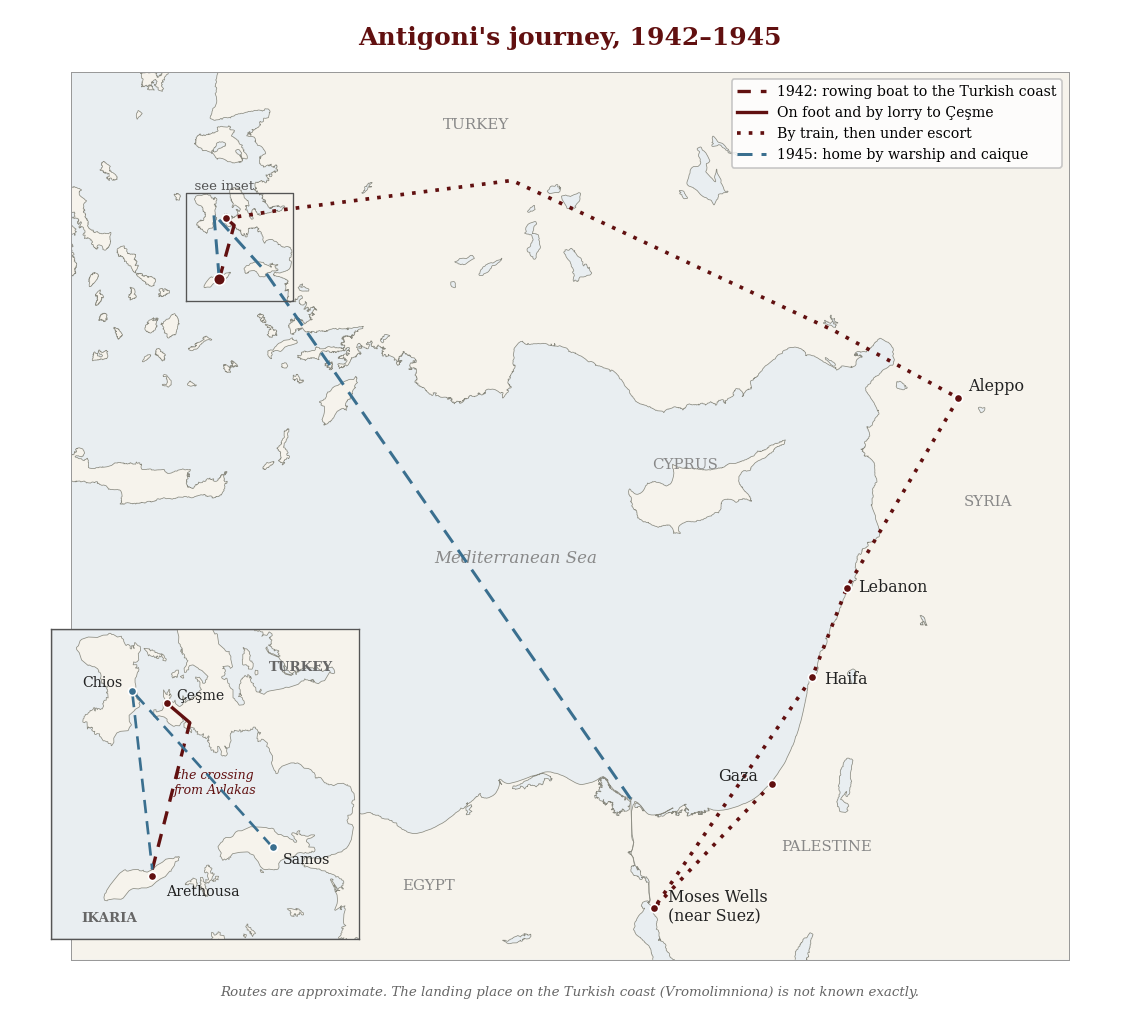
In the end we went from Turkey by train to Aleppo in Syria. There, after a month, we washed, and we were seen by a doctor.
We stayed inside a Crusader fortress, where there were French and Indian troops. We had no contact with the local people; we were shut in, and we stayed there a month and a half. After that we went to Haifa (again with no contact with the local people) and to Lebanon.
They took us to the area of the Caves of Moses [almost certainly Moses Wells, ’Ayun Musa, the refugee camp near Suez, which from July 1942 held mainly Greek refugees and trained refugee women as nurses], where we were kept under guard, with barbed wire all round. We women were put through a nursing school run by Kallergi, a Greek-American. When they had given us the blue overalls of trainee nurses, shoes and a knitted cardigan, they sent us by train to Gaza, with travel orders and an escort of Egyptian soldiers. We kept changing trains until we reached our destination, and one night we slept on a station platform.
What do you remember of that journey?
On the train there was a wagon of German prisoners, lying exhausted in the same space as their own filth. Some had urine stains on their trousers and little pools of it around them. The wagon was full of flies. One of them, with some reluctance, accepted a cigarette that some Greeks threw to him (once again the Greeks showed their humanity), and even then it struck me that his hard stare did not soften.
In the end we served in a base hospital of the 1st Mountain Brigade of the Royal Hellenic Army of the Middle East. That's how things were then: every king had his own army. Our clothes and equipment came from the English. I remember they even gave us "Don Juan" brilliantine.
When did you come home?
In 1945 we left on an English warship for Samos, where we spent the night. The next day they took us to Chios, and from there we went by caique to Ikaria.
Interview: Nasos Bratsos
I was born on Ikaria. The year I finished primary school, the Second World War broke out. Then came the Occupation of our country, and flight was the only way out. My family's flight was a long journey: Turkey, Syria, Palestine, Egypt. In Egypt I was enlisted, with my father, in the Greek Armed Forces of the Middle East, where I served until the autumn of 1945.
When I came back to Greece I finished the Commercial Secondary School in Athens. My higher education was left unfinished for the sake of my family. I married and had three children. As soon as they were on their feet I was appointed to a post in the public service, from which I retired.
Now free of obligations, I write, and divide my time like Persephone: six months on Ikaria and six in Athens. Taram Boura is my first book to be published, and Sofia the second. There are others waiting their turn.
Source. Nasos Bratsos, "Α. Ρωμυλίου: Πώς έγινα πρόσφυγας πολέμου το 1942 – το ταξίδι στη Μ.Ανατολή" ("A. Romiliou: How I became a war refugee in 1942: the journey to the Middle East"), ertnews.gr, 3 September 2016. ERT notes that a recording of part of the interview was also published with the article.
Translation. The English is based on a translation supplied to me, checked against the Greek, and a few slips corrected: Kyparissi and Kavouriaris for misspelt names, "oxen" for "water buffaloes", and "sat at their feet" for "sat on their feet". Words in square brackets are mine. The map was drawn for this page.
The text
Nasos Bratsos, interview with Antigoni Romiliou, ertnews.gr (ERT), 3 September 2016, part of a series on Greek war refugees. English translation as described above.
The map
“Antigoni's journey, 1942–1945”, drawn for this page in October 2026 from her account. Coastlines from the GSHHG global shoreline database (P. Wessel and W. H. F. Smith), via the Python mapping library Basemap. The routes are approximate.
Background to the note on Moses Wells
Middle East Relief and Refugee Administration (Wikipedia): the camps at Aleppo, Moses Wells and Nuseirat (Gaza).
“The Greek refugees who fled to the Middle East in WW2” (ekalexandria.org, after the BBC).
“When European refugees fled to Egypt, 1944” (Rare Historical Photos, from the Library of Congress): nursing training at Moses Wells.
“What it's like inside a refugee camp for Europeans who fled to Syria, Egypt and Palestine” (The World, PRI, 2016).
Pictures and film elsewhere
Not reproduced here, but worth seeing:
— Photograph of Avlakas cove by Nasos Bratsos, and a 1957 map of Ikaria by Michalis Mazaris, both published with the original ERT article.
— “Visit of King of Greece to Greek Refugee Camp”: Imperial War Museum film of Moses Wells, 30 April 1943, showing the tents, the hospital and the children.
— Greek refugees from Moses Wells coming back to Samos after three years in the desert: photograph, United Nations Archives.
— “A Greek Refugee Family from Samos at Moses Wells Encampment, Arabia, with Red Cross Workers”: wartime painting, on Art UK.
More sources, with a glossary of Greek words: The Ikarian Refugees, 1941–1946: Sources.
Back to Our family · Back to the top