There seems to be a Biblical precedent. At the start of the Book of Ruth, Ruth pledges her loyalty to Naomi: “Where thou diest, will I die, and there will I be buried: the Lord do so to me, and more also, if ought but death part thee and me” (Ruth 1:16–17). But in this example, Naomi is Ruth's mother-in-law, and both women have recently lost their husbands — they're not “beloved friends” in any ordinary sense.
There are also some now well-known figures, such as the “Ladies of Llangollen”, two upper-class Irish women, Lady Eleanor Butler (1739–1829) and Miss Sarah Ponsonby (1755–1831), who eloped to live together in a romantic partnership in Wales.
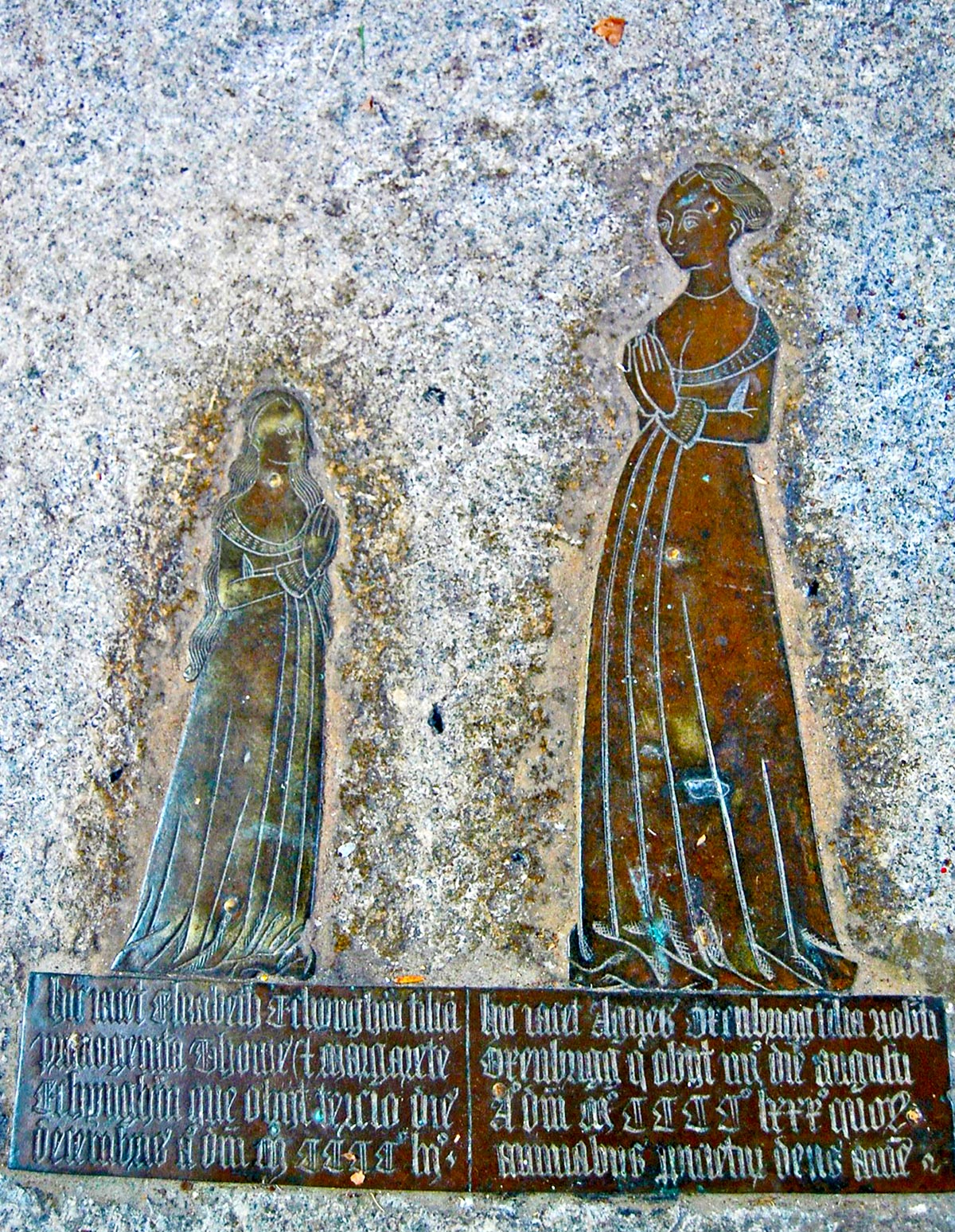
And a remarkable medieval example is shown in this intriguing memorial brass, in the floor of a side aisle in Etchingham Church, East Sussex, c.1480. Two women stand side by side looking into each other's eyes (rather than, as was common in married-couple memorial portraits, looking forward towards the viewer). It is mounted on a grey stone wall. The woman on the left is smaller, with her hair down. The woman on the right is taller, with her hair up. Both wear long gowns that brush the ground.
Elizabeth Etchingham and Agnes Oxenbrigg, a memorial brass, c.1480, Etchingham Church, East Sussex. Image source: Wikimedia Commons.Hic jacet Elizabetha Echyngham filia primogenita Thome et Margarete Echyngham que obiit tercio die Decembris Anno Domini M°CCCC°LII° — “Here lies Elizabeth Etchingham, first-born daughter of Thomas and Margaret Etchingham, who died the third day of December, in the year of our Lord 1452.”
Hic jacet Agnes Oxenbrigg filia Rob'ti Oxenbrigg q' obiit iiij° die augusti A° D'n'i M°. cccc°. Lxxx°. quor' animabus p'picietur deus, Amen. — “Here lies Agnes Oxenbridge, daughter of Robert Oxenbridge, who died the fourth day of August, in the year of our Lord 1480, may God be merciful to their souls, amen.” (Transcription and translation: The Archaeological Journal.)
Judith M. Bennett, in “Remembering Elizabeth Etchingham and Agnes Oxenbridge,” in The Lesbian Premodern (2011), and in her fuller 2008 JBAA article, notes that the arrangement of the memorial brass resembles those made for married couples, and speculates that it may represent a medieval example of a lesbian relationship — a reading she builds using Alan Bray’s framework for interpreting same-sex companionate tombs, from The Friend (2003).
[A claim in wide circulation online — including on this brass’s Wikipedia page, which is likely where it entered this note — has Bray himself discussing this specific brass, in his earlier book Homosexuality in Renaissance England (1982). That looks to be an error: Bray’s relevant work is The Friend (2003), and Alpennia’s summary of Bennett’s 2008 article is explicit that Bray did not write about this brass — Bennett applied his framework to it, not the reverse. The 1982 book also predates, by 26 years, the very article that first drew scholarly attention to this brass at all, which would make Bray's having separately singled it out a considerable coincidence. ]
In a review of Bennett's work, Baylee Woodley writes about this brass on her blog, under the heading “Significance to Queer Art History”: “Etchingham Parish and The Brass of Agnes Oxenbridge and Elizabeth Etchingham is where this art historian dreams of making a lesbian pilgrimage” (6 May 2021). Her fuller review is quoted below, in Resources & References.
Bennett's study builds directly upon the foundational work of pioneering queer historian Alan Bray, on what are colloquially termed “gay tombs” — pre-modern joint burials of same-sex companions.
Alan Bray’s Thesis on Same-Sex Tombs
In his influential, posthumous book The Friend (2003) and related essays, Alan Bray transformed the understanding of pre-modern relationships. He argued that traditional Christian society recognized, formalized, and accommodated deep, lifelong same-sex commitments, or “sworn brotherhoods.”1
In support, Bray pointed to joint same-sex tombs found in churches across Europe. Key components of his thesis include:
Shared monuments — companions were buried together under a single monument, often with their coats of arms impaled or joined in the exact manner used for a heterosexual married couple.
Expressions of love — the inscriptions on these tombs explicitly celebrated the profound bond, loyalty, and love between the two individuals.
Famous examples — Bray highlighted the 1391 tomb of English knights Sir William Neville and Sir John Clanvowe in Galata (Istanbul), as well as the modern shared grave of Cardinal John Henry Newman and Ambrose St John.2
[Curiously, John Henry Newman is a descendant of the Fourdrinier family, also associated with Mount Nod (and with the Grolleau-Vanderhoven tomb). The relationship is: the Huguenot engraver Paul Fourdrinier (Mount Nod) → son Henry Fourdrinier → daughter Jemima Fourdrinier → son Cardinal John Henry Newman. That makes Newman a great-grandson of the man in the Mount Nod tomb.]
Extension to Female “Tombs”: Bennett’s 2008 Article
While Bray focused primarily on male companions, Judith Bennett’s article in the Journal of the British Archaeological Association uses his framework to examine a rare female counterpart: the memorial brass of Elizabeth Etchingham and Agnes Oxenbridge (c. 1480) in the Church of the Assumption and St Nicholas, Etchingham, East Sussex.3
Bennett addresses how this joint monument challenges modern assumptions:
Social acceptance — rather than being hidden or condemned as “sodomy,” these intense same-sex partnerships were given prominent, socially validated space within community parish churches.4
Female visibility — Bennett expands Bray’s work by demonstrating that women, too, participated in these recognized companionate partnerships and shared funerary monuments.4
3 Judith M. Bennett, “Two Women and their Monumental Brass, c. 1480,” Journal of the British Archaeological Association, 161 (2008), 163–184; academia.edu/5205201. ↑
Judith M. Bennett, “Two Women and their Monumental Brass, c. 1480,” Journal of the British Archaeological Association, vol. 161 (2008), 163–184. The fullest and most important text on this subject.
[JMB has also written a similar-sounding piece — not yet established whether it's the same text repurposed, or a genuinely separate one.]
Judith M. Bennett, “Remembering Elizabeth Etchingham and Agnes Oxenbridge,” in The Lesbian Premodern, edited by Noreen Giffney, Michelle M. Sauer, and Diane Watt (New York: Palgrave Macmillan, 2011). Also available via Medievalists.net: “Remembering Elizabeth Etchingham and Agnes Oxenbridge”, University of Southern California, 2011.
A brief overview of this study reports:
The brass functions as a rare historical record of two seemingly unmarried women who chose to be commemorated together rather than alongside a husband or family lineage. Inscriptions typically recorded a woman's marriage or male descent; however, no husbands are noted here, and the women are depicted with conventional 15th-century signs of unmarried status (such as flowing, uncovered hair).
Because subsequent family genealogies completely omitted them, this monumental brass provides the sole surviving evidence of their relationship and shared lives. Bennett utilizes the monument to explore medieval female relationships, companionate living, and how childless or unmarried women negotiated social remembrance outside of traditional patriarchal family structures.
Baylee Woodley, Queer Art History: Brass of Agnes Oxenbridge and Elizabeth Etchingham, 6 May 2021. Her fuller review, under the heading “Significance to Queer Art History” (page-number citations below are hers, to Bennett's 2008 article):
Etchingham Parish and The Brass of Agnes Oxenbridge and Elizabeth Etchingham is where this art historian dreams of making a lesbian pilgrimage. This brass is a memorial commemorating two women who were buried together with an inscription requesting God’s mercy for them both. Elizabeth appears on the left with her hair down, and she is smaller than Agnes. This is likely representative of her being both unwed and young when she died in 1452, in her mid-twenties. Agnes is shown on the right and, although she too seems to have remained unwed, she is shown as a more mature woman, likely because she was in her fifties when she died in 1480.
Bennett finds evidence for both women remaining unwed in the lack of head coverings, lack of records (both marriage records and records of their lives, as was often the case with single women), and lack of any mention of husbands on the memorial (Bennett, 133). She also describes how this brass was designed in the style of contemporary memorial brasses for married couples, but with additional intimacy. Unlike the contemporaneous brasses, which often show couples looking straight ahead, Agnes and Elizabeth face each other and look into each other's eyes (Bennett, 134).
There also seems to have been no qualms about the relationship between these two women. It was unusual that Agnes be buried with Elizabeth instead of in the Oxenbridge mausoleum, but both families must have agreed for it to have happened, and in turn chosen to commission such an intimate memorial (Bennett, 133). The initial request for the site of burial, as Bennett suggests, most likely came from the lost will of Agnes herself.
This brass is also interesting for the notable attempts to fit it into cis-heteronormative expectations of history. Bennett writes: “some have described the brass as a memorial to two children [despite them both living into adulthood]; others have imagined they were looking at two entirely separate brasses [despite the inscription referring to them both and their being connected]; and still others have fiddled with genealogies to minimize any direct relationship between the two women” (Bennett, 131). She attributes these manipulations to homophobic anxieties, which result in “bad history,” and argues for the place of Elizabeth and Agnes in the “histories that modern… queers rightly seek from the past” (Bennett, 136 and 141).