Literary Quiz
DRAFT
Literary Wandsworth Common . . . I often wonder why "Wandsworth Common" features so often in literary texts. As a setting or significant reference in novels, poems and plays, I suspect that it pulls way above its weight — particularly where skulduggery is involved.
Off the top of my head, there's William Thackeray's Vanity Fair (c.1850); Charles Kingsley, Alton Locke (1857); Mrs Braddon, Henry Dunbar (1864); James Grant, Second to None: A Military Romance (1864); Henry Mayhew []; Tom Taylor [?], William Ulick O'Connor Cuffe, Earl of Desart, Mervyn O'Connor (1880); Oscar Wilde, The Canterville Ghost (1887); Arthur Lillie, The Cobra Diamond (1890); Arthur Conan Doyle,
And then there's Thomas Hardy, Edward Thomas,....
Big Bad Mouse", https://www.historyofwandsworthcommon.org/chronicles/10/10-2024.html
[By the way, if you come across a novel called The Witches of Wandsworth Common, you might be tempted to read it. Don't. It's absolute tosh, and has nothing whatsoever to do with Wandsworth Common - the only connection ... two words "Wandsworth" and "Common".]
So your challenge is:
a) put faces to names . . .
b) put names to quotations
c) and dates to works. (Give yourself 1 point for coming within 10 years of the publication date, 2 for coming within 5 years, but a whole 3 points for getting it spot on.
"Wandsworth Common" features in a remarkable number of literary works. Here are quotations from some of them. Can you identify the source?
I'm going to make it easier for you because I will give you all the answers. But not necessarily in the right order.
Give yourself a extra mark for estimating the date correctly — 2 points for te right year, 1 point for within 10 years.
Most also reveal something significant about how the Common has been viewed at different times.
(Some extracts slightly abbreviated.)
Add images of book jackets or relevant images?
[1]
I had literally never been farther afield than Fulham or Battersea Rise. One Sunday evening, indeed, I had got as far as Wandsworth Common; but it was March, and, to my extreme disappointment, the heath was not in flower.
[2]
"Mrs. Kirk put one or two leading questions to Amelia, to see whether she was awakened, whether she was a professing Christian and so forth, and finding from the simplicity of her replies that she was yet in utter darkness, put into her hands three little penny books with pictures, viz., the "Howling Wilderness," the "Washerwoman of Wandsworth Common," and the "British Soldier's Best Bayonet," which, bent upon awakening her before she slept, Mrs. Kirk begged Amelia to read that night ere she went to bed.
Shorter version: "the 'Washerwoman of Wandsworth Common',"
[3]
"I've said before, and I say again, and I shall keep on saying, that you two girls ought not to live alone by yourselves in a house in this out-of-the-way corner of the world."
"Out-of-the-way corner of the world! On Wandsworth Common!"
"For all practical intents and purposes you might as well be in the middle of the Desert of Sahara; you might shriek and shriek and I doubt if any one would hear you . . . "
[4]
I went out for a walk one evening, at the end of the second week in July, for a solitary ramble amongst the quiet Surrey suburbs, in any lonely lanes or scraps of common-land where the speculating builder had not yet set his hateful foot.
It was a lovely evening; and I, who am so much a Cockney as to believe that a London sunset is one of the grandest spectacles in the universe, set my face towards the yellow light in the west, and walked across Wandsworth Common, where faint wreaths of purple mist were rising from the hollows, and a deserted donkey was breaking the twilight stillness with a plaintive braying.
Wandsworth Common was as lonely this evening as a patch of sand in the centre of Africa; and being something of a day-dreamer, I liked the place because of its stillness and solitude.
[5]
"Poor Jack was afterwards shot in a duel by Lord _______ on Wandsworth Common, and Lady Barbara died of a broken heart at Tunbridge Wells before the year was out, so, in every way, it had been a great success."
[6]
"Are you the possessor of a handsome shirt-stud — a large __________? "
" Well, yes" said Monty. Was the __________ actually coming back to him?
"Well, this diamond has been discovered in the possession of a tramp — a tinker — under most suspicious circumstances. He is now being examined at Scotland Yard. He says that in the middle of a thunderstorm yesterday night he saw you on Wandsworth Common. You looked round and round to see if any one was looking, and then you threw it into a horse-pond."
"Well, well, inspector, that is the truth — I mean so far as it was presented to the mind of the tramp. The fact is that I wanted to be rid of a letter from a young lady, and I threw away the shirt-stud instead."
"It is wonderful that he recovered it."
"Yes; how did he do that?"
"He waited until dawn, and then saw the __________ glittering on the bank. You had thrown it too far."
Monty was aghast. The __________ returned to him! A tiny stone was pitched into a muddy horse-pond on a dark night, and here it was again.
When we make a pact with Mephistopheles, he keeps us to our bargain.
[7]
Unwittingly, she had jumped into the jeep with him, what had occurred after, she would never forget.
Larry hadn't even asked her where she had lived, once in the jeep, he drove out to Wandsworth Common, then drove off the road, and bumped towards a small group of Nissan huts.
"Hey, where's this, this ain't my home Larry?"
Sure as Hell look like home to me Honey," he leaped out of the jheep, and ran around to where she sat.
"U.S. Military Detachment. 657 Depot" was all that that was written on a large board outside the hut . . . .
Nine months later Mandy had been born.
[8]
I left the house earlier than usual this morning and, though it isn't exactly dark, it isn't yet light. The common is full of ghosts and shadows; the trees still ironclad, unyielding figures to the early gauze of spring; the bushes and brambles along the railwa line knotted and clumped: a jogger's paradise, though I try not to think about that . . . Once, out running, I saw a pair of men's pants in the undergrowth. How? It's not like Clapham Common. It's Wandsworth. We're all Labradoodles and Rusty Raquets here, not cabinet ministers in compromising positions.
[9]
Patch Cooper was smiling, deepening the wrinkles on his weatherbeaten face. If she hadn't known him so well; if his expression hadn't been so kind, why, she would have been quite terrified of him. As it was, his face didn't seem to matter at all. [ . . . ]
My family used to live in London," continued the gypsy. "Wandsworth Common. Aye, there were tents as far as the sky could reach. That were in my father's father's time . . . things are changed today. I do reckon we Romanies . . . we of the true blood . . . "
Patch Cooper hesitated, looking down at his rough, gnarled hands that held the smooth leather of the reins. "I do reckon we be a dying people."
[10]
Though the distance between Guildford and the metropolis is only about thirty miles, evening closed in before I saw at a distance the vast and dusky dome of St. Paul's, rising in sombre grandeur from amid the yellow haze, formed by the smoke and by the myriad lights of London.
I had left behind me the little village of Wandsworth, which is finely situated on the declivities of two small hills, and was traversing the common, then a wild and open waste covered with grass, gorse, and tall waving weeds through which the roadway passed. Clouds had now obscured the stars, and the night was so dark that I had some difficulty in tracing my path, though the accumulated glare of the innumerable street lamps and other lights of the vast city was very distinct but a few miles off, rendering the foreground darker.
When about the middle of the common, I heard the sharp report of a pistol and then the scream of a woman. These alarming sounds, and the flash of the explosion, came from the very path I had to traverse, so I spurred on my jaded hack, and found a carriage stopped on the common by two armed and mounted highwaymen, with crape masks on their faces. Such gentry were at that period still in the zenith of their perilous fame.
They had fired a shot to make the postillion pull up, and were now stationed one at each window of the carriage, demanding the purses and other valuables of the travellers.
Drawing my sword, I rode boldly up and demanded what was the matter, and who fired the shot I had heard.
"You had better ride on and attend to your own affairs," replied a surly fellow, with a horrible oath, as he coolly reloaded his pistol.
"Surrender your weapon, rascal," I exclaimed, resolutely, "or I shall cut you to the teeth!"
"Fire at him, Bill," cried he to his comrade.
On hearing this, his comrade urged his horse furiously round from the other side of the carriage.
Then I heard another female shriek as he levelled a bright-barrelled blunderbuss, the bell-muzzle of which was so near my face that the light flashed on it as he drew the trigger, for happily it only burned priming; otherwise my head would have been blown to atoms, as on inspection afterwards I found this formidable firearm was loaded with slugs of lead and iron.
"Hung fire, by all that's infernal!" exclaimed the fellow; but his exclamation of wrath ended in a howl of agony, when by a stroke of my sword I hewed off half of his right hand, and the weapon fell on the road, together with three of his fingers. On this they put spurs to their horses and galloped away at a break-neck pace.
With a shout of victory I pursued them for a few hundred yards across the common, and then returned at a canter to the carriage, the occupants of which proved to be two ladies, who, by then manner and difference of years, appeared to be mother and daughter.
The younger was a very beautiful girl with fair hair and a delicate complexion, but this was all I could discern by the light of a carriage lamp, which one of the footmen — a rascal who had hitherto hidden himself among some fern — now held within the window, while the ladies were putting on their rings, gloves, and bracelets which they had drawn off to surrender at the moment I came so luckily to their rescue.
"Mamma, dear mamma, all danger is past. They are gone, and we are safe; be assured, be satisfied," I heard the soft voice of the younger say imploringly to the elder, who was excessively agitated.
"Ladies," said I, touching my cap, "be composed now, I pray you; those fellows have fled, and are not likely to return. Fortunately, I have put a mark upon one that he will not easily efface."
"Sir," replied the elder lady, in a voice still tremulous with alarm, "accept our deepest gratitude. To you we owe our rescue. Our money and jewels would have been a trifling loss, but how know we that these men might not have murdered us here on this lonely heath? and we hear of such dreadful things in these days."
[11]
Muffled in a heavy travelling coat I went out into the wet and dismal night, having no other plan in mind than that of walking on through the rain-swept streets, on and always on, in an attempt, vain enough, to escape from the deadly thoughts that pursued me.
Without having the slightest idea that I had done so, I must have walked along the Strand, crossed Trafalgar Square, proceeded up the Haymarket to Piccadilly Circus, and commenced to trudge along Regent Street; for I found myself staring vaguely at the Oriental rugs displayed in Messrs. Liberty's window, when an incident aroused me from the apathy of sorrow in which I was sunken.
"Tell the cab feller to drive to the north side of Wandsworth Common," said a woman's voice " a voice speaking in broken English, a voice which electrified me, had me alert and watchful in a moment.
I turned, as the speaker, entering a taxi-cab that was drawn up by the pavement, gave these directions to the door-porter, who with open umbrella was in attendance. Just one glimpse I had of her as she stepped into the cab, but it was sufficient. Indeed, the voice had been sufficient; but that sinuous shape and that lithe swaying movement of the hips removed all doubt.
It was Zarmi!
As the cab moved off I ran out Into the middle of the road, where there was a rank, and sprang into the first taxi waiting there.
"Follow the cab ahead!" I cried to the man, my voice quivering with excitement "Look! you can see the number! There can be no mistake. But | don't lose it for your life! It's worth a sovereign to you!"
The man, warming to my mood, cranked his engine rapidly and sprang to the wheel. I was wild with excitement now, and fearful lest the cab ahead should have disappeared; but fortune seemingly was with me for once, and I was not twenty yards behind when Zarmi's cab turned the first corner; ahead. Through the gloomy street, which appeared to be populated solely by streaming umbrellas, we went. I could scarcely keep my seat; every nerve in my body seemed to be dancing " twitching.
Eternally I was peering ahead; and when, leaving the well-lighted West End thoroughfares, we came to the comparatively gloomy streets of the suburbs, a hundred times I thought we had lost the track. But always in the pool of light cast by some friendly lamp, I would see the quarry again speeding on before us.
At a lonely spot bordering the common the vehicle which contained Zarmi stopped. I snatched up the speaking-tube.
"Drive on," I cried, "and pull up somewhere beyond! Not too far!"
The man obeyed, and presently I found myself standing in what was now become a steady downpour, looking back at the headlights of the other cab. I gave the driver his promised reward.
I strode along the muddy, unpaved path, to the spot where the cab, now discharged, was being slowly backed away into the road. The figure of Zarmi, unmistakable by reason of the lithe carriage, was crossing in the direction of a path which seemingly led across the common. I followed at a discreet distance.
Zarmi went on and on along the lonely path. Not another pedestrian was in sight, and the rain walled in the pair of us. Where comfort-loving humanity sought shelter from the inclement weather, we two moved out there in the storm, linked by a common enmity.
I have said that my every faculty was keen, and have spoken of my confidence in my own alertness.
My condition, as a matter of fact, must have been otherwise, for I had failed to take the first elementary precaution necessary in such case. I, who tracked another, had not counted upon being tracked myself! . . .
A bag or sack, reeking of some sickly perfume, was dropped silently, accurately, over my head from behind; it was drawn closely about my throat. One muffled shriek, strangely compound of fear and execration, I uttered. I was stifling, choking . . . I staggered " and fell . . .
[Three chapters and numerous dramatic happenings later . . . ]
"Petrie! Dr. Petrie!"
The words broke in through the curtain of unconsciousness. I strove to arouse myself. I felt cold and wet. I opened my eyes and the world seemed to be swimming dizzily about me. Then a hand grasped my arm, roughly.
"Brace up! Brace up, Petrie " and thank God you are alive! . . . "
I was sitting beside Sir Baldwin Frazer on a wooden bench, under a leafless tree, from the ghostly limbs whereof rain trickled down upon me! In the gray light, which, I thought, must be the light of dawn, I discerned other trees about us and an open expanse, tree-dotted, stretching into the misty grayness.
"Where are we?" I muttered " "where . . . "
"Unless I am greatly mistaken," replied my bedraggled companion, "and I don't think I am, for I attended a consultation in this neighbourhood less than a week ago, we are somewhere on the west side of Wandsworth Common!"
[12]
In silence we again drove for an interminable distance with the windows raised, until at last, just after midnight, the carriage pulled up.
"'You will get down here, Mr. Melas,' said my companion. 'I am sorry to leave you so far from your house, but there is no alternative. Any attempt upon your part to follow the carriage can only end in injury to yourself.'
"He opened the door as he spoke, and I had hardly time to spring out when the coachman lashed the horse and the carriage rattled away. I looked around me in astonishment. I was on some sort of a heathy common mottled over with dark clumps of furze-bushes. Far away stretched a line of houses, with a light here and there in the upper windows. On the other side I saw the red signal-lamps of a railway.
"The carriage which had brought me was already out of sight. I stood gazing round and wondering where on earth I might be, when I saw some one coming towards me in the darkness. As he came up to me I made out that he was a railway porter.
"'Can you tell me what place this is?' I asked.
"'Wandsworth Common,' said he.
"'Can I get a train into town?'
"'If you walk on a mile or so to Clapham Junction,' said he, 'you'll just be in time for the last to Victoria.'
[13]
JULIA (rustling newspaper): I say — Muriel Fenchurch is divorcing her husband.
FRED: That's uncommonly generous of him.
JULIA: Do you want any more coffee?
FRED: No thanks, dear.
There is another pause. JULIA goes on reading.
Julia: There was an old lady found dead on Clapham Common last night.
FRED: Another!
JULIA: Don't be silly, Fred, the last one was Wandsworth Common.
FRED: Oh!
1. Charles Kingsley, Alton Locke (1857)
2. William Makepeace Thackeray, Vanity Fair (c.1850)
3. Richard Marsh, Tom Ossington's Ghost (1898)
4. Mrs {Mary Elizabeth] Braddon Henry Dunbar — The Story of an Outcast (1864)
5. Oscar Wilde, The Canterville Ghost (1887)
6. Arthur Lillie, The Cobra Diamond (1890)
7. Geoffrey Kennell, The Upper Crust (2012). Spelling and punctuation as in the original.]
8. Sabine Durrant, [Under Your Skin, (2014)
9. David Severn, A Cabin for Crusoe (1943)
10. James Grant, Second to None — A Military Romance, (1864)
11. Sax Rohmer, The Hand of Fu-Manchu (1917)
12. Arthur Conan Doyle, Memoirs of Sherlock Holmes — The Aventure of The Greek Interpreter (1893)
13. Noel Coward, Fallen Angels (1928?).
More to follow . . . Berridge ending, about babies conceived on the common, as suggested by Neil Robson? [PB: Neil Robson writes: "Another suggestion for a Starter for 10 (if you haven't used it already, of course) is Across the Common by Elizabeth Berridge (1964), which closes with words along the lines of 'I love you . . . We'll have a child, even if we have to conceive it on the common. It won't be the first to be gotten that way." CHECK wording and ADD.] The novel about the runner finding some clothes in the bushes? Was that Sabine Durrant? poem site:historyofwandsworthcommon.org The website historyofwandsworthcommon.org features discussions and mentions of several poems related to Wandsworth Common and its history. Key findings include: The site's "Chronicles" section mentions that "quite a number of poems feature Wandsworth Common". It specifically discusses poems written in defense of the Common during the enclosure disputes of the 1860s by Tom Taylor (editor of Punch), who published at least three such poems. A snippet from one of his poems about the Charge of the Light Brigade is also featured in another post. Another mentioned poem is the "cockney ditty" called "The Bride and Her Groom" from 1865. There is a reference to a more recent poem titled "Wandsworth Common" by David Bromwich, published in 1973. One article features a complete (though short) poem written "on a sand-dune in the Sahara" by a person using the pseudonym "The Baron," expressing a longing for Wandsworth Common. Another post includes a snippet of Victorian occasional verse about Clapham Junction, which the author describes as a place of trains where "Battersea Plains are a place of trains / That 'sparagus erst did rear". A post also draws parallels between a poem fragment about Wandsworth Common and Matthew Arnold's famous poem "Dover Beach," noting similarities in their use of nocturnal sounds and the word "darkling". The site provides snippets and context for these poems, often with links to read the full versions or more analysis on their respective "Chronicles" pages. AI responses may include mistakes. Learn more Big Bad Mouse Phillip King and Falkland L. Carey 1964 And now, at last, we get to Big Bad Mouse — see the playbill at the top of this piece. No, we're not talking about the Big Bad Mouse who terrifies the Gruffalo's Child, but a "sex-pest" who chases a young woman on Wandsworth Common. Here's a helpful plot-summary: The action takes place in the sleepy factory office of the fictitious Chunkibix Ltd. The office is run by the domineering and pompous Mr Price-Hargreaves [Jimmy Edwards] whose assistant, the shy and downtrodden Mr Bloome [Eric Sykes], is under his thumb and generally treated badly. This continues until a flasher and stalker chases a young woman across Wandsworth Common [this was changed to a prominent local park when the show toured]. Bloome is accused of being the flasher by the victim and a police detective. Surprisingly, the female workers in the office, to whom Bloome had previously been all but invisible, suddenly find him sexually interesting, and almost a hero figure. https://historyofwandsworthcommon.org/chronicles/10/10-2024.html 16 Aug 2023 — (Click on image to enlarge) Perhaps surprisingly, quite a number of poems feature Wandsworth Common. You may recall poe . . . Miss Alice, the daughter of a vicar falls for the family's groom, one George Smith. Her father is not pleased and forbids their meeting ("he gave Miss A. a scolding sharp / And Mr George the sack"). The couple elope but can't get a licence to marry. But the daughter is more than equal to the challenge. Here's a short extract. Notice Wandsworth locations such as "Love Lane" (today's Putney Bridge Road), "St Hans" (St Anne's) and of course our windmill. Their true love's course untimely checked! By hobstacles like these, Towards Wandsworth Common off they set, And sat beneath the trees, And sor the windmill turnin round, And herd the cacklin geese. Vich rooral sounds inspirin hope, They joins each other's hands, And off they goes, and tells the Clerk To publish of their bans, And takes a lodgin in Love-lane In a terras called St. Hans. https://historyofwandsworthcommon.org/chronicles/09/09-2021.html MIDNIGHT lay still on fair West Hill, [That sound alway, both night and day, 'Twixt whistle's yell, that rose and fell, An eldritch sound that thrilled the ground, WANDSWORTH COMMON, S.W.18. Written on a sand-dune in the Sahara, near Timbuctoo, August, [year]. Oh! would I were in Wandsworth Common, Where the Trees Are Green. No place on Earth can compare to Thee, S.W. 18. Here I sit on the arid banks of a river Almost dry. Ye in Wandsworth Common, Give Thanks! Ye are not Like I. I may be forgiven, surely, if I run somewhat into detail about this my first visit to the country. I had, as I have said before, literally never been further afield than Fulham or Battersea Rise. One Sunday evening, indeed, I had got as far as Wandsworth Common; but it was March, and, to my extreme disappointment, the heath was not in flower. But, usually, my Sundays had been spent entirely in study; which to me was rest, so worn out were both my body and my mind with the incessant drudgery of my trade, and the slender fare to which I restricted myself. Since I had lodged with Mackaye certainly my food had been better. I had not required to stint my appetite for money wherewith to buy candles, ink, and pens. My wages, too, had increased with my years, and altogether I found myself gaining in strength, though I had no notion how much I possessed till I set forth on this walk to Cambridge. It was a glorious morning at the end of May; and when. I escaped from the pall of smoke which hung over the city, I found the sky a sheet of cloudless blue. How I watched for the ending of the rows of houses, which lined the road for miles—the great roots of London, running far out into the country, up which poured past me an endless stream of food and merchandise and human beings—the sap of the huge metropolitan life-tree! How each turn of the road opened a fresh line of terraces or villas, till hope deferred made the heart sick, and the country seemed — like the place where the rainbow touches the ground, or the El Dorado of Raleigh's Guiana settler — always a little farther off! How between gaps in the houses, right and left, I caught tantalizing glimpses of green fields, shut from me by dull lines of high-spiked palings! How I peeped through gates and over fences at trim lawns and gardens, and longed to stay, and admire, and speculate on the name of the strange plants and gaudy flowers; and then hurried on, always expecting to find something still finer ahead—something really worth stopping to look at—till the houses thickened again into a street, and I found myself, to my disappointment, in the midst of a town! And then more villas and palings; and then a village;—when would they stop, those endless houses? At last they did stop. Gradually the people whom I passed began to look more and more rural, and more toil-worn and ill-fed. The houses ended, cattle-yards and farm-buildings appeared; and right and left, far away, spread the low rolling sheet of green meadows and cornfields. Oh, the joy! The lawns with their high elms and firs, the green hedgerows, the delicate hue and scent of the fresh clover-fields, the steep clay banks where I stopped to pick nosegays of wild flowers, and became again a child, — and then recollected my mother, and a walk with her on the river bank towards the Red House — and hurried on again, but could not be unhappy, while my eyes ranged free, for the first time in my life, over the chequered squares of cultivation, over glittering brooks, and hills quivering in the green haze, while above hung the skylarks, pouring out their souls in melody. And then, as the sun grew hot, and the larks dropped one by one into the growing corn, the new delight of the blessed silence! I listened to the stillness; for noise had been my native element; I had become in London quite unconscious of the ceaseless roar of the human sea, casting up mire and dirt. And now, for the first time in my life, the crushing, confusing hubbub had flowed away, and left my brain calm and free. How I felt at that moment a capability of clear, bright meditation, which was as new to me, as I believe it would have been to most Londoners in my position. I cannot help fancying that our unnatural atmosphere of excitement, physical as well as moral, is to blame for very much of the working man's restlessness and fierceness. As it was, I felt that every step forward, every breath of fresh air, gave me new life. I had gone fifteen miles before I recollected that, for the first time for many months, I had not coughed since I rose. So on I went, down the broad, bright road, which seemed to beckon me forward into the unknown expanses of human life. 1777 Saturday set off half after 3, went over Wandsworth Common the lower end of which was very bad owing to the late Rains, went through Streatham to Waddon Court, slept there Mounted at 1/2 after six pop'd through Beddington, Carshalton and Sutton for Potters Lane where for about an hundred yards found the Road almost Impossable owing partly to the wet weather and partly to its having been Just widening. Eight miles from Rygate an Eminence of a fine prospect . . . Until it was hacked apart and turned into something else, my
favourite local pub was the County Arms in Trinity Road, on
the edge of Wandsworth Common and barely a hundred yards
from Wandsworth Prison — a halfway house between one of the
nicest open spaces in south-west London and one of its grimmest
closed ones. PROLOGUE He lay on the grass with the warm sun bathing his face. Looking up at
the cloudless blue sky, he thought what a beautiful day it was—one of
those perfect, balmy South West London summer days that made people
feel glad to be alive and want to be outside enjoying the warmth. Grunt-
ing a short laugh, he thought, How ironic! The pain was unbearable, and
he could feel the blood running down his side, soaking his shirt and run-
ning onto the grass beneath. The sickly smell made him retch, and retch-
ing made the pain more intense. He closed his eyes, trying to replay
what had just happened, trying to make sense of it all. After the events of
the past few weeks, what he had thought was his perfect “normal” life
had ceased to exist. How could he have been so blind? How could he not
have seen what was happening? Had he been so wrapped up in his work
or himself that he had not seen any signs? Did that make him a bad per-
son or just a damn fool? He looked around, but any movement just brought more pain. From
what he could see, there wasn't anybody close. No one would hear him if
he called to for help. How bloody ridiculous—normally there were peo-
ple all over the common at all times of the day and night. His mind began
to wander. He had passed this spot so many times—walking with Gill,
playing with the children, at weekends exercising Max, the family wheat-
en terrier—and it was always busy. Closing his eyes, he lay back and tried
not to concentrate on the pain as he decided what to do. More to the
point, just what could he do? He couldn't stand or even crawl, and calling
for help would be challenging. His mouth had started to go dry, and he
let out a sigh. He looked back up at the sky, thinking, Little did I know this
would be the spot where my life would come to an end. He had always said he wouldn't want to know the future, when the
subject came up with friends over drunken dinner parties, when the
boozy conversation turned to life, the future, fate. Some friends wished
they could see into the future while others told of their “amazing experi-
ences” visiting their psychics and what they had been told about their fu-
ture lives. Utter bullshit! All bullshit. Also, he would argue, why would you
want to know the future? What had just happened proved his point. He
wouldn't have wanted to know this was where he would eventually die.
Who in their right mind would want to see the future, especially to know
when and even where they were going to die? If he had known, he
wouldn't have come within a thousand miles of Wandsworth Common!
Would that have changed his life and ultimate death? He felt the pain washing over his sweaty, bloodied body. He tried to be
calm. He had worked hard throughout his life, trying to provide the best
life he could for his family. And now he was left bleeding to death within
view of the family home, the source of so many happy memories. He
hadn't been in control of anything that had happened, even though he
thought he had. His close friends had told him to let it go, but he
wouldn't. Had he caused all this because of his stubbornness or because
of his love for his family? He wouldn't just let it go . . . he couldn't . . . let it
go . . . If only he had taken their advice, it would have all been so different.
The House of Correction at Wandsworth has, externally, little to recommend it to the eye, having none of the fine, gloomy character and solemnity of Newgate, nor any of the castellated grandeur of the City Prison at Holloway; neither can it be said to partake of the massive simplicity of the exterior of Tothill Fields, nor to possess any feature about it that will bear comparison with the noble portcullis gateway at Pentonville. To speak plainly, the exterior of the Surrey House of Correction is mean and ill-proportioned to the last degree, while the architecture of the outbuildings exhibits all the had taste of Cockney-Italian villas, and none of the austere impressiveness that should belong to a building of a penal character. Again, the central mass rising behind the stunted gateway is heavy even to clumsiness, and the whole aspect of the structure uncommanding as a Methodist college. Nevertheless, the situation is admirably chosen for the health of the inmates. Built upon a gravelly soil, upon a large open tract of country, it seems to preclude the possibility of an epidemic ever raging among the prisoners. Nor do we know a more pleasant and countrified spot than the furze-tufted Common on which stands, the view embracing a panorama for many miles round; in the distance the Crystal Palace may be seen shining like a golden bubble in the sun, whilst, looking towards the Metropolis, the Victoria Tower looms with exquisite grace from out the gray background of the London smoke; though, were it not for this glimpse of the great city, the stranger might fancy himself miles away from the Metropolis, so thoroughly primitive and half-desolate a look has the Common itself." Indeed, the only buildings near are the Freemasons' Female School, with its high red brick central tower, and the little roadside public-house, with its adjoining tea-gardens, beside the Tooting Road [i.e. the County Arms on Trinity Road]. Nor is there any sign of the bustle or hurry of London life about the place, unless, indeed, it be the occasional passing of the trains along the neighbouring lines of rail; but even then the white steam merely is seen issuing in jets at different parts of the earth as it travels along, while the ground rumbles almost with a subterranean noise - for the rail runs far below the level of the Common, and the passage of the trains can only be heard and felt rather than seen.
>MOUSE?
Borribles?
The route out of Clapham Junction, by way of the railway, lies at the bottom of a deep canyon, the track being carved through a high hill on top of which stands the Granada cinema and bingo hall. Both sides of that canyon are as high as castle walls and held in place with a million bricks which, over the years, have been covered in a grime so thick that even the beating of the harshest rain could not penetrate it nor wash those million bricks clean. There are no roads on the topside of the canyon and no high buildings save the cinema; not one glimmer of light drops down into the chasm of that cutting.
As the Borribles left the western end of platform seventeen they entered this dense blackness. They could not see where to place their feet even. They stumbled and fell, aware only of a curtain of rain an inch from their eyes. They might have been tramping to the centre of the earth but they did not grumble; after all the darkness was their friend, their protector. The longer it lasted the safer they would be.
Because of this darkness the Borribles were forced to keep closer together than was normally considered prudent. None of them wished to go astray and be found, alone and vulnerable, on the main line in the morning with slate-faced commuters staring down at them from halted trains. So each Borrible blindly followed the person in front, and it was only as the sky lightened a little that they noticed the great walls of he embankment were sinking and that the more they advanced the lower became the precipice on either side, until at last, passing below a metal footbridge, they could look to their right and left through wire fences and see the length and breadth of Wandsworth Common.
"Not much further.' Knocker's voice came back through the wind.
"But watch out for the trains, they'll be starting soon.'
Knocker was right. Not long after he had spoken the ground beneath the Borribles' feet began to shake and tremble. The stones lying between the sleepers began to rattle.
'Man,' said Orococco, 'I's an earthquake.'
'Keep well back,' yelled Stonks. 'Hold the horse.'
The Adventurers threw themselves against the slope at the side of the track and pressed themselves into the grass. Sydney held Sam's head and talked to him quickly with soothing words. Stonks stayed close alo and stroked the animal's flanks.
Jimmy ? play
PY Betts?
The Warning of Wandsworth Common
Anon. [Tom Taylor]
Punch, 4 March 1865
Wandsworth snored silent nigh;
But for yell and scream of the whistling steam,
As the darkling trains roared by.
Must Clapham Junction hear,
Now Battersea Plains are a place of trains
That 'sparagus erst did rear.]
I heard a voice of woe,
Through the Black-sea birches it scarcely stirred,
So faint it was and low:
And through the air did run;
'Twas the Spirit of Wandsworth Common that called
To the Spirit of Wimbledon!
[The Baron . . . https://historyofwandsworthcommon.org/chronicles/08/08-2023-2.html]
Charles Kingsley, Alton Locke, Chapter XI.
[FRANCIS GROSE]
Graham Swift
Making an Elephant (2018)
Nuttall, Wandsworth Common
William Ulick O'Connor Cuffe, Fourth Earl of Desart
British (Irish) Aristocrat, Fourth Earl of Desart, Author. William Ulick O'Connor Cuffe was born in London, the eldest son of the third Earl of Desart, whose family had been granted land in County Cork by Queen Elizabeth the First. He was educated at Eton and at Bonn. From 1856 to 1862, he served as a Page of Honour to Queen Victoria, then joined the Grenadier Guards as a Lieutenant, being promoted to Captain in 1865. His father died in the same year and William became the fourth Earl, being admitted to the House of Lords in 1867 as a Representative Peer of Ireland. In 1871, he married Maria Emma Preston, the great-granddaughter of Lord Edward Fitzgerald. They had one daughter, Lady Kathleen, but they divorced in 1878 and, on the 27th. April 1881 at Christ Church in Down Street, Mayfair, he married Ellen Odette Bischoffsheim. The Earl was the author of some fifteen novels, including: "The Children of Nature"; "Kelverdale"; "Helen's Vow"; "Love and Pride on an Iceberg"; "Lord and Lady Piccadilly"; and "Beyond these Voices", the latter of which was set during the Fenian Rebellion. After a short illness, he died on his yacht, off the Cornish coast near Falmouth. As he had no sons, he was succeeded in the Earldom by his brother.
Bio by: Iain MacFarlaine
[https://www.findagrave.com/memorial/26534488/william-ulick_o%27connor-cuffe]
James Grant
https://en.wikipedia.org/wiki/James_Grant_(1822–1887)
David Severn (David Unwin)
https://en.wikipedia.org/wiki/David_Severn
Mayhew & Binny visit the Surrey House of Correction on Wandsworth Common, mid-1850s.
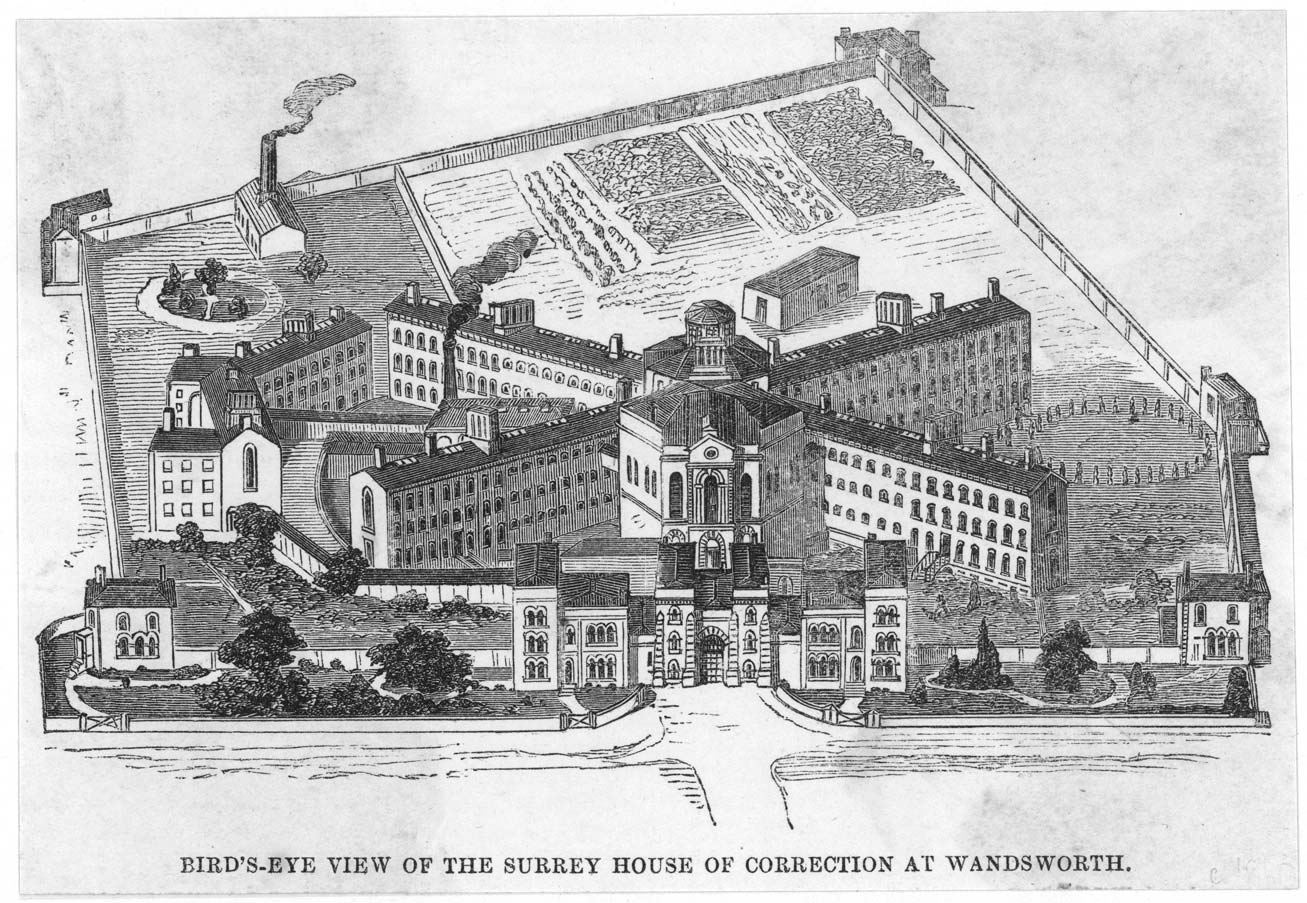
Bird's-Eye View of the Surrey House of Correction at Wandsworth [date?]
(Click on image to enlarge)