A Building history
Keith Bailey
Home › Building histories › Chivalry Road
– Introduction
– The Railway 1838–1921
– The Building of Chivalry Road & Its Environs 1865–1914
– Social Structure 1871–1911
– Conclusion
– Appendices
– 1: Richard Dootson (1826–1897)
– 2: Church of England Reformatory & Refuge, 3–4 Chivalry Road
– 3: South-West London Synagogue
– Notes
London is rightly proud of the extent and variety of its public open spaces. Their origins range from royal hunting reserves to municipal parks and gardens and the remains of medieval commons, a vital element in the agrarian economy.
Wandsworth Common comprises Battersea West Heath and Wandsworth East Heath, parts of Battersea manor held until the 1530s by Westminster Abbey. Later owners included the St. Johns and Spencers. Once covering almost 400 acres, the common was progressively eroded and fragmented to its present 172 acres, criss-crossed by roads and railways, with several large institutions and islands of residential development.
Most of the damage occurred after 1830, under successive Earls Spencer (3rd 1834–45; 4th 1845–57, and 5th 1857–1910). The family had acquired Battersea manor in 1763, adding Allfarthing in 1815. Demands to use the common for non-agricultural purposes presented the Earls with an ideal opportunity to make substantial financial gains for no outlay. They saw the commons as no different from any other property, disregarding age-old tenants’ rights.
Eventually, when most of the damage to Wandsworth Common had been done, a local campaign spearheaded by John Buckmaster led to an Act in 1871 that saved the remnants for the public. Initially controlled by Conservators, ownership passed to the London County Council in 1890.
This paper examines the transformation of one small corner of Wandsworth Common from eight acres of rough grazing to a railway goods yard and suburban housing between 1853 and 1914. The process was both complex and protracted, involving inter alia lawyers, railway companies, builders and successive occupants of the houses.
The seven acres of former rough grazing examined in this paper underwent dramatic changes in the half-century after 1855. Although New Wandsworth had a short life as a passenger station (1858–63), the goods yard survived until 1968, sustained by the domestic coal market. The surplus land was acquired by builder Christopher Todd in 1862. The process of developing a medium-sized estate was, however, protracted. Todd was already active nearby at Abyssinia Road, but his bankruptcy and an abrupt downturn in the building cycle caused by the financial crisis of 1866–7 slowed progress. Building only commenced in 1868–9.
[NB "surplus" only from the point of view of the railway company, oc curse - JCB and other local residents were understandably outraged - arguing that the any "surplus" should be returned to the Common. Hence JCB's calls to "Break Down the Fences", which he himself famously did. He may ultimately have lost this area, but other parts of the Common were saved by this agitation. ]
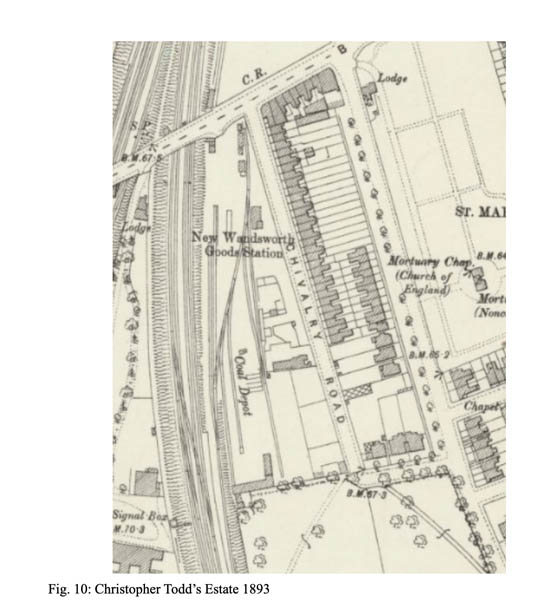
The new street facing the goods yard was laid out in 1871–2, and variously named Phoebe, Mabel and finally Chivalry Road. There were thirty mostly three- to four-storey terraced houses in the north–south section, erected piecemeal between 1872 and 1882 and attracting generally middle-class tenants. The largest contributions were by soldier turned licensed victualler Richard Dootson and builder Stephen Martin of Hackney. The southern section of Chivalry Road, with views across Wandsworth Common, was developed with three substantial houses which attracted upper middle-class tenants with up to three servants. The three houses at the south end of Bolingbroke Grove were similar. A long line of plots at the northern end remained vacant for almost a century.
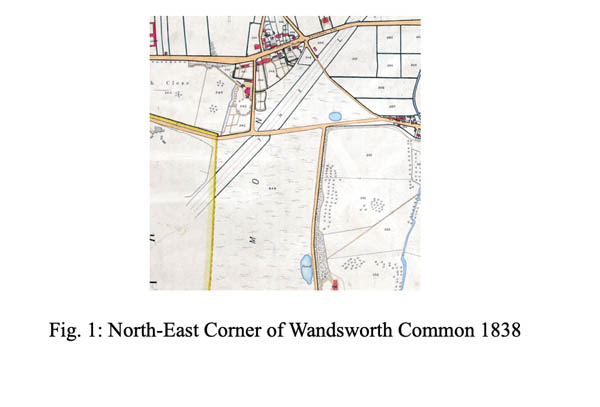
The first incursion on Wandsworth Common was the London & Southampton Railway, opened from Nine Elms to Woking in May 1838. This crossed north Battersea on a low embankment, curved south-west at the site of Clapham Junction to enter a deep cutting across the Common as far as Heathfield Road. A station named Clapham Common was provided on the north side of Battersea Rise.
The West End of London & Crystal Palace Railway (WE&CPR) made an altogether more serious impact. Its origins lay in the relocation of the Crystal Palace to Sydenham Hill. It ran from an end-on junction with a branch of the London, Brighton & South Coast Railway (LBSCR) at the foot of the hill.1 The WE&CPR involved substantial civil engineering, passing through Streatham and Wandsworth to the Thames near Chelsea Bridge. A temporary terminus named ‘Wandsworth’ north of Bellevue Road opened on 1 December 1856. Renamed Wandsworth Common in January 1858, it closed on 29 March 1858 when the extension to the so-called Pimlico terminus opened. The line finally reached Victoria in 1860. The WE&CPR was always operated by the LBSCR, which leased it under an Act of 1857. A complex financial arrangement of May 1859 effectively ended its nominal independence. A long strip of common east of the WE&CPR was potentially vulnerable to further encroachment.
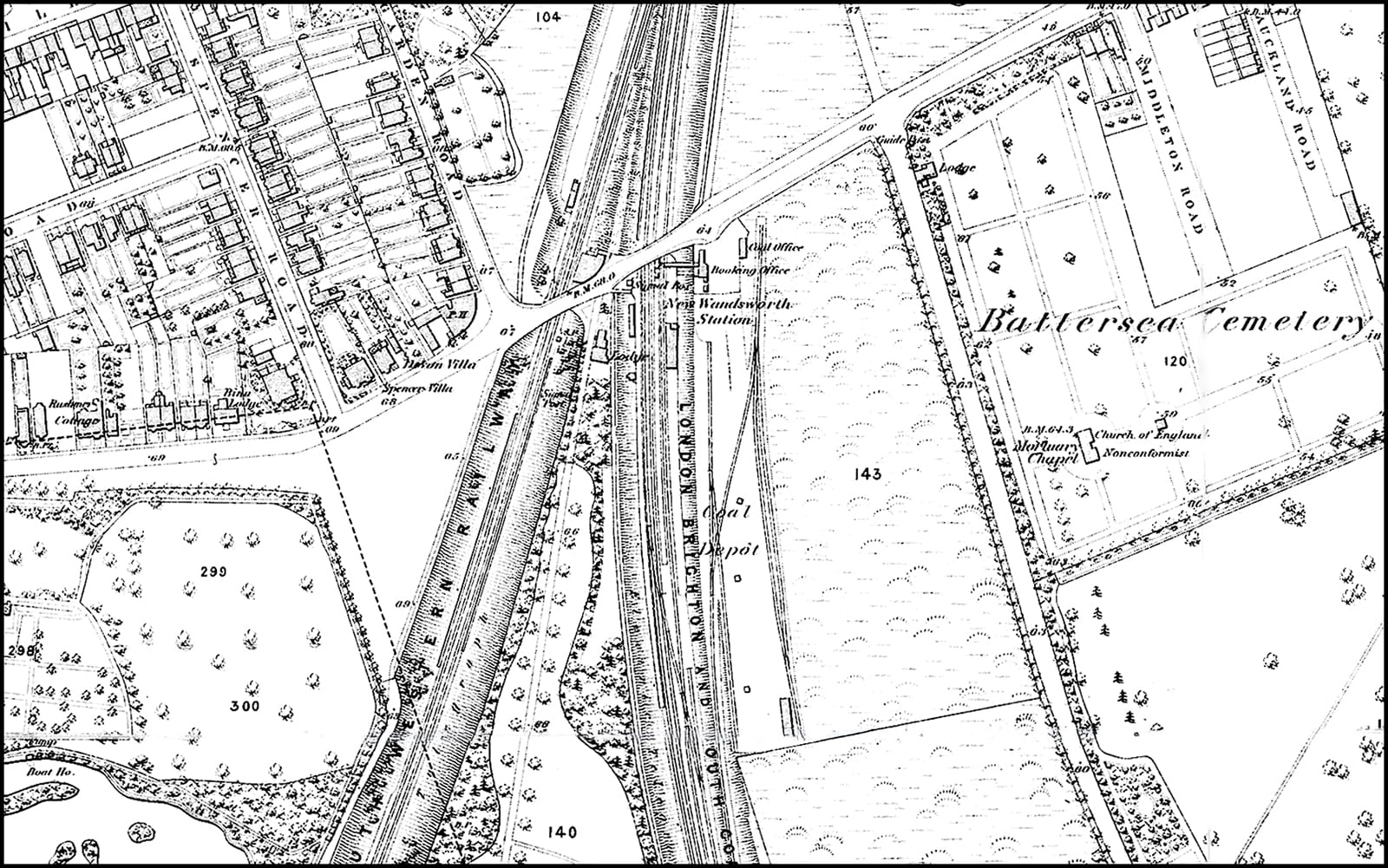
The story of Chivalry Road begins in 1854. The WE&CPR acquired 5.46 acres of the Common for £1,638 15s (only £300 per acre), reflecting the nature and current land use. The sale was conducted by lawyer and magistrate Peter Laurie (c.1810–77) and Frederick Slight (1825–68), Secretary to the LBSCR. Part of the land was used for a passenger station and goods yard which opened in March 1858 and was dubbed ‘New Wandsworth’ after embryonic suburban development nearby. The railway here is in cutting and a steep incline was required to reach the goods yard. A third running line was added in the early 1860s, and a fourth in the 1880s and 1890s. Little additional Common land was lost in these widenings, however, as the original slopes were cut back behind retaining walls.
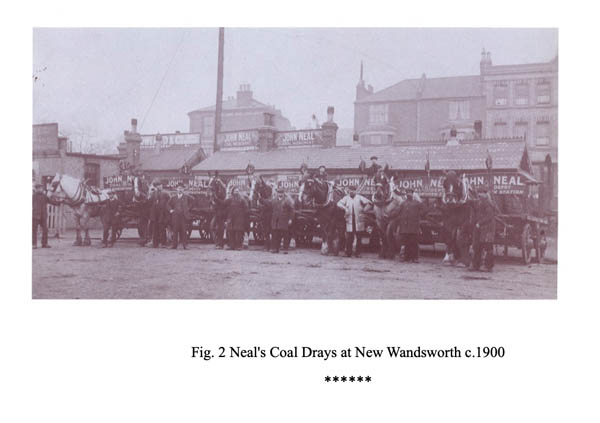
Surprisingly, when Clapham Junction opened in March 1863, New Wandsworth remained open, with alterations to the platforms to accommodate the third track. The station building was at street level. The onset of housebuilding around Balham led to the opening of a second Wandsworth Common station and goods yard in November 1869, taking yet more common land south of Bellevue Road. New Wandsworth then closed to passengers. The layout in the goods yard changed over the years, notably the provision of a house for the station master in 1898. There were three coal offices and a stable and cart shed in late 1871.2 The principal freight traffic was always domestic coal, though building materials doubtless featured in the 1870s and 1880s.
Like any railway station, New Wandsworth experienced rapid staff turnover. In March 1863, several clerks and porters were transferred to Clapham Junction. Until then there were up to twenty staff under station master Henry Harding, including four signalmen, three clerks and four or five porters.3 Harding moved to the new Wandsworth Common in 1869, leaving goods porter John Huggins, who joined the LBSCR in August 1866, in charge at New Wandsworth. He was promoted to station master in March 1873 aged twenty-five and remained in post until a protracted period of sickness began in October 1889.
| Name | Grade | Start | From | To | Notes |
|---|---|---|---|---|---|
| Huggins, John | Gds Porter / Stn Master | 8/66 / 3/73 | New | 10/89 | Sick |
| Bartlett, James | Gds Porter | 3/73 | New | 12/87 | Edenbridge |
| Vickery, William | Stn Master | 11/89 | Croydon | 10/91 | Called to resign |
| Clarke, Alfred | Gds Porter | 1/88 | New Croydon | 11/93 | Dismissed |
| Gilham, William | SM | 10/91 | Battersea Wf | — | Agent c.1900 |
| Jarvis, Richard | Clerk | 3/99 | Penge | 10/12 | Salfords [agent] |
| Winchcombe, Geo | Gds Porter | 5/00 | New | 6/05 | Battersea Wharf |
| Covill, John | Gds Porter | 10/00 | LGOC | 8/01 | New Cross |
| Rowe, James | Gds Porter | 8/01 | LSWR | 6/04 | Battersea Wharf |
| Wood, Bernard | Clerk | 10/12 | Lewes Goods | >1921 | — |
| Threader, George | Gds Porter | 11/10 | New | 2/12 | Horsham |
| Gibbons, Charles | Gds Porter | 1/11 | New | 2/13 | Battersea Wharf |
| Fiveash, John | Gds Porter | 10/12 | New | 3/14 | New Cross |
Goods porter James Bartlett joined in March 1873, aged sixteen, and remained until late 1887. His replacement, Alfred Clarke, had been demoted from head porter at New Croydon for ‘general inattention’. He was dismissed in November 1893. William Vickery, previously chief goods clerk at West Croydon, succeeded Huggins as station master, but was ‘called to resign for general irregularities’ in October 1891.4 The next station master was Battersea-born William Gilham (1864–1939), the son of a domestic groom, who joined the LBSCR in August 1878. Soon after 1900, Gilham was retitled ‘Goods Agent’. He remained at New Wandsworth well into the 1920s. Staff turnover increased markedly after 1890. Previously, men had spent ten years on average at New Wandsworth. In the 1890s this dropped to less than two years. Turnover slowed after 1900 but predictably accelerated after August 1914.
The decline in domestic coal traffic after 1950 led to the closure of New Wandsworth in October 1968. The site was eventually redeveloped as Arundel Close by Fairview Homes in the mid-1980s.
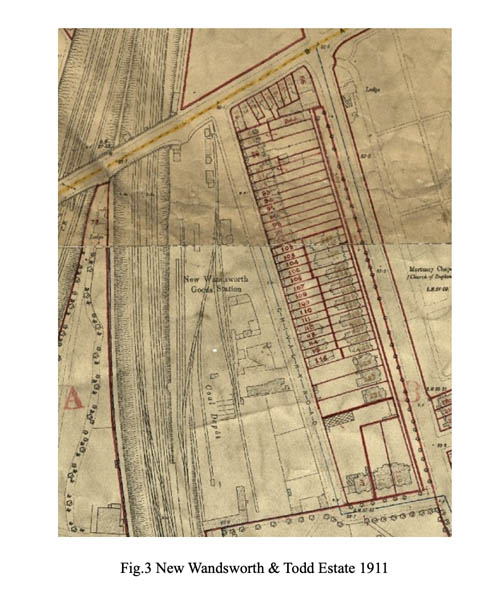
Railway companies were required by law to sell surplus land, giving priority to the original owners. Earl Spencer, the “owner” of what had been common land since time immemorial, obviously had no interest in doing so. An undated plan (c.1855–60) of obscure origin shows an area of about 7½ acres between the WECPR/LBSCR railway at New Wandsworth and Bolingbroke Grove. Of this, 5½ acres is described as “Battersea Common”, used as rough grazing.
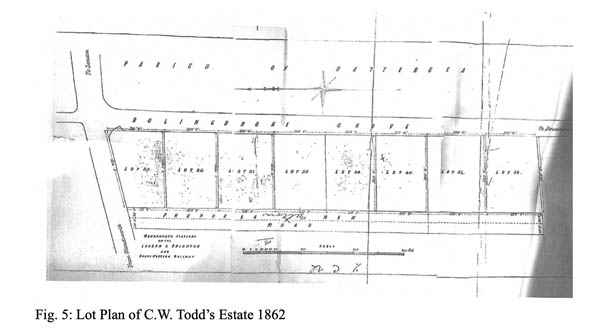
The surplus land was auctioned by Peter Laurie and Frederick Slight on 21st February 1862.5 Lots 35–42, totalling approximately 2¾ acres, were small blocks of land clearly laid out with house-building in mind. A deed of 31 May 1867 records their acquisition by builder Christopher William Todd (1830–92) for £3,290 (£1,180 per acre, four times what Spencer received in 1854).6
Lots 35–42 had frontages of 154ft to Battersea Rise, 698ft to Bolingbroke Grove, 150ft to the south and 682ft to the proposed new road. The irregular shape of Lot 35 reflects the existing line of Battersea Rise: 118ft on Bolingbroke Grove but 82ft on the new road. Lots 36–42 were each 100ft north–south and 150ft east–west. In addition, the sale included two twenty-foot strips of land on the west side, ‘to be thrown together to form a new road’. (The Metropolitan Board of Works [MBW] required new streets to have a minimum width of forty feet between frontages.) Todd was required by the auction conditions to form the new road before 24th June 1862, but did not do so.
In 1862 C.W. Todd lived at Lee near Lewisham, where he and other family members were developing the Boone’s Charity estate for the Merchant Taylors Company. In 1861, he employed 300 men and seventy boys.7 He was also developing nearby Auckland and Middleton Roads, which probably stretched him financially.8 In 1871, Todd lived on Battersea Rise, describing himself as ‘landed proprietor’. He then progressed to “gentleman” at Upper Tooting, advancing to 105 Cromwell Road in the early 1880s.
In August 1862, Todd and his brother John were adjudged bankrupt.9 They were still undischarged in June 1870, when a dividend hearing was held.10 Indeed, Christopher was still apparently subject to the bankruptcy regime when he died ‘on the Metropolitan District Railway’ in the City of London in June 1892. His widow advertised in the press regarding any claims on his estate, assessed at £33,057.11
In May 1866, Todd, Laurie and the LBSCR agreed to move the new road 20ft westwards, ‘on a portion of Wandsworth Common adjacent to New Wandsworth Railway Station’. The MBW approved the name Phoebe Road (the name of Todd’s mother, sister and daughter). On 1st June 1867, Todd borrowed £2,000 from two Gloucestershire gentlemen, Edwin Cook and John Gwynne, presumably to get work started on Phoebe Road. The loan was repaid in August 1871. On 5th January 1872, the MBW approved Todd’s proposal for Mabel Road ‘to lead out of Battersea Rise’, followed on 3rd May by Chivalry Road.14
An undated plan of thirty-five lots in Chivalry Road and Bolingbroke Grove was prepared for C.W. Todd by George Tunley and Edward Boyle of Clements Lane in the City. Both were fellow freemasons of Todd. In 1881 Tunley described himself as ‘surveyor & auctioneer’, while Boyle was ‘surveyor & architect’.15
Building began on Battersea Rise in 1868–9, where Scotsman Robert Hewitt built 1–8 Lordship Terrace (nos.153–167).16 Shortly after site-preparation began, however, that doughty champion of Wandsworth Common John Buckmaster intervened, having been alerted by two manorial copyholders, gravel-diggers who had been turned off Todd’s land. Buckmaster tried to get the land declared part of the common on which nothing should be built.17 Lordship Terrace and the short-lived licensed premises, The Lord of the Manor at no.8, were nods to the previous “owner”. In November 1871, estimated annual rental ranged from £24 to £50. One property was mortgaged to the Planet Building Society and three were still owned by Todd.18
| Property | Date | Builder |
|---|---|---|
| Battersea Rise | ||
| 151 | 1879 | H.S. Lee for G. Trigg |
| 153–167 | 1868/9 | Robert Hewitt |
| Chivalry Road | ||
| 1–2 | 1872 | Edward Newman |
| 3–4 | 1873 | James Jordan |
| 5–18 | 1877 | Richard Dootson |
| 19 | 1880 | George Randall |
| 20–28 | 1882 | Stephen Martin |
| 29 | 1887 | John Mann |
| 30 | 1875 | Lathey Brothers |
| 31–32 | 1875 | George Bush |
| Railway House | 1898 | Smith & Son |
| Bolingbroke Grove | ||
| 103–104 | 1879 | G. Bush for C.W. Todd |
| 105 | 1882 | S.J. Jerrard |
| 106 | 1888 | John Mann |
| 107–116 | 1882 | Stephen Martin |
| 117/118 (Bolingbroke Mansions) | 1901/2 | H. Bignold |
This piecemeal process is clearly apparent in the varied house-types and styles.
In February 1872, builder Edward Newman (1825–1915), of 7 York Place, York Road, gave notice of four houses in Mable (sic) Road, the ‘new road on Todd’s land’.19 Newman was a major builder by contemporary standards, building 221 houses in Battersea and Wandsworth between 1862 and 1882, mostly north of Clapham Junction. He appears to have completed only nos.1 & 2 Chivalry Road. Nos.3 & 4 are altogether more imposing, with four storeys and distinctive grey-brick facades. They were notified in December 1873 by James Jordan, a building surveyor, house and estate agent of Wilton Road, Pimlico.20
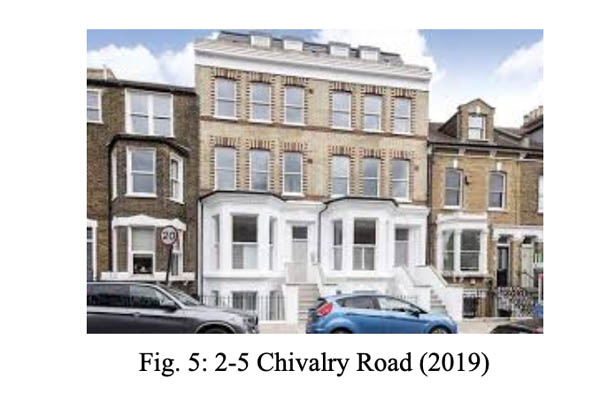
A major contributor to Todd’s estate was Richard Dootson (1826–97), whose notice to build gave his address as 6 Middleton (now Buckmaster) Road. His fourteen two-storey houses with basements and attics (5–18 Chivalry Road) still bear the legend “Dootson Terrace”. Dootson is never described as a builder in the sources, however, and ranks as one of Victorian Battersea’s most interesting characters. (See Appendix 1.)
In October 1879 coal merchant-cum-removal contractor George Trigg (1839–1920) gave notice for a furniture warehouse with residential accommodation at the corner of Battersea Rise and Bolingbroke Grove. The builder in 1884 was bricklayer Henry Lee.
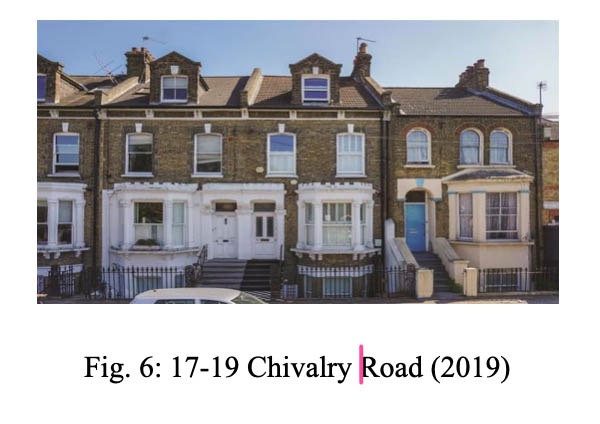
Three-storey no.19 Chivalry Road was built by George Randall of Northcote Road, in 1880. He was active in Battersea from 1860–87. The largest contribution to Todd’s Estate was made by Stephen Martin who built nineteen modest two-storey houses in 1882 (20–28 Chivalry Road and 107–116 Bolingbroke Grove). Martin lived at Stamford Hill, but his business was based in Clerkenwell.
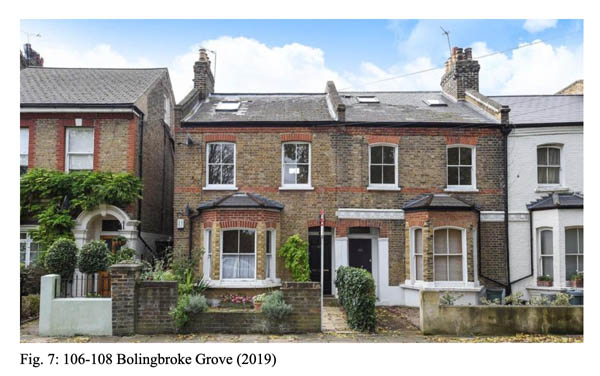
Little vacant land remained on the east side of Chivalry Road by 1885. John Mann of 20 Abyssinia Road built no.29 in early 1887, followed by 106 Bolingbroke Grove, immediately behind, in April 1888.
The origins of the three houses at the south end of Chivalry Road (30–32) are complicated, with several notices by builders in the mid-late 1870s. No.30 (South Lodge) was built by brothers Samuel and Edwin Lathey of Nine Elms, who gave notice in June 1873. They were active in Battersea and Wandsworth from 1862, specialising after 1870 in single or pairs of substantial houses. No.30 was built in the south-west corner of an L-shaped plot of 0.36 acres.
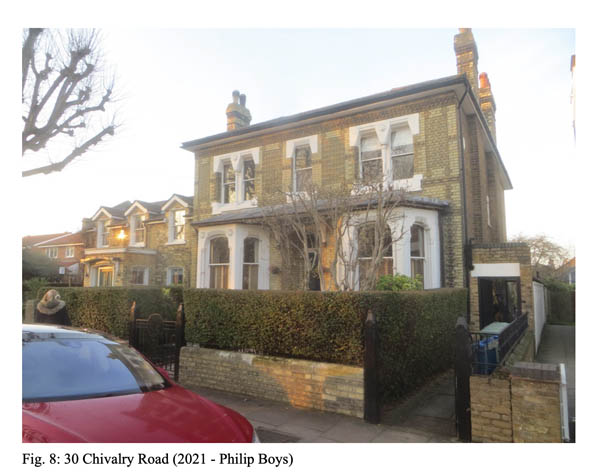
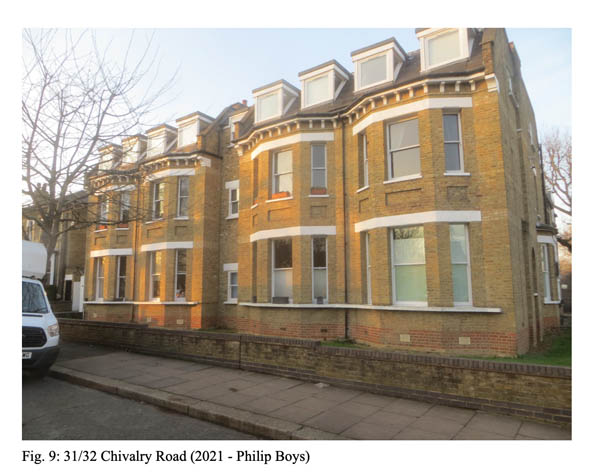
Nos. 31 (Lancaster Lodge) & 32 (St. Mark’s House, later Oakshade) Chivalry Road are conjoined thirteen-roomed villas, now significantly altered and extended to become a block of flats. Their combined width tapers from 93ft to 80ft at the rear. The 150ft. deep plots contain 0.141 (31) and 0.157 (32) acres. The most likely candidate for their builder is George Bush of Lee, doubtless an associate of C.W. Todd.
More is known about no.103 Bolingbroke Grove (originally Dingwall, later Bolingbroke Lodge), thanks to the chance survival of an Abstract of Title. No.103 is a ten-roomed villa on a plot 37ft by 150ft, leased to Bush for eighty years in early 1876 at £12 p.a. ground rent.
In October 1879, C.W. Todd sold the lease to Miss Emma Beall (1834–1925) of Hatton Road, Cheshunt for £276. Emma’s father, a prosperous cabinetmaker and upholsterer, had died in 1878, leaving around £7,000. His son-in-law George Palmer of Kentish Town, a newspaper publisher and founder of The Church Times, had knowledge of Wandsworth through his mother.21
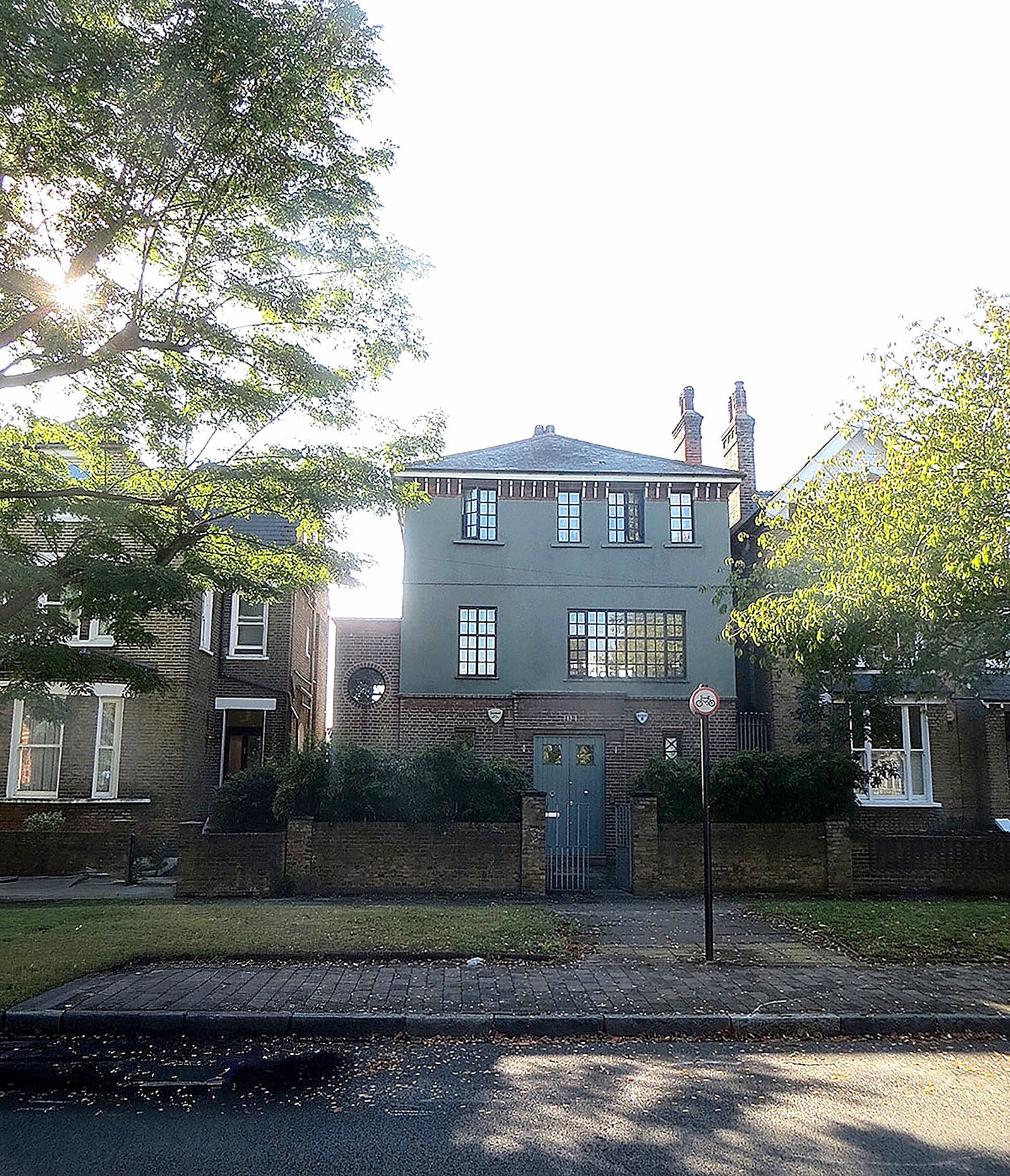
Nos.104 (Oreston) and 105 Bolingbroke Grove were erected on plots 33ft by 150ft (each 0.114 acres). No.104, a four-storey detached house, was built in 1882 for retired City chemist William Austin French (1811–92).22 No.104 became Wandsworth & Battersea Synagogue in 1915, and was subsequently much altered in the 1920s with a new façade and new buildings to the rear (see Appendix 3). No.105, a twelve-roomed villa with an unusual canted porch, was probably built by George Bush.23 In 1894–5, after standing vacant for some time, it was divided into nos.105 (seven rooms) and 105a (five rooms).
The railway goods yard contained sundry small buildings of various dates, but it was not until 1898 that a house was built by the LBSCR by Smith & Son of South Norwood for Station Master William Gilham.
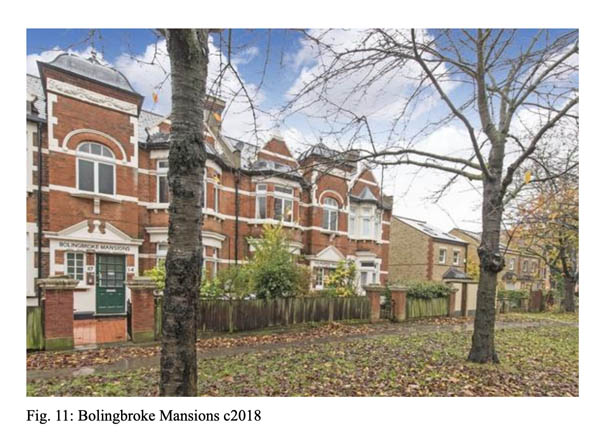
After two decades of building, sixteen plots in Bolingbroke Grove still remained vacant in 1890, ten of which remained unused for most of the twentieth century. C.W. Todd’s sudden death in 1892 may have played a part in this. Four plots adjoining Martin’s 1882 terrace were developed in 1901–2 as two small blocks of flats (Bolingbroke Mansions — 117/118 Bolingbroke Grove), each containing four dwellings. Their highly eclectic facades were designed by local architect and surveyor Herbert Bignold (1859–1939) of 67 Battersea Rise.
The principal sources for the early residents are the 1871–1911 Census returns. Local street directories and electoral registers provide information about some occupiers between Censuses and after 1911. Only a broad summary of social class and occupation is attempted here. Charles Booth’s colour-coded “Poverty Map” of 1898–99 shows Battersea Rise, the north–south section of Chivalry Road and the terraced houses in Bolingbroke Grove coloured Pink, ‘fairly comfortable, good ordinary earnings’.25 The larger houses at the south end are Red: ‘all good 3/3½ storeys, middle class, well-to-do’.
| Category | 1871 | 1881 | 1891 | 1901 | 1911 |
|---|---|---|---|---|---|
| Population | 35 | 208 | 318 | 283 | 314 |
| Houses | 10 (5 ety) | 32 (1 ety) | 54 (6 ety) | 55 (3 ety) | 66 (1 ety) |
| Households | 5 | 31 | 48 | 52 | 84 |
| % HH with Servants | 0 | 42 | 27 | 17 | 12 |
| % HH with Lodgers &c | 1 | 4 | 6 | 9 | 4 |
| Social Class (%) | |||||
| Upper Class | — | 13.8 | 2.1 | 1.9 | 1.7 |
| Middle Class | — | 62.1 | 48.9 | 32.7 | 33.9 |
| Skilled Non-manual | 20.0 | 10.3 | 21.3 | 34.6 | 35.6 |
| Skilled Manual | 60.0 | 10.3 | 23.4 | 25.0 | 20.3 |
| Semi-skilled | 20.0 | 3.4 | 6.4 | 5.8 | 6.8 |
| Unskilled | — | — | — | — | 1.7 |
| Group | 1871 | 1881 | 1891 | 1901 | 1911 |
|---|---|---|---|---|---|
| Building | 14.3 | 10.0 | 10.4 | 13.5 | 13.1 |
| Clerical/Managerial | — | — | 2.1 | 2.1 | 14.7 |
| Retail/Distribution | 14.3 | 28.3 | 22.9 | 26.9 | 23.0 |
| Domestic Service | — | — | 8.3 | — | 3.3 |
| Labouring | — | — | — | 0.5 | — |
| Manufacturing | 28.6 | 18.3 | 16.7 | 25.0 | 16.4 |
| Private Means | — | 6.7 | 16.7 | 3.8 | 14.7 |
| Professional/Gov’t | — | 33.3 | 20.8 | 1.6 | 8.2 |
| Transport | 42.8 | 3.3 | 2.1 | 7.7 | 6.6 |
Todd’s estate was half-complete by 1881 and was virtually finished in 1891. Where livestock once grazed and gravel was quarried, lived around three hundred people.
In 1871, only Lordship Terrace was complete, but was still only half-occupied. Occupiers, mostly skilled working-class, worked principally in retailing and on the railway. Oddly, given its location, railwaymen were largely absent by 1881, when three-quarters of household heads were upper- and middle-class. About 40% were professionals or ‘independent’, and a similar proportion had resident servants. Despite the proximity of a busy goods yard, Todd’s estate had achieved the kind of social profile he doubtless aspired to.
This favourable situation did not last as large swathes of south Battersea succumbed to developers and builders throughout the 1880s and 1890s, offering newer middle-class accommodation. By 1891, the proportion of middle-class households on Todd’s estate had declined from 75% to 51% and those with live-in domestics from 42% to 27%. This social decline continued with around 35% of middle-class households in 1901, though numbers stabilised thereafter. Servant-keeping however continued to decline, to 12% in 1911. By then, around one-third of houses, mainly in Chivalry Road, were in multiple-occupation.
Perhaps the most unusual change was the conversion of 3 & 4 Chivalry Road into a Church of England Refuge & Reformatory for unmarried mothers (see Appendix 2). They were home to a tailor-cum-woollen draper and a fishing tackle maker with four employees in 1881. By 1891, a missionary with seven “inmates” and a servant lived at no.3, while no.4 was vacant.
Later Census returns and directories reveal more about the occupants of 30–32 Chivalry Road and 103–106 Bolingbroke Grove. Some remained for many years, no doubt appreciating the semi-rural setting. They include the family of Major-General Edward Saunders at 32 Chivalry Road from the late 1880s to 1913. Saunders had spent many years in India; his wife was born in Mauritius and one daughter in Bangalore. Builder and contractor William Hammond lived at Bolingbroke Lodge (no.103) from c.1893 until his death in 1921. Robert Hayward, ‘oilman and pickler’ (founder of the famous Haywards Pickles) arrived at no.104 in the late 1880s and his spinster daughter Alice remained until her death in 1915.
Responsible for fourteen houses in Chivalry Road, Dootson left a significant mark here. He was never a builder, however, but his varied, often complex life is well-documented. Dootson’s career offers a useful corrective to the view that all those involved in house-building came from the ranks of architects, builders and building tradesmen.
Dootson was born at Warrington.29 From 1844–66 he served in the 2nd Regiment of Foot (now the Queen’s Royal Regiment (West Surrey)), reaching the rank of Sergeant. In 1847, he married Ann Eliza Hall (1826–96) at Winchester. After service across the Empire, from Ireland to South Africa and Hong Kong, Dootson became a Chelsea out-pensioner in October 1866.
The story of Richard and Ann Dootson is closely intertwined with the children of her brother William Hall (b.1821), notably Sarah Ann Hall (b.1847). Shortly after Dootson had left the Army, his two sons were registered in Dublin: Richard James in 1867 and Charles Frederick in February 1869. Charles’s birth notice names his mother as Sarah Ann Hall, who had married Dootson bigamously just after Christmas 1868.
In 1869 Richard was working as Manager of the Stephen’s Green Club in Dublin. Dootson and his new family returned to England during 1870, which marked the beginning of a veritable soap opera lasting many years, during which he continued to live with both women, apparently amicably, successfully bamboozling Census enumerators by describing Sarah as his ‘niece’, rather than that of his wife.
Like many ex-soldiers, Dootson became a licensed victualler. In 1871 he was a wine and spirit merchant employing a barmaid and three servants at the Greyhound Inn Peckham, a prime site at the High Street/Hill Street junction. By 1881, the family were at the Railway Tavern near Streatham Common station.
Further complexity began in February 1874, when Sarah Ann Hall married bank clerk John Walter Gilbert (1848–81) at Camberwell. In June 1875, John Gilbert petitioned for divorce, alleging that between February and December 1874, his wife and Dootson had had ‘adulterous intercourse’ two or three times a week.31 Sarah Gilbert’s ‘Answer’ counter-claimed that between May 1874 and June 1875, John Gilbert had ‘frequently committed incestuous adultery’ with her sister Emily (1855–1919).32 For reasons unknown, the case was thrown out in November 1875. John Gilbert died aged thirty-three in Autumn 1881. Sarah, now ‘Hall’ once more, outlived all the other players in this drama. She died in 1929, aged eighty-two.
Between 1880 and 1896, electoral registers give Dootson’s address as 17 Chivalry Road. He died at 17 Chivalry Road on 29th April 1897, leaving £1,900. His executors were Walter Dootson, by then a corn merchant in Islington, and Sarah Hall, ‘widow’.
Between 1884 and 1890, the Reformatory & Refuge Union opened a mission house at 3 Chivalry Road.33 The organisation was concerned with the welfare of domestic servants and their children, including finding partners for younger mothers. In 1891, the missionary-in-charge was Frances Hills, assisted by Ethel Welsh. There were ten “inmates”: eight of them unmarried servants ranging in age from nineteen to fifty-five.
In 1901, the Refuge was at 4 Chivalry Road, headed by Assistant Matron Florence Pilgrim (23; b. Snaith, Yorkshire) with her sister Jane (21). There were only four inmates. In 1911, the Refuge, with a capacity of twenty, was being run by the Wandsworth & Battersea Ladies’ Association for the Care of Friendless Girls. Later in 1911, nos.3–4 Chivalry Road became a home for twenty orphans and homeless children. Miss Edna Tatchell became Superintendent, moving with the Home to Blunden near Sandy in Bedfordshire around 1923.
Judaism was a latecomer to the varied religious life of Wandsworth and Battersea. In 1900, there was a thin scatter of Jewish families, many of them in the retail sector. Nightingale House (formerly the Home for Aged Jews) in Nightingale Lane moved from the East End to a substantial house acquired by Lord Wandsworth in 1904.
The Ashkenazi Orthodox Wandsworth & Balham Synagogue was formed in about 1913 by a merger of the Balham & Tooting Hebrew Congregation of Boundary Road and the Wandsworth & Battersea Congregation of 563 York Road. Until 1915, the combined congregation met at 77 Bolingbroke Grove, when it moved to no.104. The name was changed to South-West London Synagogue in 1927.34
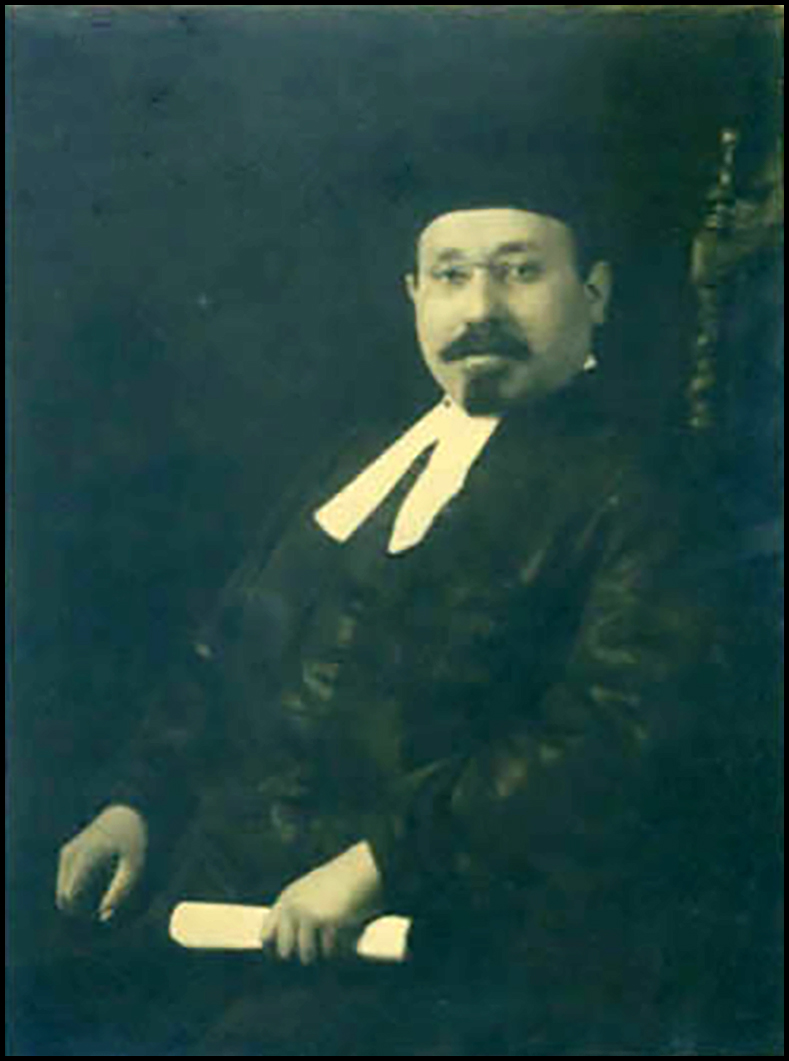
From 1914, the congregation was led by Rabbi Isaac Ostroff (1880–1933) who was born at Bauskas Novads in Kurland, Russia (now southern Latvia). He arrived in England between 1901 and 1903, living initially at Stroud, Gloucestershire. Isaac took charge of the Wandsworth & Balham Synagogue in 1914 and continued until his death in 1933.
A purpose-built synagogue was built to the rear of 104 Bolingbroke Grove in 1927. The foundation stone was laid in April, in the presence of the Chief Rabbi and various notables, including members of Battersea Borough Council. The architect was Charles Living junior of Stratford. The Victorian villa was partly converted to a hall, with a new façade.
In 1940 there were 144 male seat holders, increasing to 230 in 1950/1960, then declining to 173 by 1970. The synagogue closed in 1997 and has been converted into flats.
↑ 1. The majority of the site was actually in Penge, then a detached part of Battersea parish.
↑ 2. Battersea Poor Rate Book, November 1871 (Wandsworth Archives).
↑ 3. K.A. Bailey, The Staff of the London, Brighton & South Coast Railway in Battersea and Wandsworth 1856–1901 (Wandsworth Paper 32, 2018).
↑ 4. After a spell working as a ‘commercial clerk’, Vickery returned to the LBSCR as a clerk before 1911.
↑ 5. Lambeth Archives MSS 5839/5840.
↑ 6. Lambeth Archives, MSS 4702.
↑ 7. His father George (1792–1872) had been active as a builder/developer in south-west London for several decades, including nearby Spencer Park, also once part of Wandsworth Common.
↑ 8. Auckland commemorates the Todd family’s roots; Middleton was his first wife’s maiden name.
↑ 9. London Gazette no.22651, 8 Aug. 1862, p.3778.
↑ 10. LG 23621, p.2862.
↑ 11. Morning Post 13 Sept 1892. Todd married farmer’s daughter Ruthella Hetherington at Carlisle in 1881.
↑ 14. MBW Mins. 1872 I, p.638. The origins of Mabel and Chivalry remain unexplained.
↑ 15. Wandsworth Archives BP/6/5/383.
↑ 16. In 1861, Hewitt lived at 25 Falcon Grove. By 1881, he was a carpenter at Acton.
↑ 17. Daily News, 20 June 1870.
↑ 18. Battersea Poor Rate Book, November 1871 (Wandsworth Archives).
↑ 19. Wandsworth District Board of Works minutes, 7th February 1872.
↑ 20. Jordan’s wife moved her fancy repository from Pimlico to Lavender Hill.
↑ 21. Palmer’s mother was the daughter of famous bookseller/publisher John Hatchard, closely involved with the evangelical Clapham Sect. Palmer was the founder of the Church Times in 1863.
↑ 22. There is a possibility that the builder was George Bush, who had built no.103 in 1880. French left an estate of £16,355.
↑ 23. The Buildings of Clapham ed. A. Wilson (Clapham Society, 2000), 168, attributes it to W.A. Hunt, but that name appears in none of the surviving records.
↑ 25. It should be noted that the street-by-street perambulations in the Booth Collection (LSE) reveal an inevitable element of subjectivity in the assignment of Class.
↑ 26. LSE BOOTH/B/366, p.223; July 1899. The prostitutes plied their trade on the Common.
↑ 29. In the 1881 Census, 432 out of 437 examples of the Dootson name were in Lancashire, mostly in the southern coalfield area.
↑ 30. A prestigious private members’ club founded in 1840 by Daniel O’Donnell and others, and still active.
↑ 31. TNA J77/03891.
↑ 32. A long-standing religious bar on marriages between a man and his deceased wife’s sister was prohibited by law in 1835, an Act not repealed until 1907.
↑ 33. For background see www.childrenshomes.org.uk/BatterseaLA/.
↑ 34. P. Renton, The Lost Synagogues of London (Tymsder Publishing, 2000), 142–3.
6,376 words — K.A. Bailey, 13 February 2021