
Given all the changes taking place on the Springfield Hospital site, I wanted to write up a number of stories about the early history of the Surrey Pauper Lunatic Asylum on Burntwood Lane, including:
— Mrs Boone's search for her husband's body, 1844 — the anatomical dissection of "pauper lunatics", removed from the Surrey Asylum, 1844
— Hare and hounds, 1872...
— "A visit to Wandsworth Lunatic Asylum on a dark and gusty night" in 1880
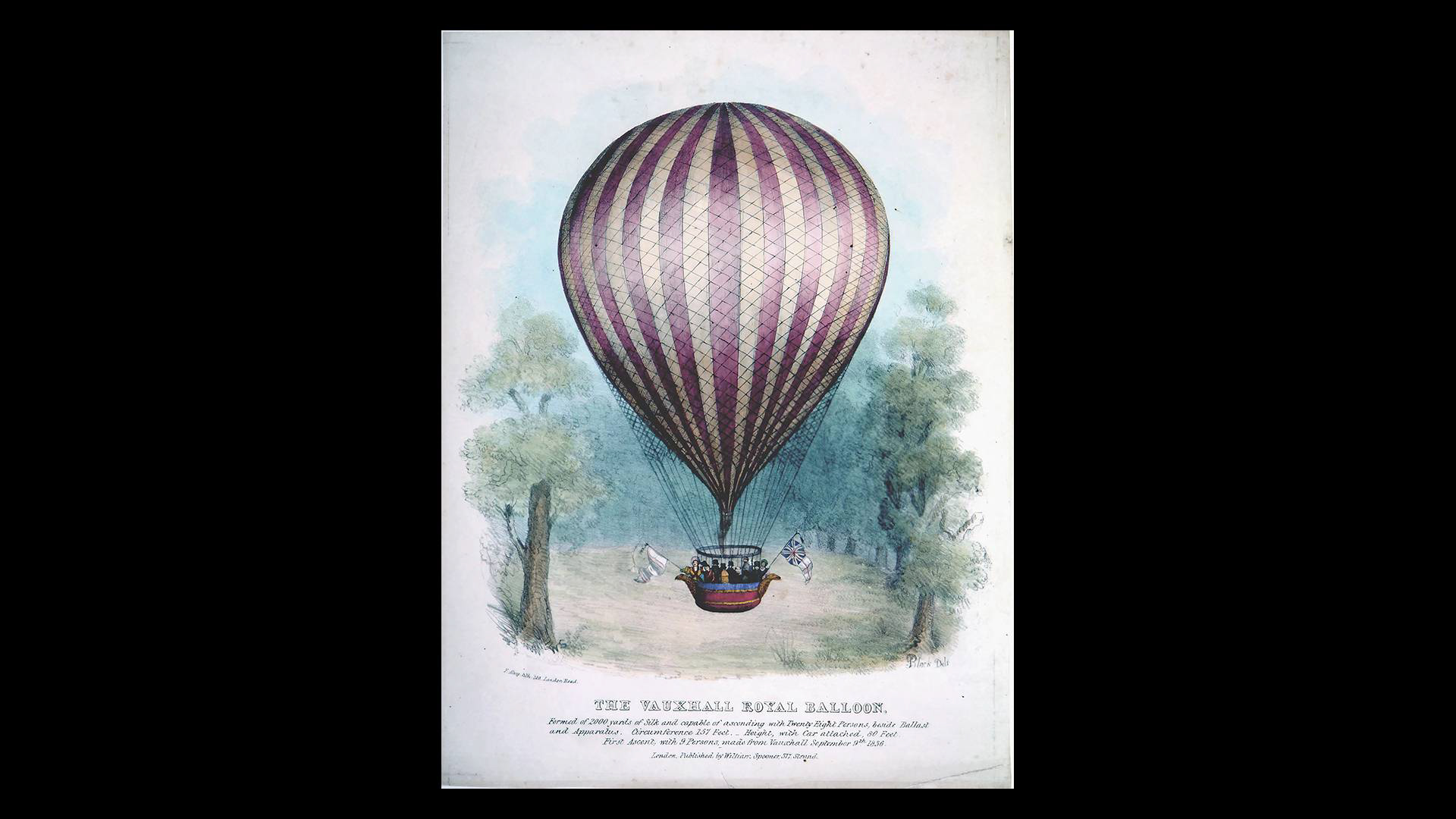
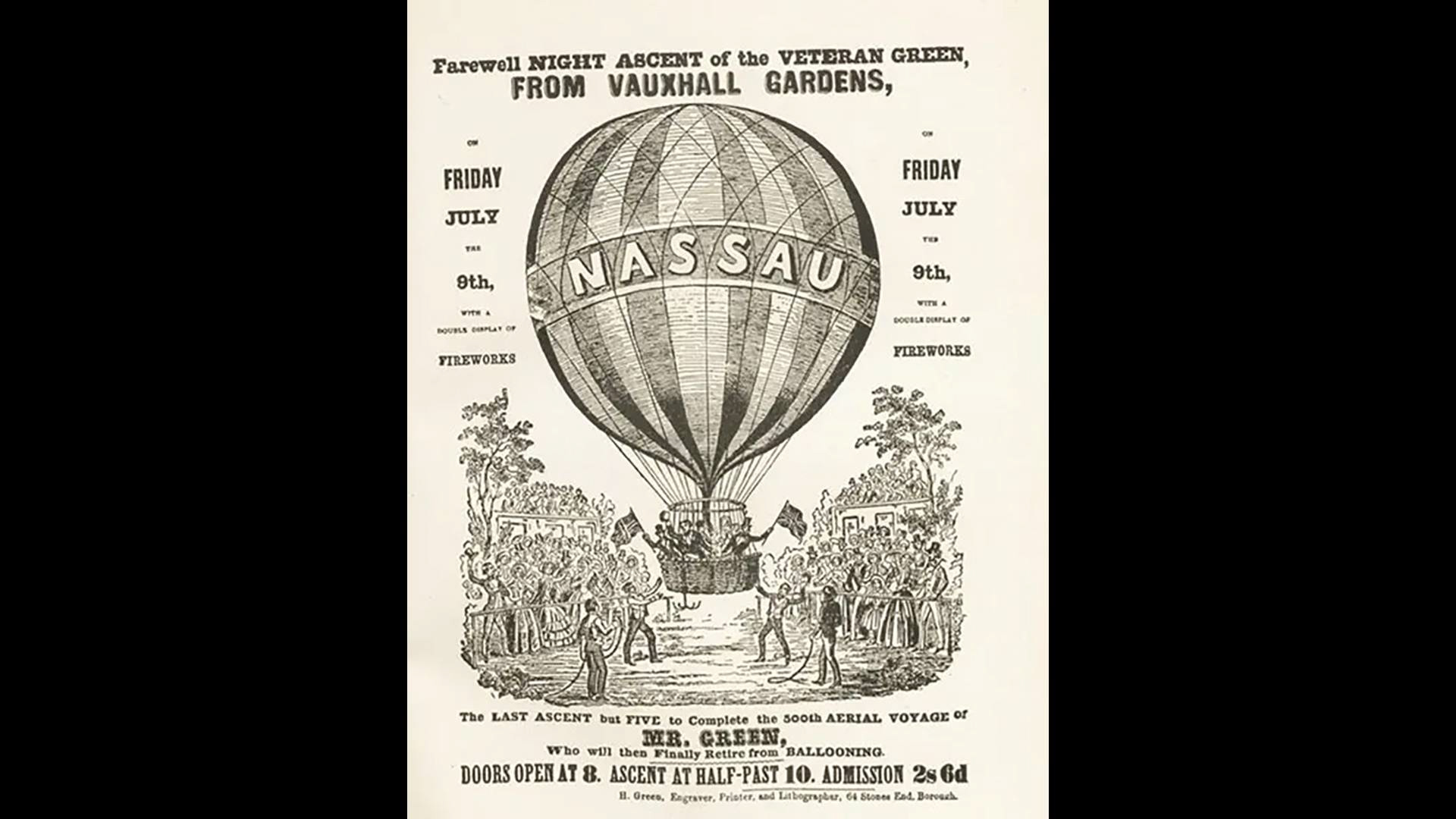
— Balloon...
— The death of Daniel Dolley, 1856...
Leading on to...
— Pioneering photographs of female patients in the asylum, by Hugh Welch Diamond, 1850—58
— Amelia Alfrey and Ophelia...
— Ending?
On the whole, there are very few references to the asylum in newspapers in the C19
So far as I can tell even its opening and subsequent development was scarcely reported
But here's a very troubling story from the early years
....Mrs Boone
[similar case of pauper dissection Bell's New Weekly Messenger— Sunday 15 December 1844e.g. https://www.britishnewspaperarchive.co.uk/viewer/bl/0001319/18441215/018/0003]But of the others, several are jocular or almost affectionate
And usually refer in some way to people's prejudices, if only to subvert them...
For example
[hare and hounds]
[a visit to a theatrical performance]
[and the arrival and departure of balloon]
You can't help thinking that this was something of a PR stunt....
It's especially interesting because it involves Doctor Hugh Welch Diamond...
(Who almost certainly put the balloonists up to it)
He was deeply involved in another story of the dark side of psychiatry in the mid-century
Probably the most notorious of all, and very widely reported nationally was the case of Daniel Dolley
Diamond is largely forgotten for his role in Daniel Dolley's story
But he has become the most famous of C19 [psychiatrists]
Because of his remarkable photographs...
I gave a longer talk on this
Which you can see here....
Here are some sequences of photographs from that talk
He clearly loved to dress his patients— his "subjects" 0 up
Here's en extraordinary one
Some of them co
But to finish I'd like to focus on just one photograph
Ophelia...
And a possible local story [stories] that relates to it
[How best to finish evening?]
1844-02-26-mrs-boone-looking-for-her-husbands-body-MorningAdvertiser.jpg
1844-02-26-mrs-boone-looking-for-her-husbands-body-MorningAdvertiser-enhancedx2-min.jpeg

TREATMENT OF PAUPER LUNATICS IN CHRIST CHURCH, SURREY.
For the last two or three days considerable excitement has prevailed in the neighbourhood of Gravel-lane, Southwark, in consequence of the following distressing circumstances:
lt appears that the husband of Mrs. Boone, who keeps a small shop at the corner of Dyer-street, Gravel- lane, had for some time been insane, and was farmed out at the expense of the parish to a lunatic asylum near Wandsworth.
On the last usual visiting day, Mrs. Boone went to see her husband, and was informed by the authorities there that he had been dead a fortnight. and was decently and comfortably buried in Wandsworth churchyard.
Thither the poor woman repaired, and having found out the sexton, discovered, to her great dismay, that no such funeral had ever taken place.
She again applied at the Wandsworth asylum, and, after considerable difficulty, she was referred to Mr. Bond, the relieving-officer of Christ Church parish. This gentleman told Mrs. Boone that it was a mistake on the part of the Wandsworth people, and that her husband, Joseph Boone, had been decently interred in Christ Church burial-ground.
By no means satisfied with this statement, Mrs. Boone applied to the rector, Mr. Mapleton, who in vain attempted to relieve the distracted woman of her anxiety, for she felt assured that her husband had not been buried in either place.
Subsequently an application was made to the superintendant registrar, and by dint of very anxious inquiry it was found that no such burial had taken place.
The parties implicated, finding at length that any further concealment was impossible, informed the poor woman that the corpse of her husband had been sent to a school of anatomy, merely for a slight experiment, but that the remains should be screwed down in a decent coffin, and respectably interred.
Mr. Robins, the parish undertaker, however, sent home the remains in a common pauper's shell to the miserable woman's abode, with strict injunctions that the so-called coffin was not to be opened.
The poor widow was naturally anxious to take a last look at her husband, but the undertaker said he would not open the shell for £20.
Mrs. Boone then applied to a neighbouring undertaker, named Wooledge, who reluctantly consented to open the coffin.
The feelings of the poor woman may be at once conceived when it is stated, that the body was entirely cut to pieces and dismembered in such a manner that all identity was entirely lost. The outrage was too much for the poor woman, and she fell fainting to the earth.
Yesterday afternoon, with a lingering belief that the mutilated remnants really were those of her husband, Mrs. Boone followed them to the grave, accompanied, notwithstanding the bad weather, by a very numerous concourse of sympathising spectators, among whom some very audible and significant observations were made regarding those who had so cruelly tampered with the bereaved woman's feelings.
Mrs. Boone had repeatedly informed the parochial authorities of Christ Church that whenever her husband died she would come forward and bury him at her own expense.
Ditto Morning Advertiser
Morning Advertiser— Monday 26 February 1844
One problem for Mrs Boone in believing the authorities may have been that Wandsworth had a record for body-snatching...
"For the last ten days the town of Wandsworth has been in the utmost confusion, in consequence of four dead bodies having been disinterred from the burial-ground in Garratt-lane; and the inhabitants have been so incensed against two brothers named White, who have lived in the town from their infancy, and who were necessaries with the body-snatchers in the removal of the bodies, that had it not been for the interference of the police officers, they certainly would have deprive them of existence. The whole of the windows in the house where the Whites reside have been demolished."
Resurrectionists, by "Phiz" (Hablot Knight Browne)— Phiz illustrated ten of Charles Dickens's novels
(Click on image to enlarge)
"Resurrection-Men", or "Body-snatchers", earned their living by digging up fresh corpses to sell to medical schools such as Bart's and St Thomas's. Since the only legally available source of cadavers was the gallows, surgeons and anatomists paid handsomely for every body supplied.
But whenever and wherever bodies were clandestinely exhumed, local people became very angry indeed, as here.
There is so much of interest in this newspaper account that I am quoting it verbatim.
Commercial Chronicle (London)— Thursday 16 January 1823
(Click on image to enlarge)
RESURRECTION-MEN
French Horn Tavern, Wandsworth
For the last ten days the town of Wandsworth has been in the utmost confusion, in consequence of four dead bodies having been disinterred from the burial-ground in Garratt-lane; and the inhabitants have been so incensed against two brothers named White, who have lived in the town from their infancy, and who were necessaries with the body-snatchers in the removal of the bodies, that had it not been for the interference of the peace-officers, they certainly would have deprived them of existence. The whole of the windows in the house where the Whites reside have been demolished.
Yesterday, at two o'clock, a Bench of Magistrates, consisting of George Tritton (Chairman), William Nottidge, Henry James Barchard, and John Faulkner Attlee, Esqrs. assembled at the above Tavern, when Michael George Wood and Henry Goldsmith, two regular body-snatchers, were brought into their presence, in the custody of William Collingbourne, the Officer of Union-Hall, on the charge of stealing the said bodies. Henry White was also in custody, but he was admitted as evidence against Wood and Goldsmith.
Henry White being sworn, stated, that he was a labourer, and lived on Wandsworth plain. On Sunday, the 5th instant, about four o'clock in the afternoon, the prisoner, Michael George Wood, came and drank tea at his house, he (witness) knew him, and when he came into the house he was in bed, much in liquor. Wood said he wanted to speak to him, and he was in consequence awoke; on going down stairs he told him there was another man coming to see him. Witness guessed what he came about, because he knew, he was a body snatcher.
Wood, after a short time, went away, saying he would return presently with his friend. About eight o'clock in the evening the other man came, and he then asked him if he had a mind to take a stiff one up that morning (meaning a dead body). Witness replied he didn't care if he did, and the man went away.
About half-past four o'clock next morning a rap came at the shutter of witness's room, and he got up, went into his yard, and put his horse in the cart; after which he called his brother John, and they proceeded as far as the Two Brewers public house, at the corner of Garratt-lane.
Witness then told his brother what he was going about; he said he should return home and have no hand in it.
He left, and witness drove his cart up All Farthing-lane, where he was met by the prisoners Wood and Goldsmith, and another man; each threw a sack containing a body into the cart, and the strange man got up alongside him in the cart, and they drove to St. Bartholomew's Hospital; and, on their arrival, he (the man) took the sacks one by one of the cart and entered the gates, and afterwards returned with the empty sacks and threw them into the cart.
[The article continues below the images . . . ]
[Notice the names of the Magistrates, all of them major local figures: "George Tritton (Chairman), William Nottidge, Henry James Barchard, and John Faulkner Attlee, Esqrs." Attlee is more usually named "John Falconer Atlee". ]
Wandsworth, c.1840: top left, All Saints Church and its ancient tiny burial ground; just below centre, a more recent larger burial ground, off Garratt Lane. The resurrection-men had waited with a cart a short distance away in what was then called "All Farthing Lane" (now St Anne's Hill).
Since this time, the Two Brewers pub mentioned here seems to have relocated eastward from the corner of Garratt Lane (aka "South Street" at this point) and East Hill to the corner of today's St Ann's Hill and East Hill. Sometime after 1971 it was renamed "The Brewers Inn". [See also PubsHistory: Two Brewers, 147 East Hill. Note to self: Samuel Poupart was the Licensee in 1874.]
On getting outside the hospital gates, he gave witness 35s. for his job.
Witness, on his road back to Wandsworth, met his brother in the London road, who told him that the neighbourhood was in an uproar, and that his cart was seen in the burial ground, and was suspected to have conveyed the bodies to London.
Witness on hearing this determined not to return to Wandsworth, and gave his brother his horse and cart, and he drove it to the prisoner Goldsmith's stable, in London-street, London road. Next morning he was taken into custody, and held to bail.
Witness subsequently met the prisoner Wood at the Three Stags public-house, near Bethlem, who said him, "I hear you have come it" (meaning, confessed). Witness replied he should speak the truth. Wood said he might do as he liked about it, and they parted . . .
All Saints Church Wandsworth c.1800. Notice incidentally the parish stocks in the foreground
(Click on image to enlarge)
William Smith saw a cart in All Farthing-lane about a quarter before five o'clock on Monday morning, the 6th inst. There were three men standing near it, apparently very busy in placing something in it, after which White drove the cart away.
On getting into the town he heard the Resurrection-men had been at work. The morning was very dark, and he could not see the features of the men; they were similar built men to the prisoners, but he could not say upon oath they were the men.
Henry Cooley stated that between four and five o'clock on the Sunday evening he was sitting in the tap-room of the Bull public-house, when in came the two prisoners, who claimed an acquaintance with witness.
After remaining there some time he left the Bull and went to the brewhouse, at Wandsworth, to see a friend, and in the course of conversation, witness inquired whether there had been any funerals that day: his friend inquired why he asked such a singular question, to which he replied that he had just left two desperate body snatchers at the Bull, and he was sure they intended to rob the graves that night.
Several other witnesses stated that they had seen the prisoners about the town on the Sunday night . . .
"Two men placing the shrouded corpse which they have just disinterred into a sack while Death, as a nightwatchman holding a lantern, grabs one of the grave-robbers from behind."
Coloured drawing by T. Rowlandson, 1775. [Wellcome Collection. Public Domain Mark.]
(Click on image to enlarge)
. . . James Gardner, a labouring man, stated that he was going to work up Garratt lane, soon after five o'clock in the morning, and saw a cart and horse standing near the burial ground; near the ground he kicked against something apparently very bulky, the contents of which rattled; as he was about to overhaul the something, two men came up and laying hold of a sack at each end placed it in the cart, and drove off.
Witness gave information to Oakley, the watchman, and said he suspected they were resurrection-men, and advising him to pursue them. He replied he could not be expected to attack two men without fire-arms, and as he was unprovided with any, he should not risk his life.
The Chairman said the conduct of Oakley was most shameful, and he was unfit for his situation.
Witness could not say the prisoners were the men he saw; they were certainly very much like them.
Hugh Callendar, the beadle of Wandsworth*, stated that in consequence of Mr. Collingbourne, the High Constable, telling him that some of the graves in the burial-ground had been robbed, he gave notice to the grave-digger, and several graves were examined, when four were found to have been robbed, the bodies were stolen, and the shrouds, &c. were left in the coffins.
Mr. Collingbourne, the High Constable, said, that the burial-ground from whence the bodies had been stolen was very retired, and any person might gain access to it from some fields unperceived by any individual. The ground was now very full of bodies, and some of them were not more than 19 inches under the earth.
The prisoners protested their innocence, and they were committed to take their trial, and Henry White was remanded to prison to give evidence against them.
It is impossible to describe the indignation of the townspeople against the prisoners. On their being placed in the coach to be conveyed to Horsemonger-lane [the main Surrey gaol at this time], it was nearly filled with snow, that had been thrown by the mob at the execrable wretches; and they may think themselves very fortunate it did snow, by which means stones and other missiles were hidden, otherwise they certainly would have beea dreadfully bruised.
* The Beadle— a parish constable, usually with ceremonial as well as legal duties.
Mr Bumble, Beadle— a character in Charles Dickens's Oliver Twist, illustrated by "Kyd" (Joseph Clayton Clarke), 1889.
(Click on image to enlarge)
So where had the exhumed bodies come from?
I suppose it must be the (now long-closed) graveyard at the north of Garratt Lane. As maps of the period show, this was largely surrounded by fields, hence "very retired, and any person might gain access to it . . . unperceived".
According to Mrs Basil [Isabella] Holmes's classic study, The London Burial Grounds (London, 1896), Garratt Lane Cemetery was consecrated in 1808 and was 1 3/4 acres in area.
But if this was only opened in 1808, it must have filled very rapipdly, since the article reports that "The ground was now very full of bodies, and some of them were not more than 19 inches under the earth."
So is it possible they came from the very small (quarter-acre) graveyard at All Saints itself, which most certainly would have been over-full? This is supported by the comment here, which names the "church-yard".
"Conviction of the Resurrection-Men", Commercial Chronicle, 21 January 1823.
(Click on image to enlarge)
SURREY SESSIONS
CONVICTION OF RESURRECTION-MEN
On Saturday George Wood and Henry Goldsmith, two noted "body-snatchers," were indicted for stealing three dead bodies, from the burial ground of Wandsworth, Surrey . . .
Both prisoners were found Guilty, and sentenced to pay a fine of £20 each; to be imprisoned six months in the County Gaol; and to enter into securities, themselves in £20 each, and two sureties in £10 each; and to be further imprisoned until the said fines were paid and securities entered into.
William Hogarth, The Reward of Cruelty, 1751.
(Click on image to enlarge)
[PB: There is an enormous literature on this subject, but the classic study is Ruth Richardson, Death, Dissection and the Destitute: The Politics of the Corpse in Pre-Victorian Britain (London: 1987, 2001). Good online sources include Wikipedia: Body snatching and Resurrectionists in the United Kingdom, and Kate Ravilious, "Haunt of the Resurrection Men", Archaeology magazine, May/June 2013).]
A curious tale, of Hare-and-Hounds racers getting lost en route to their clubhouse in Roehampton and crossing the asylum grounds in 1872:


THAMES HARE AND HOUNDS
Feb. 10. Last Saturday was fixed for the last regular Saturday afternoon winter run of this club, and a very fair meet assembled at Roehampton . . .
After starting up the road past the Well House the scent lay right round the Bowling Green housed over some rough ground, including gravel pits ad libitum.
It was then picked up over the heath land, past Wimbledon Mill to the Pound, and so down the High-street to Wimbledon-lane, the pace being very hot for the first two miles, Fuller and Syers then leading, closely waited on by Scott and Burt.
The hounds then found themselves under the park and above the railway, which they crossed and made for Durnsford-road [1], passing the Wandle by Copper Mills Bridge [2].
Passing the Plough [3] they were cheered by the information that the hares were but a very little way ahead.
The latter had, it seems, made a bad shoot for Garrett Green [4], which they missed, eventuating on the grounds of the Surrey County Lunatic Asylum [5], whence they were hotly pursued by a large detachment of keepers and physicians, who, unaccustomed to paper chase costume, not unnaturally mistook them for escaped maniacs.
These, however, not being in other than medical training, tired after a few fields, and the chase was resumed by the legitimate pursuers round Tooting on to Wandsworth Common, when the hounds caught sight of the hares jogging along by a lane near Burntwood [6].
The promised run to sight then began, and was continued past the Surrey County Prison [7], to the no small delight of the police there assembled, until both hares were run down on the railway bridge near the Patriotic Asylum [8] by Fuller and Syers.
A fresh start was made from the corner of Alfarthing [9], the bags being taken by the invalided honorary secretary in a trap, who drew his unsuspecting followers down St. Ann's Hill and North-street [10], to the Wandle Bridge [11], and so up the High-street of Wandsworth, to the utter astonishment of the natives.
West Hill and Cutthroat-lane brought the men to Putney Heath, and home to Roehampton . . .
The foremost hounds were in at 5.54, having been away 1 hour 19 min, including a 2 min halt at Wandsworth Common, which proved the run have been a very fast one, for the distance traversed could not have been short of 11 ½ miles . . .
In all probability there will be a really long run arranged for Thanksgiving Day.
[BNA: Link]

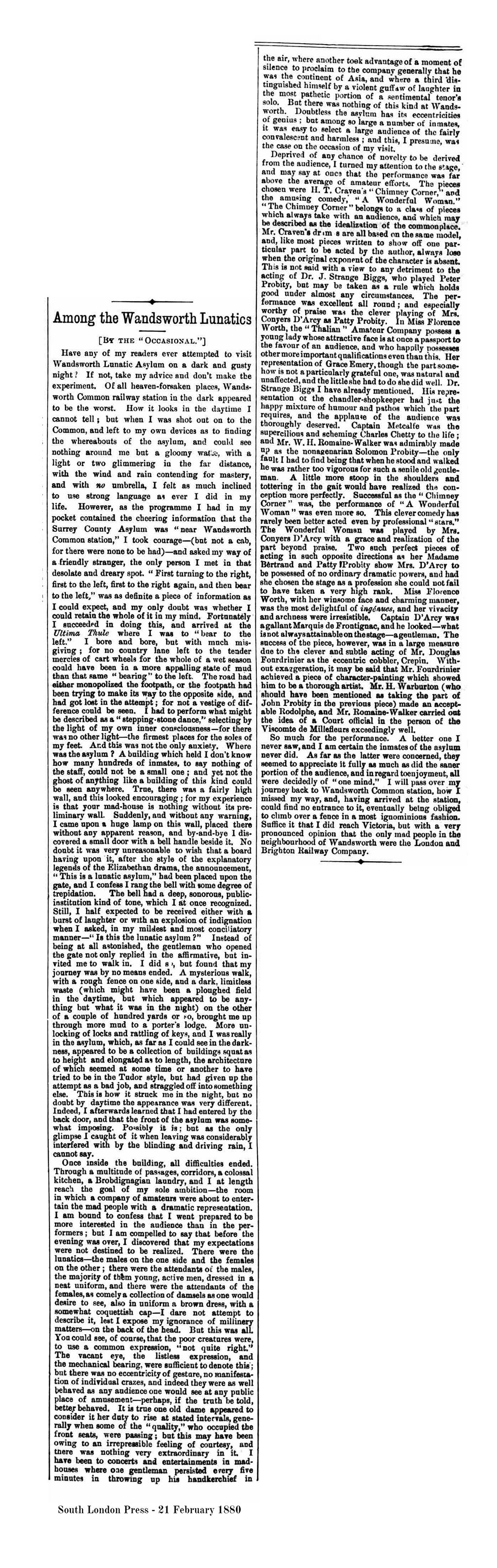
Among the Wandsworth Lunatics
[BT THE "OCCASIONAL"]
Have any of my readers ever attempted to visit Wandsworth Lunatic Asylum on a dark and gusty night ? If not, take my advice and don't make the experiment.
Of all heaven-forsaken places, Wandsworth Common railway station in the dark appeared to be the worst. How it looks in the daytime I cannot tell; but when I was shot out on to the Common, and left to my own devices as to finding the whereabouts of the asylum, and could see nothing around me but gloomy waste, with a light or two glimmering in the far distance, with the wind and rain contending for mastery, and with no umbrella, I felt as much inclined to use strong language as ever I did in my life.
However, as the programme I had in my pocket contained the cheering information that the Surrey County Asylum was "near Wandsworth Common station," I took courage — (but not a cab, for there were none to be had) — and asked my way of a friendly stranger, the only person I met that desolate and dreary spot.
First turning to the right, first to the left, first to the right again, and then bear to the left," was as definite piece of information as I could expect, and my only doubt was whether I could retain the whole of it in my mind.
Fortunately I succeeded in doing this, and arrived at the Ultima Thule where I was to "bear to the left." I bore and bore, but with much misgiving; for no country lane left to the tender mercies of cart wheels for the whole of a wet season could have been in a more appalling state of mud than that same "bearing" to the left. The road had either monopolized the footpath, or the footpath had been trying to make its way to the opposite side, and had got lost in the attempt; for not a vestige of difference could be seen, I had to perform what might be described as a "stepping-stone dance, " selecting by the light of my own inner consciousness — for there was no other light — the firmest places for the soles of my feet.
And this was not the only anxiety. Where was the asylum ? A building which held I don't know how many hundreds of inmates, to say nothing of the staff, could not be a small one; and yet not the ghost of anything like a building of this kind could be seen anywhere. True, there was a fairly high wall, and this looked encouraging; for my experience is that your mad-house is nothing without its preliminary wall.
["A fairly high wall"— was there one? All round? Even along Burntwood Lane? If so, when was the wall removed? (I recall it was lowered on Beechroft.)]
Suddenly, and without any warning, I came upon huge lamp on this wall, placed there without any apparent reason, and by-and-bye iI discovered a small door with a bell handle beside it. No donbt it was very unreasonable to wish that a board having upon it, after the style of the explanatory legends of the Elizabethan drama, the announcement, This is a lunatic asylum," had been placed upon the gate, and I confess I rang the bell with some degree of trepidation.
The bell had a deep, sonorous, public institution kind of tone, which I at once recognized. Still, I half expected to be received either with burst of laughter or with an explosion of indignation when iI asked, in my mildest and most conciliatory manner — "Is this the lunatic asylum ?" Instead of being at all astonished, the gentleman who opened the gate not only replied in the affirmative, but invited me to walk in. I did but found that my journey was by no means ended.
A mysterious walk, with a rough fence on one side, and a dark, limitless waste (which might have been a ploughed field in the daytime, but which appeared to be anything but what it was in the night) on the other of a couple of hundred yards or so, brought me up through more mnd to a porter's lodge.
More unlocking of locks and rattling of keys, and I was really in the asylum, which, as far as I could see in the darkness, appeared to be a collection of buildings squat to height and elongated as to length, the architecture of which seemed at some time or another to have tried to be in the Tudor style, but had given up the attempt as a bad job, and straggled off into something else.
This is how it struck in the night, but no doubt by daytime the appearance was very different. Indeed, I afterwards learned that I had entered by the back door, and that the front of the asylum was somewhat imposing. Possibly it is; but as the only glimpse i caught of it when leaving was considerably interfered with by the blinding and driving rain, I cannot say.
Once inside the building, all difficulties ended. Through a multitude of passages, corridors, colossal kitchen, Brobdignagian laundry, and I at length reach the goal of my sole ambition — the room in which a company of amateurs were about to entertain the mad people with a dramatic representation. I am bound to confess that I went prepared to be more interested in the audience than in the performers; but I am compelled to say that before the evening was over, I discovered that my expectations were not destined to be realized.
There were the lunatics — the males on the one side and the females on the other; there were the attendants of the males, the majority of them young, active men, dressed in a neat uniform, and there were the attendants of the females, as comely a collection of damsels as one would desire to see, also in uniform a brown dress, with a somewhat coquettish cap — I dare not attempt to describe it, lest I expose my ignorance of millinery matters — on the back of the head.
But this was all you could see, of course, that the poor creatures were, to use common expression, "not quite right." The vacant eye, the listless expression, and the mechanical bearing, were sufficient to denote this; but there was no eccentricity of gesture, no manifestation of individual crazes, and indeed they were well behaved as any audience one would see at any public place of amusement — perhaps, if the truth be told, better behaved.
It is true one old dame appeared to consider it her duty to rise at stated intervals, generally when some of the quality, " who occupied the front seats, were passing; but this may have been owing to an irrepressible feeling of courtesy, and there was nothing very extraordinary in it I have been to concerts and entertainments in madhouses where one gentleman persisted every five minutes in throwing up his handkerchief in Price Twopence. the air, where another took advantage of a moment of silence to proclaim to the company generally that he was the continent of Asia, and where a third _distinguished himself violent of laughter in the most pathetic portion of a sentimental tenor's solo But there was nothing of this kind Wandsworth.
Doubtless the asylum has its eccentricities of genius; but among so large a number of inmates, it was easy to select a large audience the fairly convalescent and harmless; and this, I presume, was case the occasion of visit.
Deprived of any chance of novelty to to be derived from the audience, I turned my attention the stage, and may say at ones that the performance was far above the average of amateur efforts. The pieces chosen were H. T. Craven's "Chimney Corner", and the ammusing comedy, "A Wonderful Woman." "The Chimney Corner " belongs to class of pieces which always take with an audience, and which may be described as the idealization of the commonplace.
Mr Craven's dramas are all based on the same model, and, like most pieces written to show off one particular part to he acted by the author, always lose when the original exponent of the character is absent. This is not said with a view to any detriment to the acting of Dr. J. Strange Biggs, who played Peter Probity, but may be taken as a rule which holds good under almost any circumstances. The performance was excellent all round; and especially worthy of praise was the clever playing of Mrs. Conyers D'Arcy as Patty Probity.
In Miss Florence Worth, the Thalian Amateur Company possess young lady whose attractive face is at once a passport the favour of an audience, and who happily possesses other more important qualifications even than this. Her representation of Grace Emery, though the part somehow is not a particularly grateful one, was natural and unaffected, and the little she had to do she did well.
Dr. Strange Biggs I have already mentioned. His representation of the chandler-shopkeeper had just the happy mixture of humour and pathos which the part requires, and the applause of the audience was thoroughly deserved. Captain Metcalfe was the supercilious and scheming Charles Chetty to the life; and Mr. W. H. Romaine-Walker was admirably made as the nonagenarian Solomon Probity — the only fault I had to find being that when he stood and walked he was rather too vigorous for such a senile old gentleman. A little more stoop in the shoulders and tottering in the gait would have realized the conception more perfectly.
Successful as the "Chimney Corner" was, the performance of A Wonderful Woman" was even mote so. This clever comedy has rarely been better acted even by professional stars." The Wonderful Woman was played by Mrs. Conyers D'Arcy with a grace and realization of the part beyond praise. Two such perfect pieces of acting in such opposite directions as her Madame Bertrand and Patty Probity show Mrs. D'Arcy to be possessed of no ordinary dramatic powers, and had she chosen the stage as a profession she could not fail to have taken a very high rank.
Miss Florence Worth, with her winsome face and charming manner, was the most delightful of ingenues, and her vivacity and archness were irresistible. Captain D'Arcy was a gallant Marquis de Frontignac, and he looked — what is not always attainable on the stage — a gentleman. The success of the piece, however, was in a large measure due to the clever and subtle acting of Mr. Douglas Fonrdrinier as the eccentric cobbler, Crepin. Without exaggeration, it may be said that Mr. Fourdrinier achieved piece of character-painting which showed him to be thorough artist.
Mr. H. Warburton (who should have been mentioned as taking the part of John Probity in the previous piece) made an acceptable Rodolphe, and Mr. Romaine-Walker carried out the idea of Court official in the person of the Viscomte Millefleurs exceedingly well.
So much for the performance. A better one I never saw, and I am certain the inmates of the asylum never did. far as the latter were concerned, they seemed to appreciate it fully as much did the saner portion of the audience, and in regard to enjoyment, all were decidedly of one mind."
I will pass over my journey back to Wandsworth Common station, how I missed my way, and, having arrived at the station, could find no entrance it, eventually being obliged to climb over a fence in most ignominious fashion. Suffice it that I did reach Victoria, but with a very pronounced opinion that the only mad people in the neighbourhood of Wandsworth were the London and Brighton Railway Company.
[BNA: Link.]
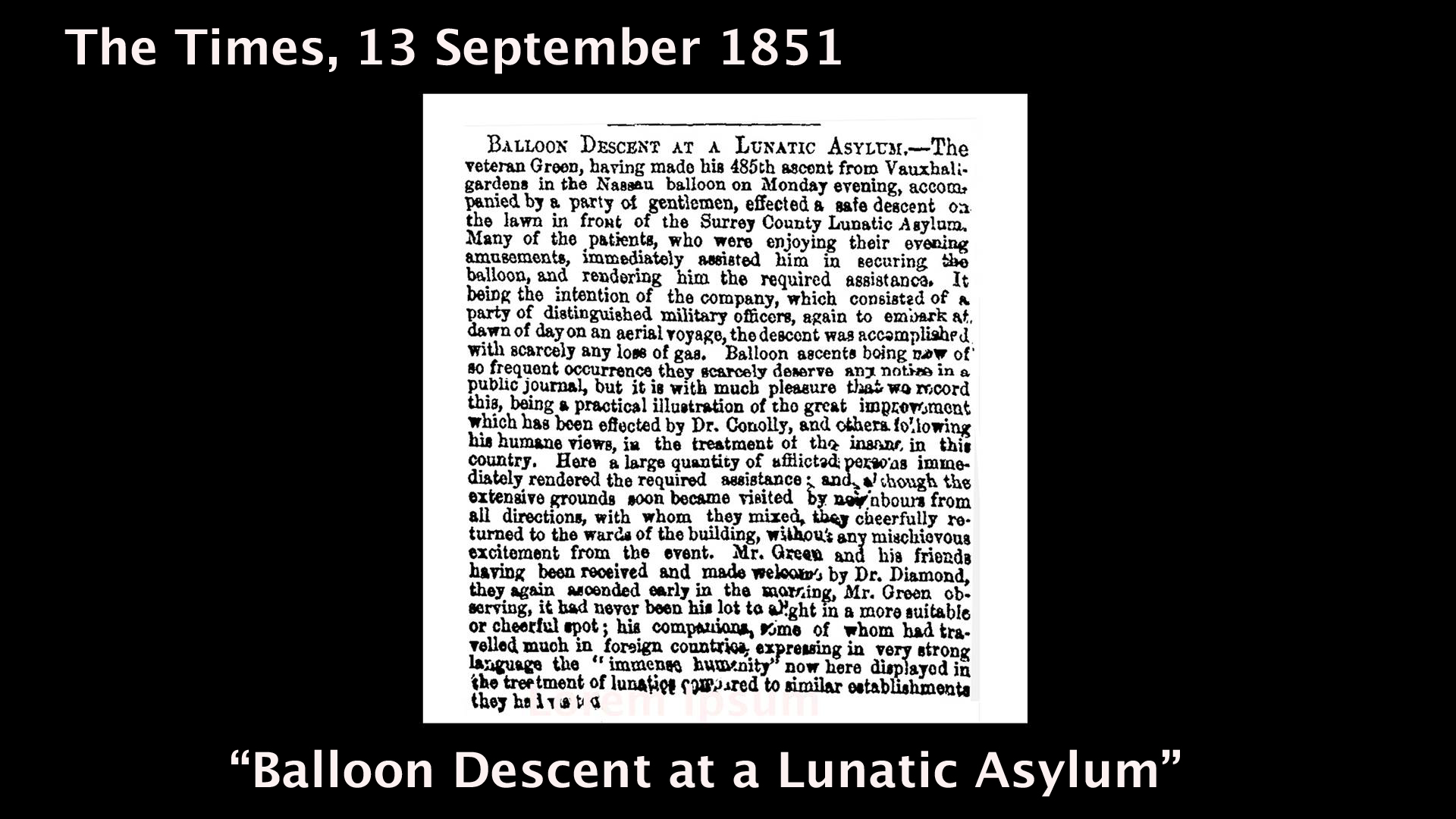
Balloon Descent at a Lunatic Asylum.
The veteran Green, having made his 485th ascent from Vauxhall-gardens in the Nassau balloon on Monday evening accompanied a party of gentlemen, effected a safe descent on the lawn in front of the Surrey County Lunatic Asylum.
Many of the patients, who were enjoying their evening amusements, immediately assisted him In securing the balloon, and rendering him the required assistance.
It being the intention of the company, which consisted of party of distinguished military officers, again embark dawn day on aerial voyage, the descent was accomplished with scarcely any loss of gas.
Balloon ascents being now of frequent occurrence, they scarcely deserve any notice in a public journal, but it is with much pleasure that we record this, being a practical illustration of the great improvement which has been effected by Dr. Conolly, and others following his humane views, of the treatment of the insane in this country.
Here a large quantity of afflicted persons immediately rendered the required assistance; and, although the extensive grounds soon became visited neighbours from all directions, with whom they mixed, they cheerfully returned to the wards of the building, without any mischievous excitement from the event.
Mr. Green and his friends having been received and made welcome by Dr. Diamond, they again ascended early in the morning, Mr. Green observing, it had never been his lot to alight in more suitable or cheerful spot.
His companions, some of whom had travelled much in foreign countries, expressing in very strong language the immense humanity now here displayed in the treatment of lunatics, compared to similar establishments they had visited.
Morning Advertiser— Thursday 11 September 1851
April 9, 1856 — Death of a Lunatic
A patient's death at the Surrey Lunatic Asylum in Wandsworth prompts a national outcry over the treatment of such unfortunates.
65-year-old Daniel Dolley, not a violent man but described as "excitable and foolish," had that morning struck Dr. Charles Snape, the resident Superintendant. Dolley landed a "good sharp blow" to the doctor's head with his fist before being subdued by three "keepers."
The angered Snape orders that the man be placed in a narrow shower-bath; "Pull the string, keep him in a half-an-hour." For 28 minutes, drenched by unheated waters, Dolley remains in the cubicle, less than two feet square, secured by an iron bar. Removed by an orderly, the poor man is dead within a quarter hour's time.
At a perfunctory inquest at "the dead house," Dr. Snape pressures the autopsy surgeon to conclude that death was due to a bad heart.
The surgeon, however, surreptitiously removed Dolley's heart, which he then carried round to several London physicians, none of whom saw evidence of significant heart decay. The Commissioners in Lunacy soon charged Dr. Snape with "unlawfully causing the death of an aged lunatic."
With an unblemished record, Snape admitted he had never treated a patient like that before, but he had never been struck by a patient before either.
He's also supported by several experts who testify to the efficacy of the shower-bath in calming unruly madmen. Investigators for the Commissioners computed that Dolley had been drenched by some 618 gallons of cold water. One doctor even spent nine minutes in the cramped bath, he called the experiment "quite disagreeable," conceding that the experience had been probably even worse for "an exciteable lunatic."
Although the charge was reduced to manslaughter, a grand jury refused to indict. The Times, though acknowledging the "universally asserted" benefits of the shower-bath, called for restraints on its use, "It would be extremely difficult to convince twelve jurymen, not selected from the inmates of Bedlam, that any human being could endure the rush of water from a shower bath of unusual severity for half-an-hour without imminent hazard of life."
[Tom Hughes, Victorian Calendar: Link.]
There is a lot more to say about this case— I've probably already made some notes somewhere— e.g. about Hugh Welch Diamond's role in performing an autopsy, with the aid of his son, and then showing it other doctors, possibly with the intention of attacking Snape.
And did Diamond resign shortly after, as a result of the Daniel Dolley scandal, and move to Twickenham to open his own private asylum?
But this is not what Hugh Welch Diamond is famous for. It is photography...
Back to the top of this page . . .