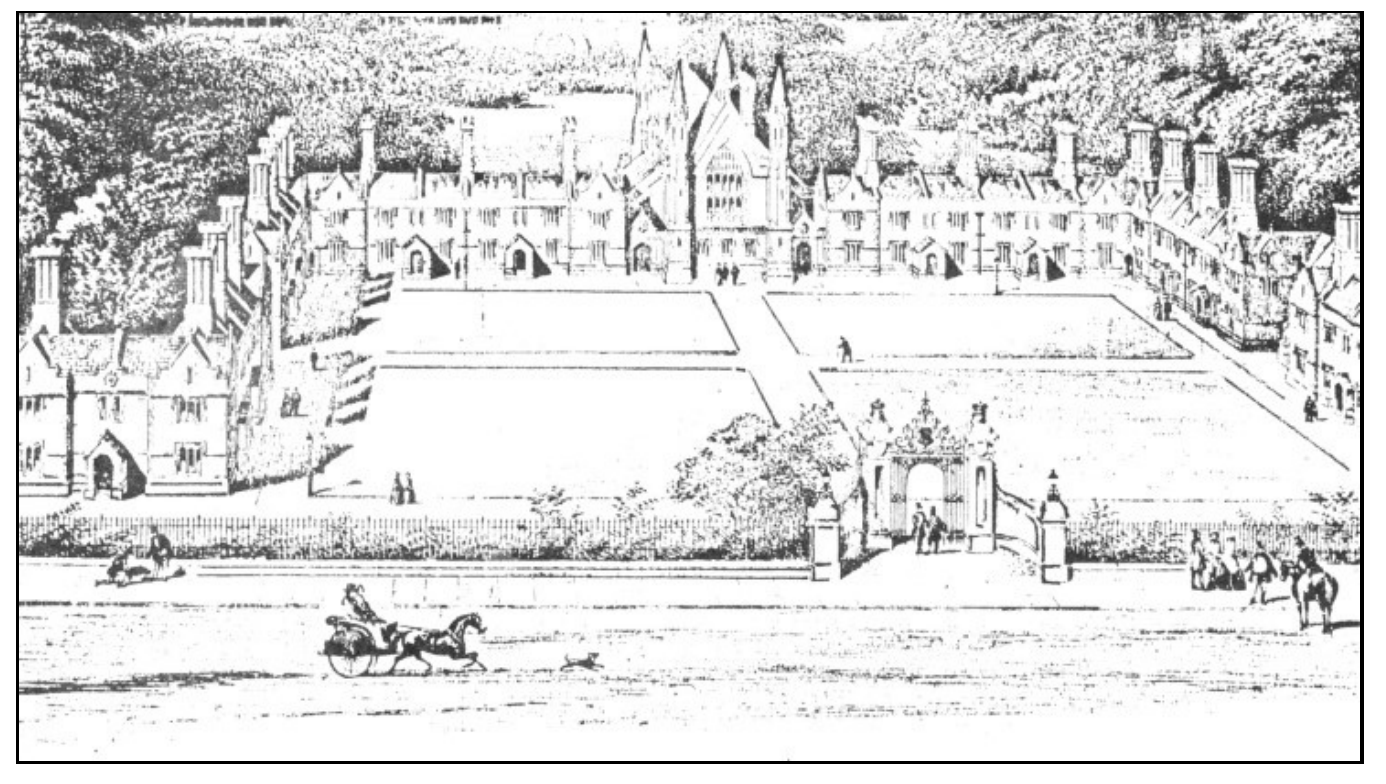
An artist's impression of St Peter's Hospital dating from 1850, before the institution was completed, showing the gateway that still stands on East Hill. (The Builder)
Build: 05 July 2026 — v1
Today only the ornate gates to St Peter's Hospital, a block of almshouses belonging to the Fishmongers' Company, survive at the top of East Hill, Wandsworth, their true origins obscured by the plaques on them marking the London County Council (LCC) housing development known as the East Hill Estate. The Fishmongers' Company, one of the City of London livery companies, had provided almshouses in south London from the seventeenth century. In 1615 Sir Thomas Hunt willed £20 10s per year so that the Company could build a hospital for six poor freemen, all of whom were to receive small pensions. In the same year letters patent were obtained from James I to establish almshouses, which were built originally in the parishes of Newington and St George in Surrey.1
In the 1840s the Fishmongers' Company decided to replace the old hospital at Newington, which had been named after the patron saint of fishermen, and bought land on East Hill. The position was described in the Illustrated London News at the time as ‘as open and airy a spot as any in the environs of the metropolis’, and the site offered a clear view towards the railway line and the Thames, across a foreground of open fields on which sheep grazed, according to the illustration accompanying the article.2 The Fishmongers' Company architect, Richard Suter, was responsible for the design and it is interesting to note that the Company looked at the St Clement Danes almshouses in Garratt Lane, amongst a number of other institutions, when considering Suter's scheme. The Garratt Lane buildings (now known as Diprose Lodge) survive today and there is a useful comparison to be made between them and St Peter's Hospital, both of which were conceived as three sides of a quadrangle with a chapel at the centre.
An artist's impression of St Peter's Hospital dating from 1850, before the institution was completed, showing the gateway that still stands on East Hill. (The Builder)
The first stone of the new almshouses was laid on 23 June 1849 by Mr W. Flexman Vowler, the Company's prime warden, and they were to cost £25,000 compared with the figure of £400 for the erection of the old ones at Newington in 1617. The style was Tudor, with lofty chimney-stacks as a prominent feature. For the dressings Caen stone was used.3 The quadrangle was about 255 feet by 235 feet in size, with its southern side opening onto the high road and fronted by a fine pair of gates and railings (the latter were removed in June 1983). The quadrangle's centre was laid out as four lawns divided by paths. The new hospital was opened in 1851, and its appearance stayed relatively unchanged until the almshouses were demolished in 1923.
There were forty-two houses, each self-contained with three rooms, with additional rooms for the medical officer, clergyman and paymaster. The forty-two almspeople were both men and

2. The northern façade of St Peter's Hospital viewed from the railway. (Illustrated London News)
The almshouses were sold in the early 1920s, the former inmates were granted pensions, and the demolition of the buildings to make way for the LCC housing estate was of sufficient interest to feature under the heading of ‘The Passing of Old London’ in the Manchester Guardian during the summer of 1923.4 It was a mark of the prestige of the new project that it was one of the two LCC housing estates chosen to receive a visit from King George V and Queen Mary on a cold winter Saturday in 1927.5
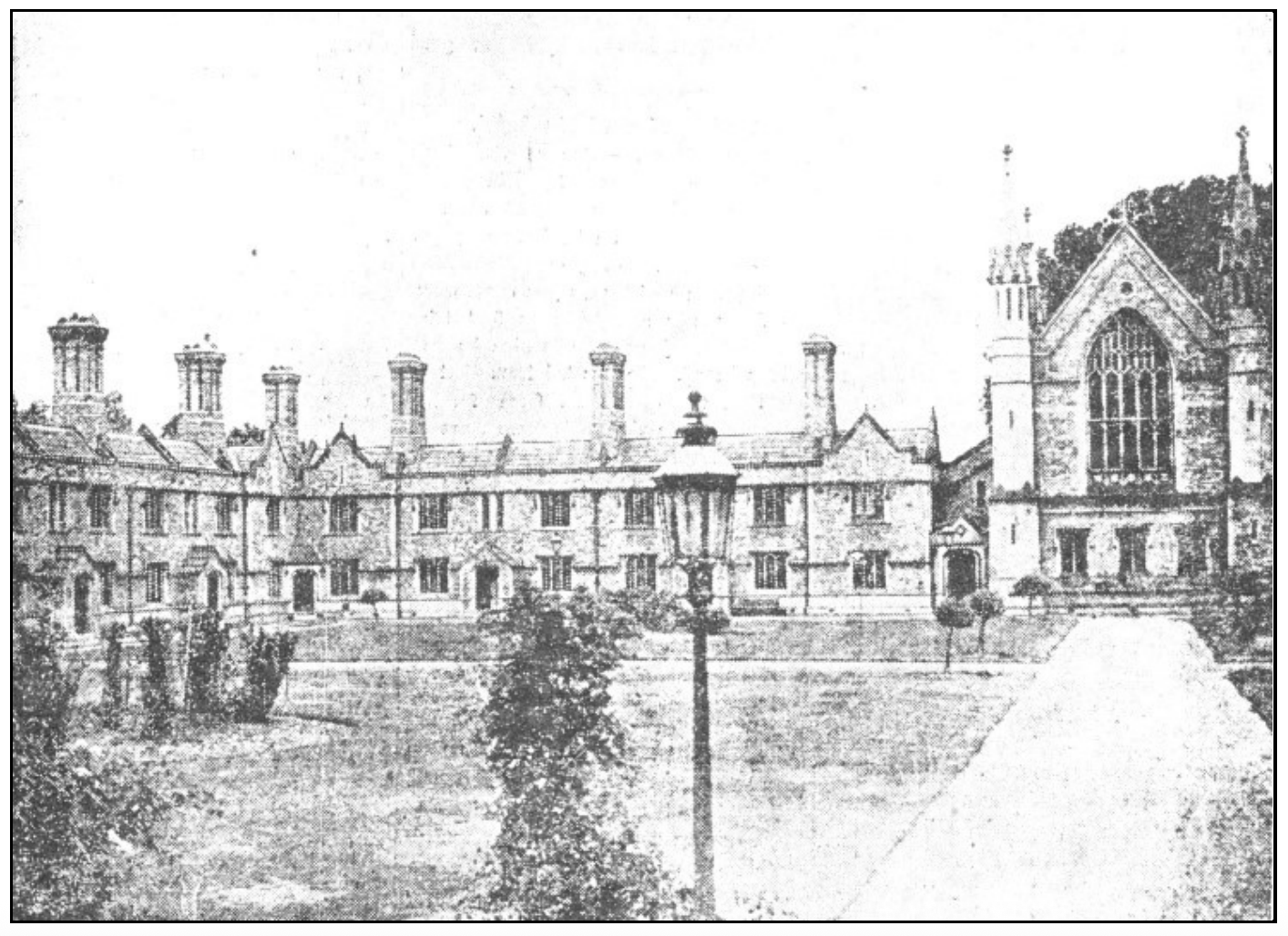
3. St Peter's Hospital in 1923 shortly before it was demolished. (Manchester Guardian)
A number of the flats on the LCC's East Hill Estate were damaged during an air raid in April 1941, and the whole development eventually suffered the same fate as St Peter's Hospital. Today newer housing stands on the site, but still residents pass through the old almshouse gates, with only the Wandsworth Society plaque dating from 1996 to give them any background to the symbolism of the fishes carved on the gate posts.

St Peter's Hospital in 1923 shortly before it was demolished. (Manchester Guardian)
Note.—The final paragraph has been slightly modified to bring the article more up-to-date for modern readers.
© Wandsworth Historical Society 1985, 2017
References
1 Go to www.fishhall.org.uk for more information on the history and heritage of the Fishmongers' Company.
2 Illustrated London News, 24 May 1851, pp. 451–52.
3 The Builder, 2 Feb. 1850, pp. 49 & 54.
4 Manchester Guardian, 27 Jul. 1923, p. 7.
5 The Times, 21 Feb. 1927, pp. 15 & 16.