Remembering Eddie Fisher ("Sir Edmund Tintacks")

(Click on image to enlarge)
8, Loxley Road
8 November 2020
Given that this year's Remembrance Sunday is the 8th of November, I thought it would be a good time to write about one of our own - Edmund Fisher, who grew up on Loxley Road and went to Emanuel School.
I have yet to find his exact date of birth, but it was registered in the April-June Quarter of 1899 - which suggests he was born some time between March and June 1899. (The date matters, as you will see.) In 1905 he was living across the Common at 8 Dents Road, but in 1911 we find him at 8 Loxley Road. He is 11 years old.
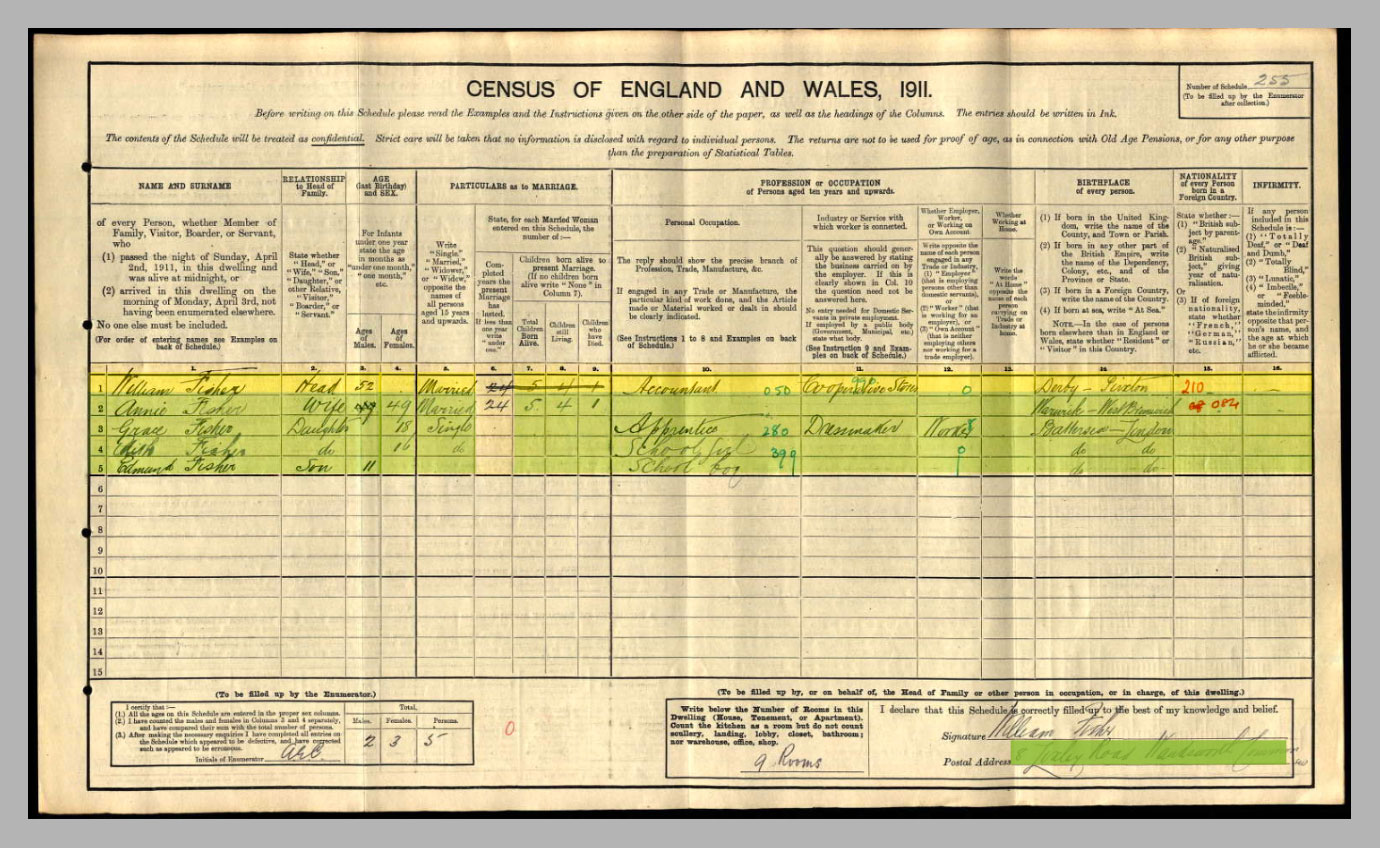
1911 Census - the Fisher family at 8 Loxley Road
Also listed are his father, William (an accountant), his mother Annie, and two sisters. He also had an elder brother, living elsewhere, and another sister, but she had died.
(Click on image to enlarge)
Eddie Fisher, captain and champion
At 15, Eddie was already 6 feet 3 inches (1m 90cm) tall and powerfully built - a champion athlete, the captain of a rugby team that never lost a match.
In 1915 Eddie won the School's Athletics Challenge Cup after winning the 220 yards, Hurdle Race, High Jump, Long Jump, and the 440 yards.
Such was his athletic prowess that he helped Emanuel win the Challenge Cup at the Public Schools' Athletic Sports. (People said he would have performed even better, but for an accident which happened a few weeks previously, when "he had had the misfortune to put his head through the window of a railway carriage - an accident which necessitated his head being stitched, which prevented him from training". Sadly, no further details of how he achieved this have ever come to light.)
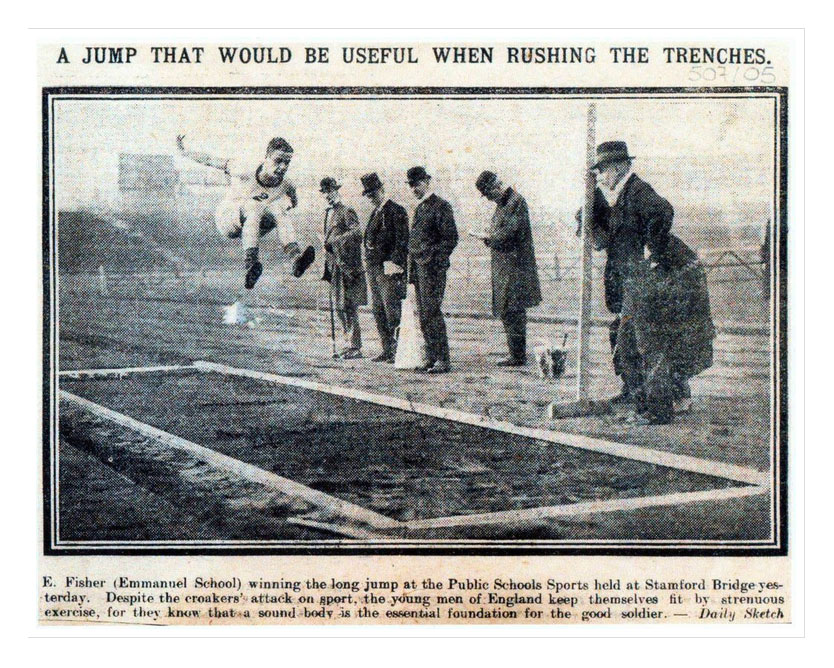
"A JUMP THAT WOULD BE USEFUL WHEN RUSHING THE TRENCHES"
"E. Fisher... winning the long jump at the Public Schools Sports held at Stamford Bridge...the young men of England keep themselves fit by strenuous exercise, for they know that a sound body is the essential foundation for the good soldier", Daily Sketch, 1915.
(Click on image to enlarge)
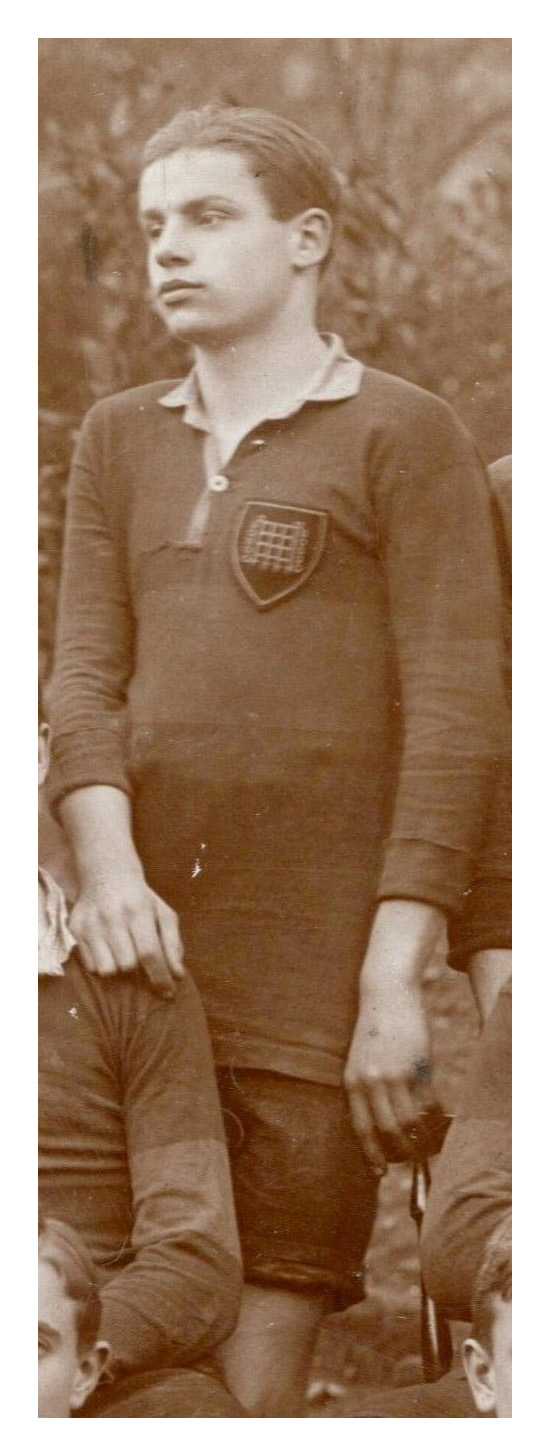
Eddie Fisher, captain of the First XV, 1914-15
(Click on image to enlarge)
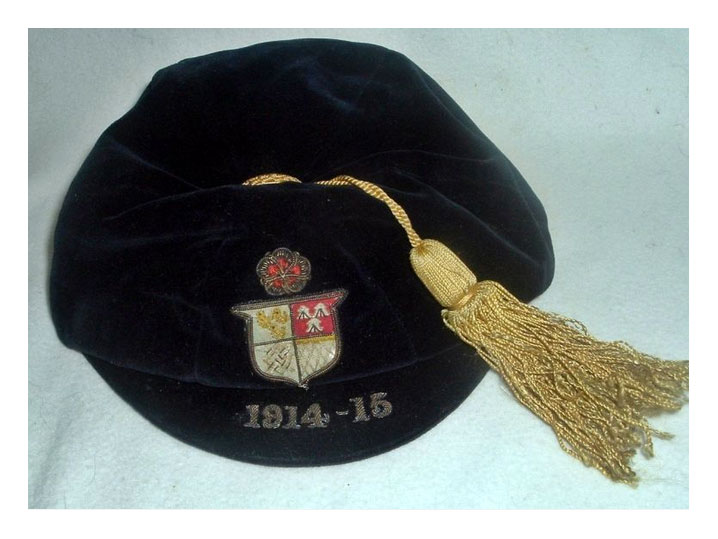
The cap he was awarded as captain of the first XV.
(Remarkably, it turned up on EBay in 2012.)
(Click on image to enlarge)
The white feather

(Click on image to enlarge)
At some time in 1915 Eddie Fisher was crossing Wandsworth Common, perhaps on his way to school, when a woman pinned a white feather on his school uniform. Given his size and mature manner, she can't have known that he was still much too young to sign up. He was a coward, and she planned to shame him into enlistment.
It worked. According to his sister, Gladys, Eddie was mortified.
Somehow or other he was able to present papers to the enlistment boards - apparently signed by his father, the school vicar, and the headmaster - that declared he was 18 (two years older than he in fact he was). Did he falsify their signatures? Or did they collude in the deception?
Eddie had been active in the school's Officer Training Corps, and he was definitely officer material, regardless of his youth.
As a fellow pupil recalled, "Eddie rose to the position of Cadet Lieutenant in the OTC and on a night march in 1915 he rescued a party of exhausted boys. After a while Fisher, who had gone on with the others, returned triumphantly, driving a wagon and two horses, which he had commandeered to pull us out of the 'miry fastnesses.'"
He joined the 3rd East Lancashire Regiment as an officer. Inevitably, he soon distinguished himself as a sportsman, as the regimental notes record:
"[2nd] Lieutenant Fisher was a real 'tearer' at the quartermile and sprints. At the brigade sports at Dieval, Fisher won the 100 yards, 220 yards and a gruelling mile; almost on the top of that he had to take part in a relay race, which he won for us by making up a deficit of at least a third of a lap - a wonderful performance."
The War in France, 1916
But for the Somme, Eddie might have gone on to become an Olympic athlete (as one of his contemporaries did). On the 15th or 16th November 1916, 2nd Lieut. Fisher was killed as his battalion attempted to take German trenches in a local action that became known as the battle of the Ancre. On the 18th November, the battle of the Somme was over. In all, about one million men were dead. Aged only seventeen and a half, Eddie was one of the youngest officers to die in the war.
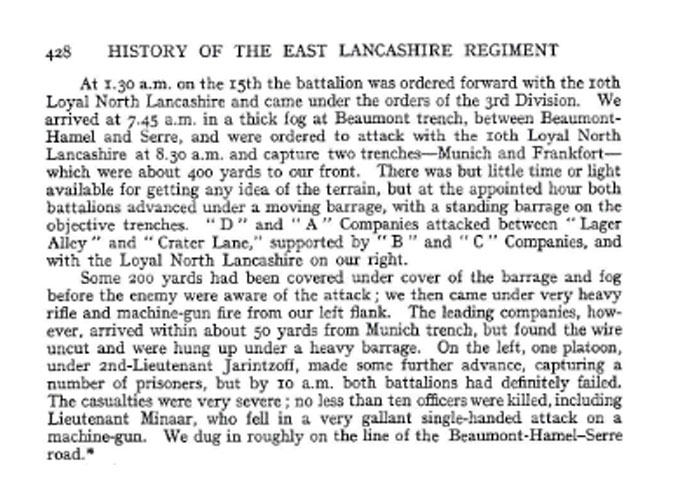
The Battle of the Ancre, from the regimental history.
[You can view a map of the Somme battlefields here.]
(Click on image to enlarge)
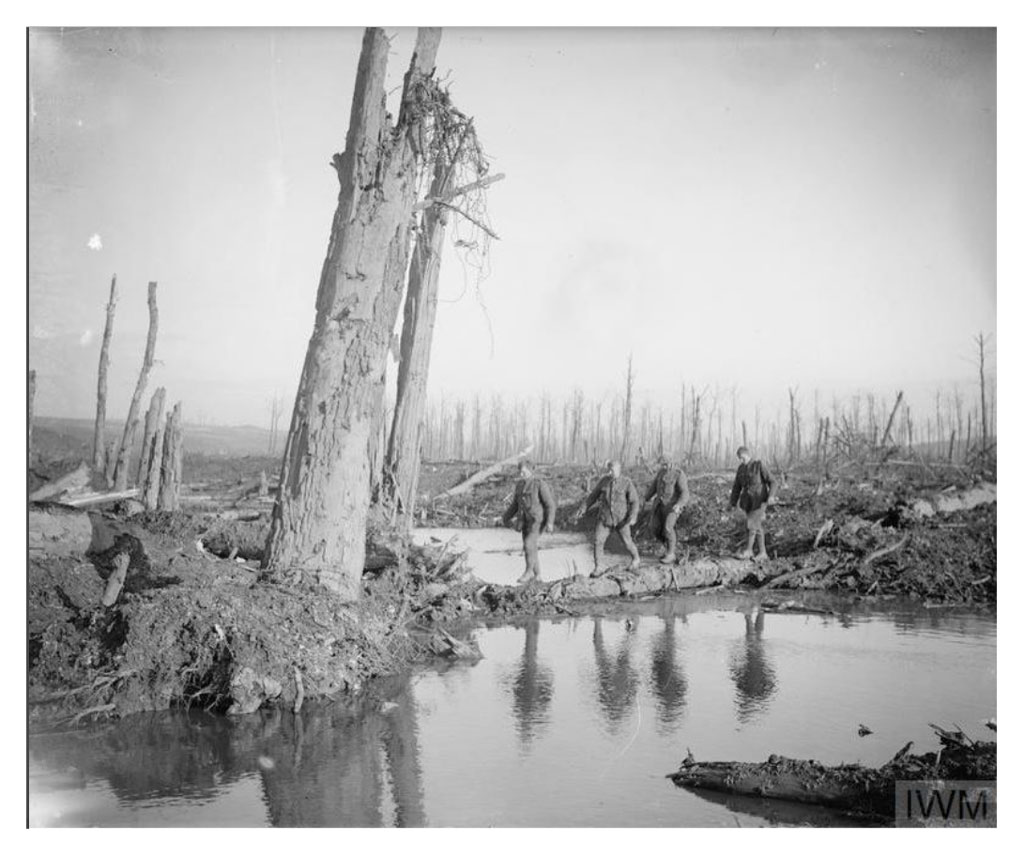
The terrain at Ancre, where Eddie Fisher died.
(Click on image to enlarge)
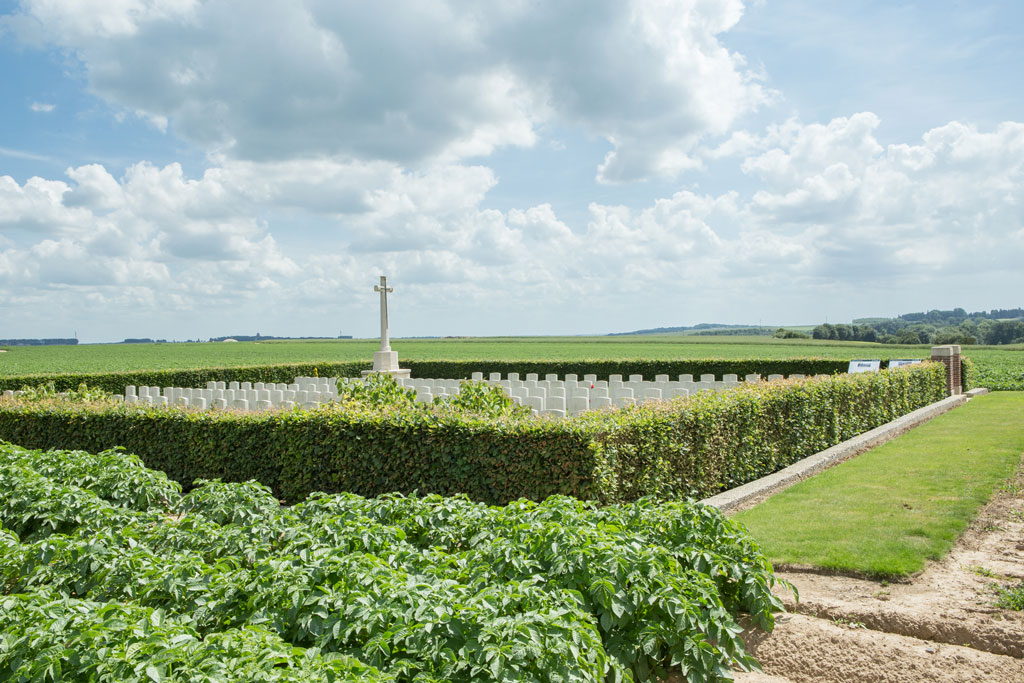
Eddie's grave in Waggon Road Cemetery, Beaumont-Hamel.
(Click on image to enlarge)
By WWI standards Waggon Road is a small cemetery - he is there with 156 others.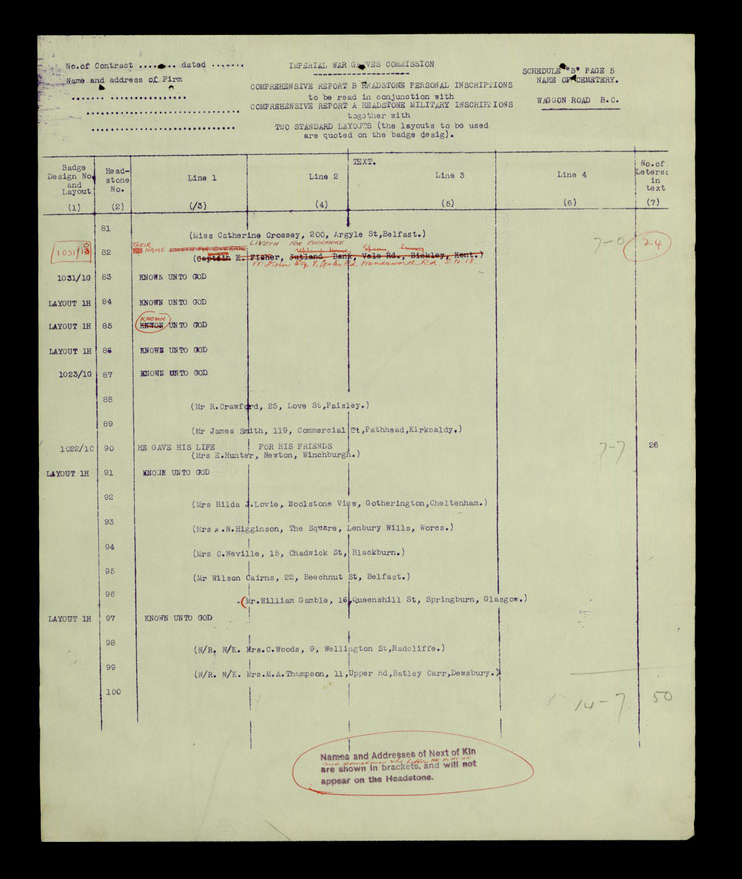
Edmund Fisher's family asked to have the words "THEIR NAME LIVETH FOR EVERMORE" carved on his headstone at the Waggon Road Cemetery.
As you can see in the right hand column, there were 24 letters of text to pay for.
(Click on image to enlarge)
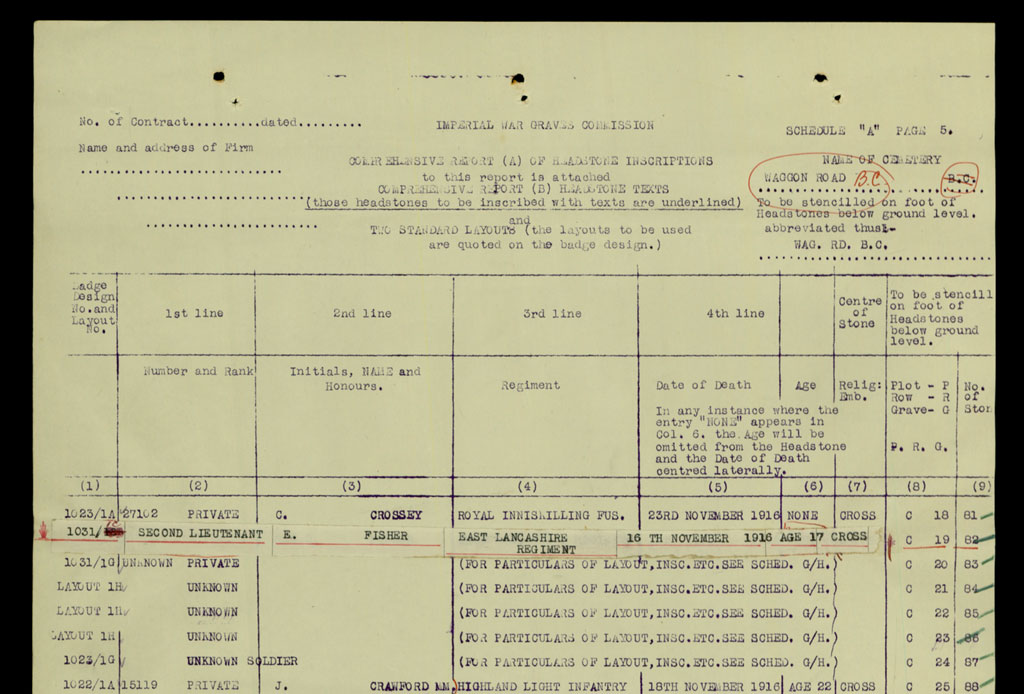
Imperial War Graves Commission entry for 2nd Lieutenant E. Fisher
(Click on image to enlarge)
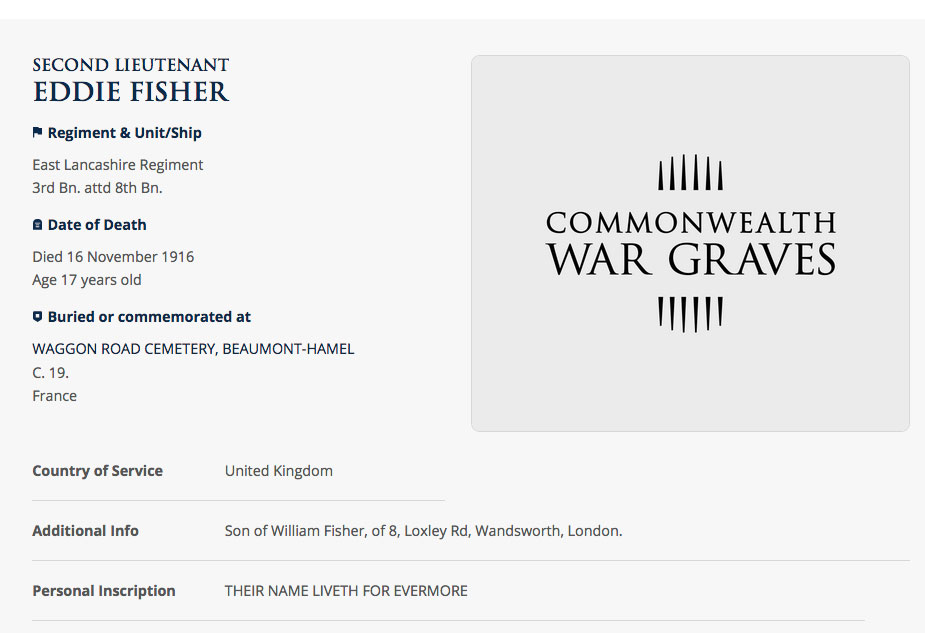
Commonwealth War Graves entry for Edmund Fisher
(Click on image to enlarge)
The Emanuel Memorial
About 800 boys fought in the Great War, and of these at least 145 were killed.
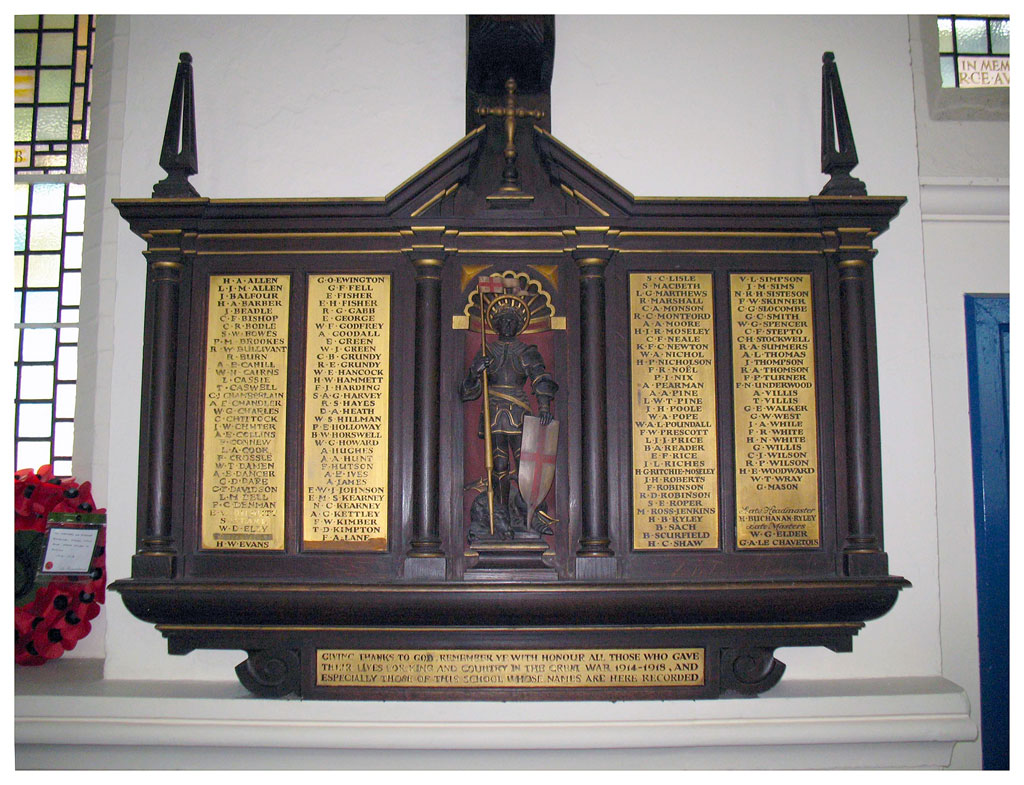
The Emanuel School memorial in the Chapel.
(Click on image to enlarge)
Eddie Fisher remembered by his contemporaries - "A Very Perfect Knight"
Eddie's death made headlines not just in local papers - "Another Emanuel School Hero" - but even as far away as the USA, where the New York Herald reported his death under the sub-heading "Athletes Famous for their Skill and Endurance Give Lives in War."
As Old Emanuel Joseph Deeks remembered years later, "We felt the tragedy of war every week, for at daily service in the School Chapel we heard of the death of some Emanuelite serving in the front line... Perhaps the most tragic was the fate of Eddie Fisher."
In the Christmas 1916 edition of the school magazine The Portcullis, a fellow schoolboy wrote "An Appreciation" of Eddie - "Sir Edmund Tintacks" - so named because he was "a very perfect knight, and like the knights of old, he has made the supreme sacrifice in the cause of honour for King and Country...We of Emanuel are proud to belong to a School which can turn out such chaps as he":
ONE of the latest names to be inscribed on Emanuel's "Roll of Honour" is that of E. Fisher. It is with the greatest regret that we have to report that he was killed in action. But although the School and this earth can know him no more, there is no death for such as he.
Little more than two terms ago he was in our midst, and his face is still fresh in the memory of most of us.
Do you remember how, when we were in Shell I, he was nicknamed "Sir Edmund Tintacks"?
"Sir Edmund " - in truth he was a very perfect knight, and like the knights of old, he has made the supreme sacrifice in the cause of honour for King and Country.
Although only seventeen years of age when he took his commission, he left behind him a very crowded record of good work done for Emanuel. He attained the responsible position of a Prefect, and was House Captain of Lyons.
He worked his way from a Private to a Cadet Lieutenant in the O.T.C. [Officer Training Corps], and was Captain of one of the most successful fifteens of recent years. He was a splendid athlete, and we all remember how he won for Emanuel the coveted "Tippets" Challenge Cup, by his fine running and jumping, although but a few weeks previously he had had the misfortune to put his head through the window of a railway carriage - an accident which necessitated his head being stitched.
He was a very keen worker for the School Chapel and was instrumental in bringing many boys up to the School services. Will those chaps honour his memory by a regular attendance at these services as he would have wished?
He was honoured and respected by the men under his command, and our loss is undoubtedly shared by them.
We of Emanuel are proud to belong to a School which can turn out such chaps as he. May we all, in whatever walk of life we may be called in the future, be aided, by the memory of E. Fisher, and those other fellows who have left such splendid examples behind them, to be an honour to the old School.
A. W. S.
"The council of war at 8 Loxley Road"
Here is another memory of Eddie, one very different in character. Looking back in 1961, towards the end of a long life, one of Eddie's closest school friends said he wanted to talk about the past. He was in some pain and speech did not come easily, but his words were later reported in The Portcullis:
The School memory uppermost in his mind went back to 1915.
The hero of that epoch was Edmund Fisher, a giant of six foot three who captained an unbeaten rugby team, made several athletic records, and was a senior prefect. At this period there were no wireless, no television, almost no cars or cinemas: senior boys made the School their life.
One night the prefects decided to have a supper. Leave was obtained and the limited victuals to be found in 1915 were scraped together. Later an excursion over the roofs was proposed...
[But during the adventure one of the boys] fell through a skylight and seemed severely injured. Suddenly Shirley Goodwin [the headmaster], an awesome and monumental figure, appeared: Fisher was deprived of his prefect's badge.
This rankled, for though Fisher was the senior he had not taken part in this particular escapade.
At the week-end a council of war was held at 8 Loxley Road (not yet S.W.18)... Fisher's father was indignant and brought the session to a close by using one of the first telephones to summon one of the last taxis in this district. Into it were loaded the score or so of cups and trophies that Fisher had won, the two boys, and the parent.
Their destination was the Headmaster's House, Emanuel School, and there was blood upon the moon.
There was some delay, for it was a Sunday afternoon, and during it the visitors arranged the cups and shields in a neat semi-circle round the doorway. At last the Headmaster appeared and, after showing some astonishment at the blaze of silver, took Mr. Fisher inside.
Ten minutes later the waiting boys heard a door open, and then Shirley Goodwin's gigantic and infectious laugh. They knew that all would be well. From his waistcoat pocket the Headmaster produced the prefect's badge which, akin to Napoleon, he was rarely without.
Fisher was reinstated, the cups reloaded into the waiting cab, and off they drove.
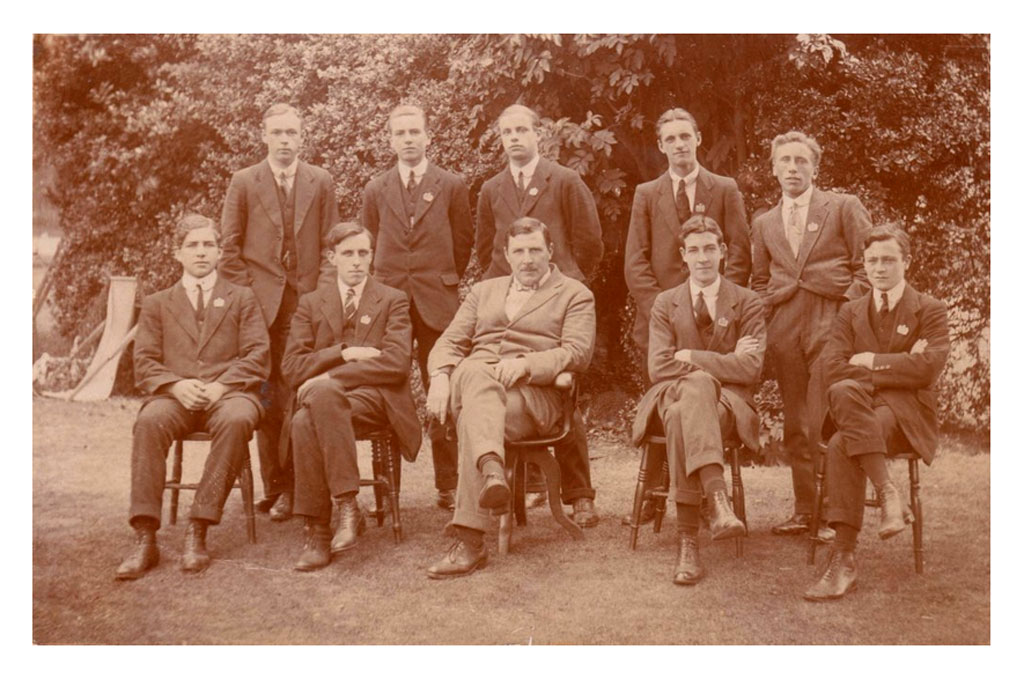
Edmund Fisher (centre, back row) with fellow senior prefects, and Headmaster Shirley Goodwin (1915 or 1916).
(Click on image to enlarge)
Acknowledgements
I would like to thank Tony Jones, the Emanuel School senior librarian and archivist, for enabling me to consult the school's remarkable records and collections.
- Emanuel School at War
- War Memorials Online
- BBC: Five films of the Battle of Ancre - is it possible that Eddie Fisher appears in one of these remarkable reels?
- Wandsworth 1914-1918
Notes
Although I have focused this article on one person, there were a number of others who lived on Loxley Road (or whose families did), who I could have written about. (Indeed, of all the roads in our area, Loxley appears to have been the hardest hit at this time.)
For example, L. A. Criddle, Queen's Royal West Surrey Regiment, husband of Freda Criddle, 49 Loxley Road. He died aged 29 in Belgium on 2nd December 1916. He is buried in Lijssenthoek Military Cemetery. His headstone carries the inscription: "BLESSED ARE THE PURE IN HEART FOR THEY SHALL SEE GOD".
Also John Corlett and William Payne (no.16), Geoffrey Hills (no.20), Arthur Prismall (no.65), Archibald Davey (no.73).
Or who lived in nearby roads - Lyford, Burntwood Grange, Ellerton, Frewin, Herondale, Magdalen, Heathfield, Trinity, Baskerville, Routh, or the Prison Quarters (where Strickland Crescent is named after Charles Strickland, a prison officer who died in 1916).
Many (though not all) of these men are recorded on the fine Memorial Rood Screen at St Mary Magdalene Church, where there are links to brief but excellent biographical notes. Their addresses are listed here.
Here are some good links:
After reading the article, Keith Bailey emailed to say he'd been inspired to do some further research on the Fisher family:
"William snr was living at 11 Anhalt Road Battersea in 1891/1901, described as accountant in 1891 and commercial clerk in 1901. He married in 1887. The children were: William Harold (Battersea 1888; m.St Michael Battersea 1913, engineer of 8 Loxley Rd.); Margaret 1890-6 b/d Wandsworth; Grace 1892; m.1920 St Mary Mag Wandsworth; Edith 1895; m. 1924 St Mary Mag.
Neither William nor Annie seem to be readily traceable in death/probate records."
Get in touch!
Email me, Philip Boys (14 Loxley Rd) at historyboys@chargeofthelightbrigade.com.
You can see other articles in this series here: The Hidden History of Our Streets.