
Last modified: 3 October 2026
Snow at the 3rd London General Hospital, compiled from images in The Gazette, 1914-1920, set to "Let It Snow", by Sammy Kahn and Juli Styne, performed by Josh Turner.
— tiny version, small enough to download and send as an email attachment.
— higher-resolution version on YouTube.
This video-card grew out of a talk I did last month that you can view from the Friends of Wandsworth Common website, or here:

Christ born on Wandsworth Common . . .
"Taking Hyde Park as representing Jerusalem . . . Bethlehem would be on Wandsworth Common."


COMPARATIVE OUTLINE OF THE HOLY LAND
Mr. John MacGregor (Rob Roy) describes the size and the bearings of the Holy Lend in a way very intelligible to a London audience, and to others familiar with English geography.
Taking Hyde Park as representing Jerusalem, the relative positions of the Temple, the Mount of Olives, the Dead Sea, Bethlehem, the Sea of Galilee. and other localities. Ihe outline is, of course, but a rough one, but it is suggestive.
Jerusalem occupies, as it were, that part of Hyde Park to the east bounded by the Serpentine. The site of the Temple — Mount Moriah — the space north of Achilles' statue, and Zion — the Dairy.
Gethsemane would he located at Grosvenor-square, and the Pool of Bethesda at Grosvenor-gate, while the Pool of Siloam would be Buckingham Palace Gardens water, and Kedron River Park-lane.
The Holy Sepulchre would be in the site of the barracks, and strange to say, Herod's Palace on that of the of the Royal Humane Society.
The Guards' house at the bridge represents the Jaffa Gate, and the Mount of Olives — 2,700 feet above the sea-level — would be in Bond-street. The upper Pool of Gibon would be at the Round Pond in Kensington-gardens, and the Damascus Gate would be represented by Victoria Gate. Petersburg place, Bayswater-place, would be the site of the Russian convent, and Rachel's tomb would be close to Chelsea-bridge.
Bethlehem would be on Wandsworth Common; Hebron at Redhill; the Dead Sea — 1,300 feet below sea-level at Erith; Carmel at Leicester Nazareth at Peterborough; and Mount Hebron at the mouth the Humber; while the Sea of Galilee would be in the fens of Norfolk. near Stoke, and the Mediterranean at Great Marlow . . .
[Source: BNA: Link.]
Drat! I missed celebrating this event last month. But better late than not at all. And besides, December is a very culinary month.
We may chiefly remember John Charles Buckmaster today for his powerful influence on securing Wandsworth Common, but there's a lot more to him. Here's another of his many personae — cookery lecturer and author:

Buckmaster's Cookery remained in print from 1874 at least until the start of the First World War. (I hope to sort out the details of its publishing history, but not quite yet.)
JCB, writing from St John's Hill, Wandsworth, dates his Preface "2 November 1874":
It was with much reluctance that I accepted in 1873, the invitation of Her Majesty's Commissioners of the International Exhibition to deliver a course of lectures on Cookery. One of the exhibits that year was Food, and it was thought this section might be more instructive by lectures . . .
But there was a small problem: John Buckmaster knew absolutely nothing about cooking. But fortunately for him his wife, Emily, daughter of a Cambridge butcher, certainly did. Doubtless she coached him thoroughly, and his lectures were a triumph. (Though so far as I know he never credited her contribution.)

John Buckmaster lecturing (sermonising?) on Cookery at the Third International Exhibition, 1873, held at South Kensington. One newspaper reported his talks to be “far more entertaining than most plays going on these days”. During its run, JCB famously taught Queen Victoria how to cook an omelette.
Notice the demonstrators — five of the six are female — preparing food to hand out to the audience to try. The cook at the back, in front of a range and open grate, wears a large crinoline — not ideal where open fires were involved.
The demonstrators in front are cooking with gas — Buckmaster's lectures did much to promote the installation of gas in homes at this time. (We should not forget that Wandsworth Gas Works, close to Wandsworth Bridge, and another in Battersea, were among of London's largest — both gasworks survived until fairly recently. Edwin Rayner Ransome (on whom more below) was a director of the Wandsworth gasworks.)

The International Exhibition building at South Kensington, 1872. See Link.
A single event symbolises the birth of the domestic subjects movement, a movement that was to promote tirelessly the re-education in housewifery of the British female. On 1 April 1873 J.C. Buckmaster of the Science and Art Department, South Kensington Museum, gave a series of lectures and demonstrations on the application of scientific principles to cookery, as part of the third International Exhibition that had been organised after the success of the Great Exhibition of 1851.
The lectures were spectacularly successful; crowds flocked to them and one newspaper reported them to be “far more entertaining than most plays going on these days”.
This missed the point; something far more momentous than entertainment was intended, and what started as a fad among the fashionable of London society soon spread to become a movement bent on raising the standard of cookery and household management in all private homes.
Within three months a prospectus for a National Training School for Cookery was issued. Its aim was “to teach the best methods of cooking articles of food in general consumption among all classes". Over the next 30 years women in this movement assiduously promulgated the need for domestic instruction across the nation.
[Annmarie Turnbull, "An Isolated Missionary: the domestic subjects teacher in England, 1870-1914", Women's History Review, vol.3 no.1, 1994.]
Incidentally, John and Emily were great entertainers at their home on "New Road" (now Prested Road), near the new Clapham Junction railway station. (Their house itself was demolished many years ago, when the station expanded.)
As their son Martin described ruefully years later:
My father . . . could not afford a large family and although we kept two or three servants, in the Victorian manner, as well as a governess, I found myself very much a backstairs slave, cleaning the household boots and knives — no rustless steel then.
My father and mother were most hospitable, and if friends called they were usually invited to lunch or dinner, no fuss or preparation, only a few more plates and knives and forks for me to tackle later.
I did not much mind slavery in the kitchen and scullery, but I hated the servitude of the dinner parties, when my father dressed me as a waiter, in a boiled shirt and white tie, to wait on his guests and my brothers, through a five course dinner.
I know I was a snob but I hated the patronage of the guests who told me "how well I waited". I was then about sixteen years old, a very sensitive age.
I hope one day to write in detail about this aspect of JCB's life's work, which had a profound effect on the teaching of Domestic Science in schools (and probably on very much more).
At this point I was going to relate one of JCB's cautionary tales — probably the one about how a young wife's culinary failings caused the breakdown of their marriage ("Hashed mutton is the horror of most husbands"). But I'll leave that for another time.
I hope to pick this up again in April next year. But in the meanwhile, if you're interested in learning more, and perhaps in researching this topic for yourself (or just want to try cooking some of JCB's recipes!), please get in touch.
One of the most thrilling sides of producing the Chronicles month after month, year after year, is that people with no obvious connection to Wandsworth Common stumble across things I've written and get in contact. Some ask for extra info., but mostly they add something completely unexpected. I love it when this happens.
There have been a number of examples this month, including a wonderful picture from the photographer Fred Kingsbury (who owned the studio on Bellevue before Dorrett and Martin), and the splendid discovery of a velocipede from 1869 made, it seems, by Edwin Rayner Ransome's company — Ransome lived on North Side, and was among the stoutest defenders of the Common prior to the 1871 Wandsworth Act, and (as a Conservator) way beyond.

A week or so ago, I received a very interesting email about Fred Kingsbury, whose studio on Bellevue was later used by Dorrett and Martin (they took over the lease 1 April 1899):
"I came across your website while searching for the photographer Fred(erick) Kingsbury.
I don’t know any more about him than you already do except that he took the attached wedding photo of my great-grandparents Max Schliephak and Charlotte Poulsen. I don’t know if the photo was taken on the day itself, but the wedding was on 31st December 1898.
You can see the name Fred.k (short for Frederick) Kingsbury and the address 16 Belle Vue Road at the bottom.
This page at the National Archives also seems to detail a photo of his from 1897 that they have. It refers to 16 Belle Vue Road.
You’re welcome to use the photo on your webpage if it’s of any interest.
All the best.
David
Thanks, David!
I rather wonder if Max and Charlotte had a connection with Wandsworth Common, but there's nothing obvious yet. Here is their marriage, on New Year's Eve 1898:

Did the couple travel down to Bellevue from Paddington? Or did Fred Kingsbury travel there (which seems unlikely). Were they perhaps honeymooning locally?
David also sent me a link to an image (undigitised, or not online) in the National Archives catalogue of
Photograph of the ladies Eileen and Ruby Elliot grouped. One figure seated with legs crossed, the other figure looking down with right foot on sofa.
[Copyright: Frederick Kingsbury, 16 Belle Vue Road, Wandsworth Common, registered 5 June 1897.]
[National Archives: Link.]
Alas, no image is available to view online. It would be good to have a copy, wouldn't it.
I wonder if Eileen and Ruby Elliot lived locally?
David replied:
My great-grandfather, Max Schliephak, was originally from Germany, and the first place I know of when he moved to London was at 90 Victoria Street. He did some kind of apprenticeship there.
Their marriage certificate shows that he called himself a “Chemist” at the time they got married, though I’m not sure of the difference between that and a pharmacist in those days. Coming from a German background, he would have been called an “Apotheker”. I have a postcard written to him at 90 Victoria Street from Germany, where he is addressed as “Apotheker-Chemist”.
I don’t know if you have access to Ancestry.co.uk, but I think there’s a good chance that this is the likely family of Lady Eileen Elliot and Lady Ruby Elliot. If so, they seemed to be daughters of the 4th Earl of Minto. Whoever that is. It might explain by the National Archives bother to keep a photo. It adds a bit of colour to Fred Kingsbury’s life if he was taking photos of the aristocracy.
They both married in the Westminster area. So, I wondered if he perhaps he had more than one studio, either at the same time or consecutively.
Then I found this article. It says about Fred and about 16 Belle Vue “On April 1st, 1899 Dorrett and Martin entered into a partnership and bought the premises of Fred Kingsbury, who had a photographic business at 16, Belle Vue Road, Upper Tooting (1 p. 63,64 ; 10) and for a short period also at 60, The Strand, in London ( 1 p.64;p.114 n. 126; 3 p. 18)” then it also mentions “... while Martin had stayed near the Bellevue Road business... “
Fred(erick) also seems to have taken some well known photographs of Constance Wilde, the wife of the famous Oscar Wilde.
On this page, it says “It did strike me that, as I put it in my article, the photograph showed ‘a woman whose beauty had lost some of its bloom since the familiar Frederick Kingsbury studio photographs of 1892.”
On this Sotheby’s page, if you click the second photo down, you can see a photo of Constance, taken by Frederick in 1892. The address on it is 45 St George’s Place, Knightsbridge.
The same photo of Constance is here on the National Portrait Gallery website.
I hope some of this is interesting. It adds some detail about one of 16 Belle Vue’s occupants but, as we now know that Fred had several studios, it probably makes it less likely that either my great-grandparents, or the Ladies Eileen & Ruby Elliot had any specific connection to Wandsworth.
[Readers with access to Ancestry.co.uk can read more about Max and Charlotte here.]
Thanks once again, David — so much very useful info. to add to the picture. I'd completely forgotten Fred Kingsbury's studio in Town, even though I'd mentioned it in a talk I gave (with Chris Allies) on Dorrett and Martin for the Friends of Wandsworth Common in October 2023:
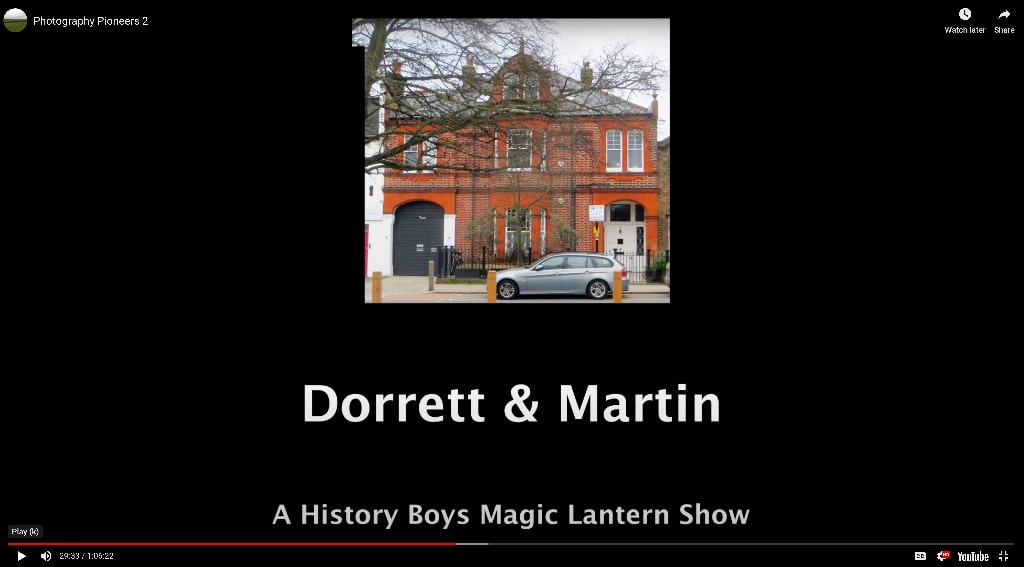
"PIONEERS OF PHOTOGRAPHY ON AND AROUND WANDSWORTH COMMON - PART II 10/2023 - The second instalment of our heritage talks about pioneering photographers, this time focussing on Paul Martin and Harry Dorrett, who worked together at a studio facing the Common at 16, Bellevue Road (Athol House). Martin pioneered the use of ‘snapshots’ taken with a hidden camera and images taken with very long exposures at night. "
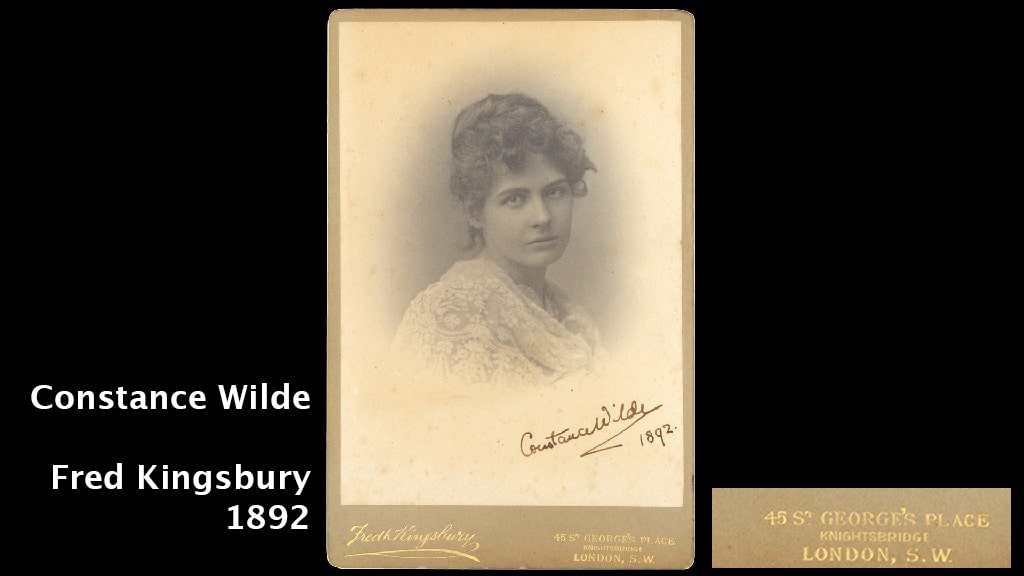
Constance Wilde, taken by Fred Kingsbury in his Knightsbridge studio, 1892 (three years before Oscar Wilde's imprisonment in Wandsworth).

Photo Colin Kirsch.
A fortnight ago, Colin ("WingYourHeel") Kirsch emailed me about his latest acquisition:
I have a bicycle museum (online) and have recently managed to acquire an 1869 velocipede with a stamping (cartouche) by S. & E. Ransome of Essex St Strand. I’ve just started researching the company.
Edwin Ransome is mentioned in a Quaker periodical relating to the establishment of a school in Tasmania. At the moment I am assuming he is the "E" in S. & E. Ransome. But I’ve also seen him mentioned on your page as having an interest in Wandsworth Gas Company (below) and a wider family connection to Ransome’s lawnmowers.
I wondered if you had any information that shows his connection to S. & E. Ransome Ltd?
I did have some info., and I shared it with Colin. Here's something I wrote about Edwin Rayner Ransome a couple of years ago:
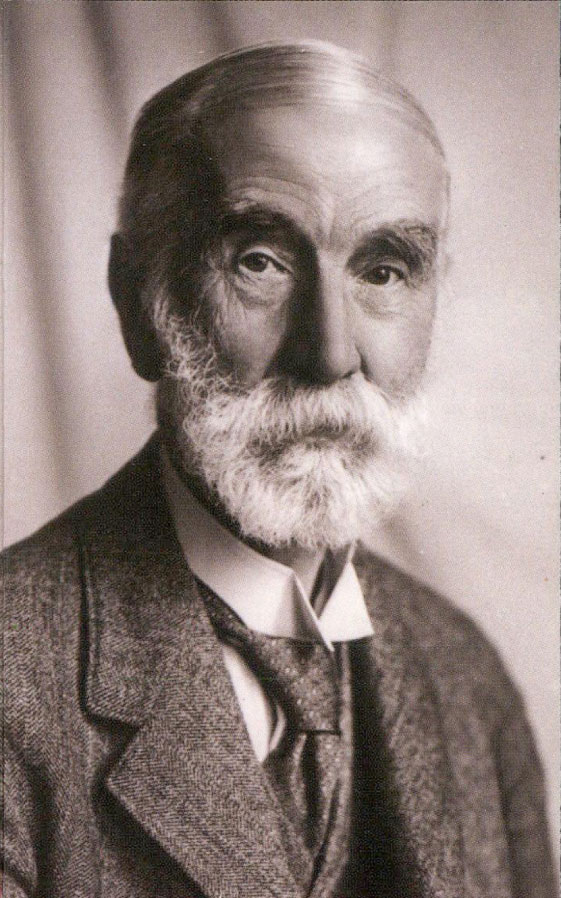
Edwin Rayner Ransome, a Quaker and a passionate campaigner for Wandsworth Common.
Visit Colin's wonderful Online Bicycle Museum for numerous fine images of the velocipede in question: 1869 | E.R. Ransome, the French Velocipede Company.


"This velocipede represents an important part of British cycle history because its cartouche, engraved and stamped into the backbone, shows it to be built by Edwin Rayner Ransome of 10 Essex St, Strand, London, and licensed by the French Velocipede Company of 14 The Strand, London.
This company was one of the first to import velocipedes from France for resale in Britain: “A boneshaker with forged ironwork, and front wheel of 32 inch, 34 inch or 36 inch was £10 or £12 according to finish and fittings.” ££12 in 1869 would be around £1750 today."
[Online Bicycle Museum: 1869 | E.R. Ransome, the French Velocipede Company.]
You may recall I wrote about velocipede racing on Wandsworth Common a couple of years ago:
— HoWC: Chronicles: April 2022: Velocipede Racing on Wandsworth Common.
Two wheels good, four wheels bad

RACE WITH VELOCIPEDES
Yesterday a race took place with the now fashionable recreation of velocipede riding level road on Wandsworth-common, between six amateur velocipedians, for a stake of £15. The distance contested was two miles, and two of the competitors, who travelled with two-wheel machines, were handicapped, and put 25 yards below the starting point. The other four, who contended with the old-fashioned four-wheel velocipedes, started level.
The race was commenced at a sharp pace, Mr. Canton (four wheels) finishing the first mile in five minutes and 32 seconds, and commanding a good lead a spirited race was kept up, the riders of the two-wheel velocipedes working easier than their opponents; and when within half a mile of the winning point a French gentleman (M. de Ferne) on a two-wheeler came from the rear, passed his opponents, and won by several lengths.
The last half-mile was covered in two minutes and 28 seconds, and the two miles accomplished by the winner in 10 minutes and 30 seconds.
[BNA: Link. Also e.g. South London Press — Saturday 24 April 1869.]
I wonder how these speeds might compare with a modern bicycle? Any cyclists out there prepared to provide some times?
The straight, level "two-mile" course must be our Trinity Road, which at that time stopped at North Side. But in fact the distance is a little less — just over 1.8 miles.

Four- and three-wheeled velocipedes. The latter is described as a "Rantoone" — Colin may know otherwise, but can we assume the "Rantoone" owes the first part of its name to Edwin Ransome? In which case, who or what des the "Toone" refer to?
Mike Tuffrey, historian of Clapham and a regular correspondent, tells me that the three old parishes that form the Borough of Lambeth (Clapham, Streatham, Mary Lambeth) may be beating the bounds next May. Very exciting news indeed.
"It's looking like the three old parishes in modern Lambeth — Clapham, Streatham and St Mary Lambeth — may organise a joint beating the bounds on May 24th next year. I went on a bike ride of St Mary's as part of this year's Lambeth heritage festival, organised by Jon Newman, and the idea has grown from there. 'Joint' as in doing it on the same day with potential to actually meet up at Clapham New Park where the three join, if we can get the timing right . . .
My first task is to walk the route and see how close we can get. The boundary on the west is described as "the watercourse" — I'm guessing Mayford Road, then back east along Nightingale. We'll get to wave at your Common at least!"
Which raises puzzles about the precise route of the Clapham parish boundary.
There are two major questions. What is the course of the boundary with Battersea that crosses Clapham Common? (On tithe maps drawn up in the early 1840s, for example, Clapham claimed the whole of Clapham Common, but Battersea disagreed.)
— More on the Battersea/Clapham boundary crossing Clapham Common
And second, even closer to our Common, the enigma that is "Clapham Detached", which you can see marked on the map below. In this case Nightingale Lane is its northern boundary. (The centre of the road? Or one side of the road? The issue is in part which parish had responsibility for the upkeep of Nightingale Lane.)

Stanford, 1878: "Map of London and its Environs, Shewing the Boundary of the Jurisdiction of the Metropolitan Board of Works. Also the Boundaries of the City of London, the Parishes, the Districts & Extra Parochial Places."
Clapham attached or detached?
I replied:
Yes, it looks like the boundary of "Clapham (Detached)" included part of the northernmost of the two tributaries to the Falcon Brook (Anglo-Saxon "Hildaburna"; "York Sewer" from mid-C19) that met/meet at the corner of Calbourne Road and Mayford Road.
So the mysterious Clapham Detached's southern border — the "watercourse" in question — ran beneath most of today's Oldridge Road — the eastern half of Calbourne Road — northern part of Mayford Road — Birchlands Avenue (centre of road, or through the back gardens and edge of Nightingale Housw?).

OS, 6-inch map, c.1868, marked up to show the boundary of "Clapham Detached". W.C. refers to Wandsworth Common; C.C. to Clapham Common; B. is Battersea parish; and S is Streatham parish. The tributaries of the Falcon Brook, and ornamental lakes created by damming it, are marked in blue.
If you're interested in participating, contact me and I'll forward.
And finally, wonderful news from from the Friends of Wandsworth Common . . .
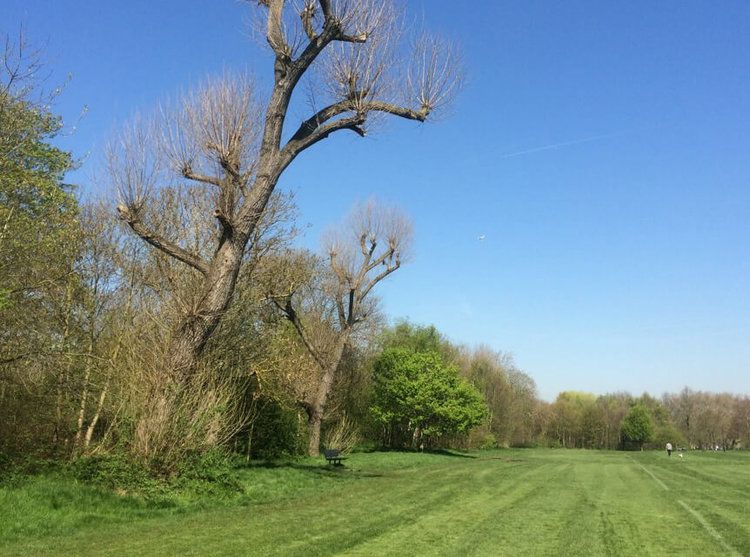
BLACK POPLAR PLANTING
[We'll soon be planting] some rare black poplars close to where the three once grew near Skylark and the Cat's Back bridge.
The young saplings have been grown from cuttings from the one in the playground next to Skylark which has been genetically verified as a pure native rather than a hybrid. It is therefore one of the rarest natives in the country.
Black Poplars are among my very favourite trees. Every one that dies is a grievous loss to the Common.
Here are some links:
— Woodland Trust: Black Poplar (Populus nigra subsp. betulifolia)): "Imposing, elegant, rare. The black poplar was once a staple of Britain’s landscape but these days, the trees are few and far between."
— Wikipedia: Populus nigra.
— National Trust: "Saving our native black poplars".
SO many more stories still to tell. But that's all for now, folks.
Send me an email if you enjoyed this post / want to comment on something you've seen on the site / would like to know more — or just want to be kept in touch.
If you would like to receive notifications of new Chronicles, let me know.
And visit here for videos of talks, and local history shorts
There's a SEARCH box at the top of this page, and here . . .
Philip Boys ("History Boys")
December 2024
Return to the top of this page . . .
