We were advised unless we could secure a copyholder, of which there were not more than six left, or an Act of Parliament, the common must go.
I managed to obtain a list of copyholders, and there was only one at all likely to become a plaintiff. He was a poor, ignorant old man, either a bachelor or a widower, living in a dirty, tumble-down, pantiled old copyhold, and obtained a miserable living by selling potatoes, brickdust, and treacle. I had often seen him, but had never spoken to him.
I mentioned these qualifications to the lawyer, who said, "He is the very man!"
I made some private inquiries, and found he had a weakness for gin and water. I passed his shop almost every morning about the time he was watering his greens and sorting his potatoes. The next [321] time I said, "Good morning, Mr. Wrigsby." He returned the compliment. I praised his potatoes and at once ordered half a bushel.
I allowed a few mornings to pass by, simply wishing him good morning. I said, "If you will call on me in the evening and bring up another half-bushel of potatoes I will pay you."
He came up. I sent my wife into another room and asked Mr. Wrigsby to have a pipe. He sat down. I ordered some hot gin and water. We talked about the rates and taxes, and we agreed that the parish was going to the bad.
I asked, "Who is your landlord?" He replied, "Nobody; it's copyhold. One gentleman endeavoured to purchase a copyhold, but he would not have been admitted by the Court Leet."
[PB: Using Ancestry, I have not been able to find a "Wrigsby" living in Wandsworth at this time. This is not surprising. Presumably JCB has disguised his name. Yes, it was Digby - see Shirley Passmore.]
I said, "You are a copyholder?"
He replied: "Yes, but I never go to the Court. My father was a copyholder, and he kept two cows and a pony on the common, but I have no cows, and I am my own pony, and think it would be a good thing if the common was built over; it would bring a little more business into the parish."
11 [322] "Have a little more gin and water, Mr. Wrigsby. I think as you don't get any benefit from the common the least they could have done would have been to give you compensation, or a piece of the common. You are a poor, hard-working man, and I think they have behaved very badly to you. All the rich people round the common have been helping themselves pretty freely, and I daresay you know I have been doing what I can to stop any further stealing."
"Everybody in the parish knows what you have done, but you don't seem to have prevented it. I hear that fellow Dobs, who owes me a bill I can't get, is taking in a bit near the lane."
"Mr. Wrigsby, Dobs is a land-stealer, and you are the only man in the parish that can stop his stealing."
[PB: Presumably "Dobs" is Christopher Todd.]
"How can I stop it? I have no money to go to law."
"Mr. Wrigsby, you would be the greatest benefactor this parish ever had if you would only enter your protest against this robbery of your rights. I will guarantee that you shall [323] not be sixpence the poorer, and if we win you may be richer."
"Do you want me to go before the magistrate and complain? "
"No. I want you to sign a paper that you object to these enclosures."
"Well, as it's to oblige you, I don't mind, if you will promise to stand by me, but I can't afford any expense, and I depends on you. If the common was built over it might not do me much good. I daresay they would build shops as sells the same as I do."
"When shall we meet to sign this paper? Will you come to my house, or shall I come to yours?"
"Just as you like."
"Then, if you don't mind, perhaps you will come to me next Thursday evening at halfpast six. You need not mention to any one our conversation, because it only concerns the copyholders, and you are almost the only one left. Will you have a little more refreshment before you go home?"
"No, thank you."
As soon as I saw Mr. Wrigsby's back I ran [324] off to the lawyer and reported our interview. He was highly delighted. He said, "At seven my clerk shall be there with the plaint; it has been prepared a long time. You and my clerk must witness the signature."
On Thursday Mr. Wrigsby was in good time. I had ready the long clay and tobacco and gin and water. We talked about parish - matters, and just as the first glass was finished I heard a knock at the door. I said, "I daresay this is the man with the paper."
It was important that Wrigsby should have his wits about him. The clerk began reading the plaint, and I kept Mr. Wrigsby occupied in conversation while the rights of estuary and turbary were gone over. Mr. Wrigsby paid little attention to it. He made no remarks, except asking if all that writing was about the common.
It was rather a long business, but at last we came to the end, "whereof the memory of man faileth not," and Mr. Wrigsby signed it in the presence of two witnesses. I shall never forget the expression of joy on the clerk's countenance as he watched Mr. Wrigsby put on his spectacles and sign his [325]
[PB: "the rights of estuary and turbary". Turbary is the ancient right to cut turf, or peat, for fuel on a particular area of bog. Is "estuary" the same as "estover" - the right to collect and cut firewood?]
name. He took a little piece of blotting out of his pocket and placed it carefully over the signatures, put the plaint in his black bag, said ' Good-night, Mr. Wrigsby," and was out of the house in an instant.
Mr. Wrigsby wondered he should be in such a hurry. He thought he had come to talk about the common. Poor Mr. Wrigsby little thought that he had commenced proceedings against the lord of the manor, the Brighton and South Coast Railway Company, the West London Extension, the South-Western, and six others.
It may be said that I ought not to have taken advantage of Mr. Wrigsby's weakness, but it was our last extremity, and Aristotle would have defended it.
Whatever came of it, Mr. Wrigsby could not suffer; he had nothing to suffer with.
The lawyer asked me to accompany him to a Q.C. in Lincoln's Inn, who was the best authority on real property. A few minutes after ten he came into his chambers, and the lawyer laid on his table the plaint. After some general remarks about commons he turned over page after page, then turned it back again, then looked at the signatures, [326] and appeared to me not very sanguine about the matter. Anyhow, we were now going to law, and there was some satisfaction in knowing it.
I ventured in the most respectful way to say, "I think, sir, I ought to tell you that the plaintiff in this case is a very illiterate man."
"I should think he is a damned idiot, or he would never be a plaintiff in a case of this kind. There is no law on the subject - the law has to be made. I will attend to it, but God only knows where it will end."
We left, and for a few weeks everything was quiet. I occasionally called on Mr. Wrigsby, whom the lawyer had never seen, and what astonished me was that he had told this eminent Q.C. that he didn't want to see him. As soon as the other side knew Wrigsby was plaintiff, off they went to him, and told him that he would be sent to prison for signing an affidavit. He came to me in great trouble, and told me the enemy had been to him.
I gave him a pipe and something to drink, and as we parted he said pathetically, "You will stand by me, won't you?"
I replied, "To the very last." I frequently called on him [327] with words of comfort and encouragement.
At last he was cited to appear on his affidavit before the court, and immediately after he had an attack of gout, which I hoped would continue long enough for the case to stand over.
I called on his doctor, and said, "I have seen Wrigsby. I don't think he is well enough to appear."
He replied, "Don't you want him to appear? I can give you a certificate for the usual fee," which I paid, and Wrigsby did not appear.
The Long Vacation was coming on, and Wrigsby still had the gout. The defendants were very anxious to force on the case, but were rather late. I hoped, and the committee hoped, something would happen.
We continued at convenient intervals our meetings, and public feeling and most of the newspapers were with us, but they could not stop the lawsuit or say much about it. One paper praised the public spirit and intelligence of the plaintiff.
As soon as the courts opened Wrigsby had to appear. The doctor's certificate had lost its virtue. I saw him, and explained to him that, no matter what they asked, he was to
14 [328] say that he was a copyholder, and meant to protect his rights. He repeated this over tome. I begged of him not to say anything more. I said, "If they ask you your age say you are a copyholder."
I called with a cab for the great plaintiff, but I had my fears. I felt as if we were going to an execution, but Wrigsby knew he was going into society, and dressed accordingly. He had on a pair of primrose-coloured breeches and gaiters, which hung on his body in graceful fulness; a yellow plush waistcoat, with large glass buttons, which gleamed like cat's eyes; a blue coat, far too small, with a few brass buttons; and a large white choker twisted round his neck like a tablecloth.
The appearance of the plaintiff in court was a sensation. Six defendants were each separately represented by counsel, supported by a strong detachment of lawyers. Where the carcase is there will the eagles be gathered together. As Mr. Wrigsby stood up the Vice-Chancellor looked at him, as well he might, for he was a natural curiosity.
Counsel for the Railway Company began by a few loving remarks about Mr. Wrigsby's health, [329] and in less than twenty minutes Wrigsby told the whole story of his signing the affidavit - what I had told him to say, that I would stick to him to the last, that he should not be sixpence the poorer for the lawsuit, perhaps better, that the common was no good to him and never had been, and it was to oblige me that he signed the paper. He didn't know exactly what it was about, but I told him it was all right.
If an earthquake had swallowed up me and the others I should not have objected.
After all my work this was a terrible blow. The lawyer leaned over to me and said, "It is all up." The counsel and lawyers for the defendants sniggered at each other, waiting for the magic words, "Judgment for defen
The thieves who had stolen the common laughed outright, and as I came out of court jeered at me. The Vice-Chancellor, a pious, good old man - may he rest in peace ! - said, "I shall reserve judgment." Then the counsel and lawyers stared at each other and leisurely packed up a cartload of papers and books and left.
I never spoke to Wrigsby again, and I felt [330] counsel's opinion of him at our first joyful interview was correct. What was to be done? Another mass-meeting where we could pour out our sorrows and find comfort in the frantic hurrahs of the demos, who wanted to go at the fences!
JCB writes:
I managed to obtain a list of copyholders, and there was only one at all likely to become a plaintiff. He was a poor, ignorant old man, either a bachelor or a widower, living in a dirty, tumble-down, pantiled old copyhold, and obtained a miserable living by selling potatoes, brickdust, and treacle. I had often seen him, but had never spoken to him.
I mentioned these qualifications to the lawyer, who said, "He is the very man!"
I made some private inquiries, and found he had a weakness for gin and water. I passed his shop almost every morning about the time he was watering his greens and sorting his potatoes. The next [321] time I said, "Good morning, Mr. Wrigsby." He returned the compliment. I praised his potatoes and at once ordered half a bushel.
Something else I was working on yesterday involves "James Smith Digby", who John Buckmaster writes about at length in his autobiography (he calls him "Wrigsby")
Here's a mention in the Survey of London/Battersea:
One such copyholder, James Smith Digby, was persuaded to file a case in Chancery. An agricultural labourer with little or no education, Digby was not the best choice for a stooge, quickly crumpling when he appeared in court.171
One of the most remarkable events in the whole history of Wandsworth Common
JCB:
He was a poor, ignorant old man, either a bachelor or a widower, living in a dirty, tumble-down, pantiled old copyhold, and obtained a miserable living by selling potatoes, brickdust, and treacle. I had often seen him, but had never spoken to him.
I mentioned these qualifications to the lawyer, who said, "He is the very man!"
I made some private inquiries, and found he had a weakness for gin and water. I passed his shop almost every morning about the time he was watering his greens and sorting his potatoes. The next [321] time I said, "Good morning, Mr. Wrigsby." He returned the compliment. I praised his potatoes and at once ordered half a bushel.
Presumably his place of residence entirely irrelevant - so far as JCB and his lawyer were concerned he was a copyhoder, and therefore had rights over the whole of the common?
PB to KB
I assume the case is (at least in part) about your Chivalry Road patch (since The London Brighton and South Coast Railway Company are involved), so thought I'd better mention it:
I've got quite a bit on this, though I haven't been able to see the Chancery transcript in the National Archive (it hasn't been digitised).
[NA: Link]
Plaintiffs: James Smith Digby.
Defendants: Hon Sir John Poyntz [Spencer], Earl Spencer, The London Brighton and South Coast Railway Company, Peter Northall Laurie, Frederick Slight (since deceased), Christopher William Todd and Robert Hewitt.
Plaintiffs: James Smith Digby.
Defendants: Hon Sir John Poyntz [Spencer], Earl Spencer, The London Brighton and South Coast Railway Company, Peter Northall Laurie, Frederick Slight (since deceased), Christopher William Todd and Robert Hewitt.
Date: 1868
Did have any land in the vicinity of the future Chivalry Road>
Or was it simply that he was a copyholder, and therefore had rights over the WHOLE of the common?
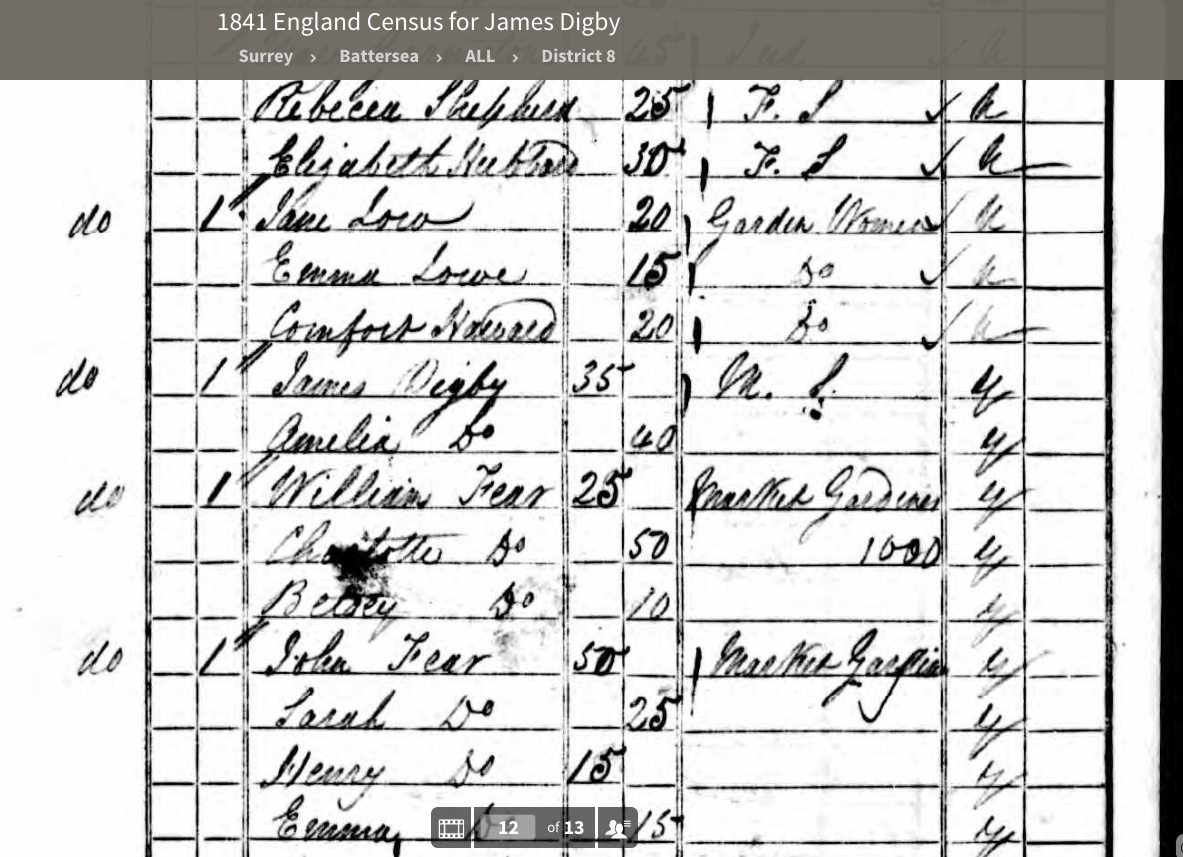
Almost certainly the latter - it appears he was probably living in Falcon Lane [Road] in the 1841 Census - a "Male Servant" - already living with Amelia (they did not marry until the following year). This is consistent with JCB saying he passed him most days.
KB:
I'm afraid the SoL rather traduces James Smith Digby (1804-86). Born in Battersea, son of a blacksmith, he was a 'male servant' in 1841, but thereafter in the Census a [master] grocer with a shop in the High Street.
[PB: Check that KB means battersea Hisgh Street. There was a Henry Digby, grocer, in Wandsworth High St.]
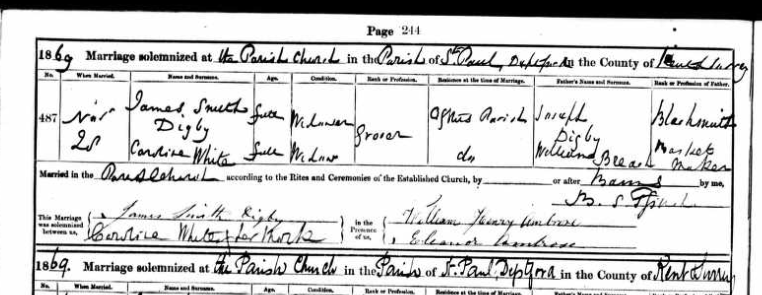
He married twice, but had no surviving children. His signature on the 1869 marriage certificate (at St. Paul Deptford) is in a very fair hand compared with others involved. The 1867 Directory has him in High Street. [PB: check which]
So, no semi-literate ag lab, merely a Buckmaster stalking-horse. It's easy to see him getting flustered by a posh lawyer though. All the defendants in the case were involved in the Chivalry Road saga. Thanks for the tip-off.
I've always found the very Victorian practice of not-naming-names entirely annoying - clearly they didn't think that posterity would expose their deceit.
The libellous pen-portrait of the hapless Digby might have suited Buckmaster's purposes, but he was clearly dealing with no straw-chewing Battersea peasant.
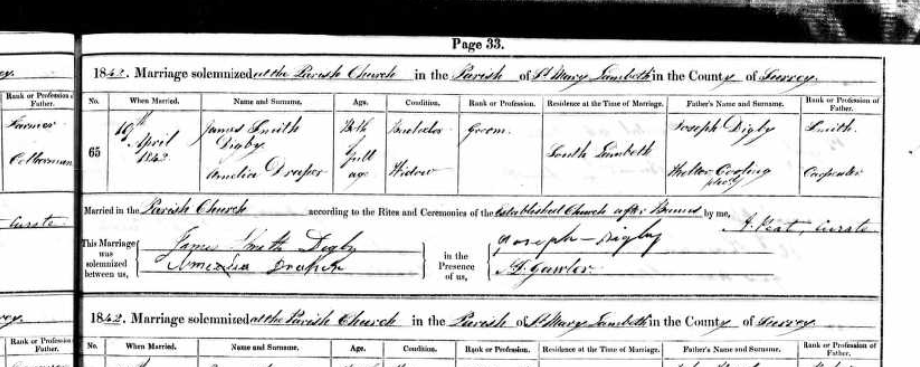
Digby was first married in 1842 at Lambeth. Amelia died in August 1865, so during the Buckmaster tale he was indeed a widower. He remarried at Deptford in November 1869. His entire life seems to have been spent in Battersea.
Attached exhibits show his signature on the two marriage certificates. You'll note that his blacksmith father was also able to sign.
Send me an email if you want to comment on anything you've seen or read on the site, or would like to know more about something, or just want to be kept in touch.
Philip Boys (aka "HistoryBoys")