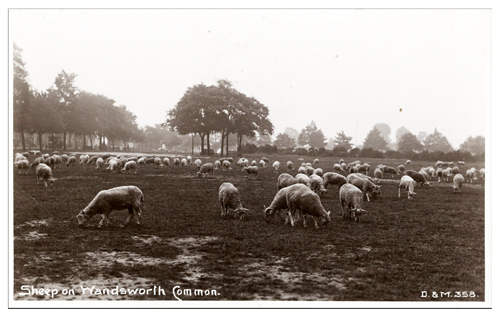
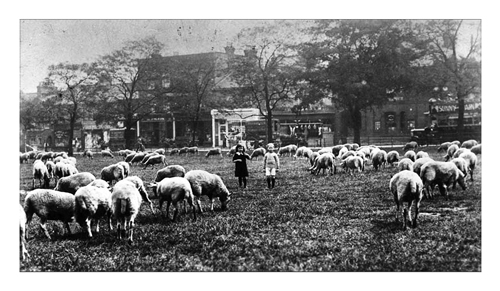
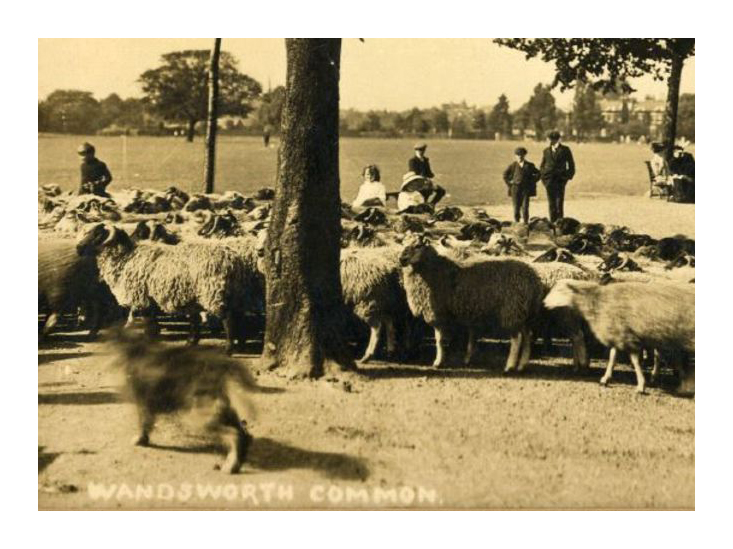
[FINISH THIS OFF: This article was published in ... in 196?....Very grateful to Neil Robson for locating and scanning it...Wandsworth Historical Society...]
THE LAST SHEPHERD ON WANDSWORTH COMMON .
(Extracts from "Odd Corners in Surrey' by William T. Palmer)
In his "Talks with Shepherds" Mr. Walter Johnson, F.G.S., has 4 whole chapters entitled "The Highland Shepherd in London" (1919) with reference to the grazing of Wandsworth, Tooting and Clapham Common at that time. The author had previously visited flocks and their keepers at Selborne (Hampshire), Cumberland, Surrey, Dartmoor, Cotswold, the Isle of Wight, and Lincolnshire.
The London chapter commences:
"Each returning summer brings almost to the door of the jaded towns-man a bit of pure country life. For into this 'roaring Loom' which men call London comes annually from the Highlands a flock of sheep to graze upon the scant grass of the much trodden common."
in the early years of the experiment, the animals were brought from Aberdeen to St. Katherine's Wharf by steamboat. The shepherd, though suddenly transferred from a remote sheep-run in the Highlands to the bustle of a great city, is fortified by the calm stoicism which is the gift of his craft, and stands the change well. Mr. Johnson found the philosophic Highlander thinking lightly of his own troubles and much about those of his collies:
"Tweed had na a minute's rest yesterday. Tooting Bec Common is an abominable place. Do what you will, the sheep are always a-scattering and you're always a-hounding them, and always they are giving: trouble. It's full of bushes, and the grass is no good, all grey and wiry, different altogether from the other commons. Give me Clapham Common, or Wandsworth Common; Clapham has the best grass, but I like Wandsworth best. At the Burntwood Lane end of the Common you get such a splendid breeze.
"Tweed is indeed a peculiar dowg: if I'm walking on the vera edge of the pavement by the Common, and where's a motor coming, he begins to push me back to the pavement and the Common."
Usually there are in the flock from four to five hundred animals, Most of them belong to a cross-breed, the parents being respectively Highland and Leicester.
The six weeks! drought of 1919 burnt up the grass until the Common looked as if it had been scorched with a flat iron. Much of the pasture was tall coarse tufts of purple moor grass (Molinia), which sheep eat, more in Scotland than in England, especially after it has had a "touch of frost".
"Hooch, aye, but they'll be doing all right. The grass is bonny, but there's a nice bit of fallow meat, they'll na starve. That bit of cough you notice is only because the grass is dry, and I give them plenty of water when they get in the fold."
The shepherd's work was distributed among three or four grazing grounds, all public parks or commons. The changes were generally made in the early morning. On a particular Saturday he had fetched his sheep from Tooting Common, nearly two miles away, at four o'clock while the roads were still quiet, One reason for moving the sheep in the early morning, is that they shall be well fed by eleven o'clock; after that time they give little anxiety. |
"Dear faithful Tweed, what a sad end was thine; about a twelve month after this conversation, a motorist driving madly along the busy highway which crosses a South London common, knocked down the poor creature, and the end was too horrible for description.
The driver said he could not see Tweed. Then he told the judge that Tweed was fighting with another dowg. Wat rideeclous nonsense.
If he didin't see the dowg, how did he know that the dowg was fighting? And if he saw him fighting, how could he say he didna see him? What a haver!* I got £ 25 compensation, but would rather have Tweed then £ 80."
When Tooting Common was in part laid out for allotments it did not receive its full share of visits. For some reason the pens got foul: the "fly" attacked the sheep, and they had to be treated by the shepherd for "maggots" every day.
When fleeces got long, the flock was driven to Finchley to be shorn.
A few weeks later the flock was dispersed to buyers and the Highlander and his collies went home. The indomitable Highlander was tending his flock when London came in for air raids:
"Yes, I was there and the sheep had been brocht into the pen by the barn. The shrapnel fell about; see, it made holes through the roof of that barn. I saw some bits of it, which I keepit i' ma pockut. I wunnered whether I should let the sheep out, in case a boomb fell, for, you see, they were all close together. I could see the German aeroplane overhead, and sheels brusting all around it."
At the end of the season the sheep are killed to supply London with a tiny fraction of its meat. Prior to that they were shorn, either in Hyde Park or at Finchley. The year of demobilization after World War I, when many colonial soldiers were present in London, the operation not only took place earlier than usual, but more expeditiously, for two Australians came to Finchley with their machines and did it fine.
The Highland shepherd had an abundant stock of dry humour. When asked "Do you leave the sheep behind in winter?" - "Hooach, aye, I leave them behind right enough. I leave them ahint, and they're all eaten before I've been hame a week,"
The Chief Officer of the Parks Department of the London County Council informs me "After 1921 sheep were no longer grazed on the south-western commons".
Wandsworth Historical Society News Sheet no. 2/61 pp.3-4
PB: I'm finding it impossible to locate a copy of Walter Johnson's book, TALKS WITH SHEPHERDS, 1925, George Routledge, London - there are a few old copies for sale but £60 - £175. Carry on looking because there may be much more - the above is just a report of a precis.
Parts of the book were obviously used to create two radio stories, broadcast in 2017. I wonder if we could get hold of a transcript or a copy of the broadcasts?
A Shepherd in London: Flocking to Selfridge's
Radio 4
Fri 29 Sep 2017
Episode 1 of 2
In the 1920s and 30s, sheep were used in London parks to keep the grass down. Hyde Park, Kensington Gardens, Clapham Common and Hampstead Heath all had sheep grazing on them, and there was much competition between shepherds to get their flocks chosen for the privilege. There was considerable profit to be made too - for when they were good and fat, the sheep were herded to Smithfield Meat Market to be prepared for the table.
In Flocking to Selfridges, writer Jerome Vincent imagines the experiences of George Donald, a shepherd from Aberdeenshire, who has brought his flock (aided by his faithful sheepdog Birk) to graze in Hyde Park. George is no stranger to the capital, but is always astonished by the way in which Londoners behave, likening the crowds in Oxford Street to mindless flocks of sheep.
It's 1925, and technology is moving on apace. One day in the park, George bumps into a fellow Scot - a young man at the cutting edge of the next new thing. He's John Logie Baird, the inventor of television, and George Donald is able to give him a word of advice.
Reader: Bill Paterson
Producer: David Blount
A Pier production for BBC Radio 4.
[Source: Link]
Looking for Angels: A Shepherd in London
Episode 2 of 2: Looking for Angels by Sarah Salway
[https://short-stories.co/@sarahsalway/looking-for-angels-1knv7mnpv63e]
In the 1920s and 30s, sheep were used in London parks to keep the grass down. Hyde Park, Kensington Gardens, Clapham Common and Hampstead Heath all had sheep grazing on them, and there was much competition between shepherds to get their flocks chosen for the privilege. There was considerable profit to be made too - for when they were good and fat, the sheep were herded to Smithfield Meat Market to be prepared for the table.
In Looking for Angels, writer Sarah Salway has George Donald, a shepherd from Aberdeenshire, visit an Open Air School for children with TB, which existed on Clapham Common in the 1920s. Accompanied by his flock (and his faithful dog Birk), George befriends both staff and pupils, including a young schoolmaster suffering from shell shock, and a Cockney girl who proves herself an able shepherdess.
Reader: Bill Paterson
Producer: David Blount
A Pier production for BBC Radio 4.
[Source: Link]
A Shepherd in London : BBC Radio 4 Extra : September 28, 2017 11:00AM-11:15AM BST
A Highland shepherd sees into the future after a meeting with a fellow Scot in London.